When talking to prospective new saunners, I am often met with enthusiasm, followed by “…but I feel like I’m doing it wrong…”
So long as you are staying hydrated, not pushing too hard, and listening to your body, there’s not a wrong way to sauna.
That said, many facilities (both in and outside Japan) have developed methods that promise the best sauna high, skin cleanse, or what have you. In Japanese, this is known as 整え方, translating to “how to totonou/ achieve a sauna high”. I have found saunas will increasingly list their suggestions for how to attain totonou (ととのう). I don’t believe in a singular bulletproof method that works all the time for everyone. That said, I think that:
- So many individual factors play into the experience, including what you ate, how you slept, how hydrated you are, that even the same method can give you drastically different results on a given day. This makes a blanket prescription for how to achieve totonou short of ever being bulletproof. It can be a great guide, but you will have to try different tactics overtime to more consistently get the most out of your sauna experience (leading to my next point)
- Ultimately, you will need to experiment with what works best for you. Once you start building a sauna practice, you will start experimenting, listening to how your body feels after trying a given method. Mixing and matching methods, understanding what works best relative to certain temperatures and different facilities, and other considerations are paramount to building your sauna routine.
For those who are in Japan, and aren’t sure where to start, here is my default recommendation. *
*Note. I am not a doctor. If you are concerned about any underlying health conditions that would potentially interfere with your experience, please consult a medical professional.
My suggestion:
- Start with a warm bath.
- Sauna
- Cold plunge
- Relax (5-10 minutes)
Repeat as many times as desired.
I typically go for 2-3 on a standard outing, and extend if I have extra time/want a more intense sauna high. That said, more does NOT necessarily equal better, and I wouldn’t describe it as such. If you are just getting into sauna, one or two rounds will likely be more than enough.
Beginner Guidelines:
- (Sauna) When in doubt, get out. You are likely still learning how listen to your body. In the modern world where we are increasingly out of touch with our kinetic instincts, you may needlessly push yourself beyond what is optimal (more on this below). More does not always equal better. Start slow, and you can build up over time in needed. I find five minutes on the lowest bench is often a great place to start, but if you can’t do this to start, there is nothing to be worried about!
- Cold Plunge. Use the water ladle (picture below) to wash off. Start with the outer extremities of your body (hands, feet), and gradually pour inwards. As a beginner, I often suggest avoiding full submersion into the cold plunge. Start with the ladle, and if you feel ready, dip your feet in. At most, I would suggest slowly entering the cold plunge, and getting out once submerged. Just this will, for most people, be invigorating and foreign.
- Pay particular attention to the temperature of the cold plunge here. Cold pools (水風呂) 20 degrees or higher will be a better entry point than anything 15 degrees or below. As a beginner, 10 degrees or lower will likely be excruciating, and I would avoid it until you feel ready. This part of the experience is the most extreme. As such, exercise the most caution when using the cold pool.
- R E L A X. Most guides suggest you find a chair (plentiful in nearly any facility), pat dry off, and sit for 5-10 minutes. This will allow your body temperature
- IF you feel up for it, go for another round. A rule of thumb that I like to use so I’m not glued to the clock, is that once your legs are naturally dry (assuming you pat dried with your face towel), your skin will feel refreshed and ready for another round.
- I always consider my first round a warm up round. Starting with the bath especially, my core temperature will be a bit higher, and I won’t be in the full swing of things. It’s completely okay to start lighter.
Side Note:
There is a tendency I hear, particularly with men, to view how long they can spend in the sauna as a point of pride, and even an extension of their character, and masculinity in the case of men.
Recently, I was traveling outside Japan and overheard the following conversation in a gym sauna:
“Yeah, it’s supposed to hurt. It’s supposed to be pain. You’re not supposed to enjoy it. Come on, stay in longer”.
I couldn’t think of a less true statement. For several reasons.
- Sauna injuries are real. Full stop. While incredibly rare, they are near either the domain of people needlessly pushing themselves beyond reason, or people touching parts of the sauna that shouldn’t be touched (it happens more than you’d think…). I’ve seen people pass out, shivering for hours afterwards, and burn skin (all of these have been outside of Japan, in places with less established sauna and bathing cultures). None of these are remotely normal, and all of these cases were 100% preventable if the individuals had applied (repeat after me) common sense and basic safety protocols. Listen. To. Your. Body.
- Anecdotally, the presence of alcohol is a commonality between around half of the injuries I see. If you’ve been drinking, save the sauna for another day. It’s simply not worth it.
- How you feel in the sauna is variable on so many different things, including: what you ate that day, hydration that day, sleep, exercise, mood, the weather. Like how this will affect your sauna tactics, it should also inform when to take it easy. The race against your ego is a race to nowhere. True in life and in sauna.
- More is NOT always better. A common example for me. If I sauna in the morning, I have to be careful not to do too many rounds or push my limits, or I will end up too tired and relaxed for the rest of the day.
- See below for my recommendation on a lighter, morning circuit!
- If you aren’t hydrated, or ate a lot of food beforehand, or were out in the sun all day and walk in with a high core temperature, more can be disastrous. A lighter session can be just what your body needs in some cases (if sauna is appropriate in the given circumstances).
That being said, on a weekend where I have the time, if I feel up for it, adding an extra round or two more than normal can help me feel deeper sensations, help me sleep and relax, and unwind for the week. It’s all about context and knowing what you need. Different tools for different situations. Having different sauna tactics and routines is about having a toolbox to get the job done in a variety of circumstances. Overtime, you will develop an array of tactics that will become second nature to you, naturally integrating into your sauna experience. With that in mind, here are a few places to get started for those curious about building off of a beginner’s routine.
SAUNA GUIDES: 整え方
Note: These aren’t hard and fast. Experiment with these as you like. There are plenty of ways to sauna- here are just to get started.
“Adopt what is useful. Discard what is useless”– Bruce Lee.
With that in mind, enjoy!

Russian Style: (Intermediate)
- Warm up (shower, warm bath/hot tub, etc.)
- Sauna
- Cold Plunge
- Repeat sanua and cold cycle 2-3 times (in immediate succession)
- Relax (as long as needed)
Repeat as needed.
Notably absent: vodka. I do NOT recommend adding this to your routine…
Russian banya (literally “bath” in Russian), is characterized by its parilka (Russian style sauna), which looks like a wood-fired pizza oven, opposed to a Finnish style sauna heater/stove. The focus is generally on a lower humidity and higher heat (between 80 and 100 degrees Celsius, or 175-215 Farenheit, with 15-25% humidity) than a Finnish style sauna (80-90 degrees Celsius/ with about 20-40% humidity, depending on the loyly). That said, this is just an average, and temperatures can vary between locations. The lower humidity allows the heat to be a bit higher while remaining tolerable. Due to the higher heat, I have found the cold pools tend to be a bit more extreme than a lot of Finnish style locations (however, I imagine this isn’t the case in Finland, since going into an actual lake is most common there).
In terms of sauna habits, this tends to result in a more fast paced, hot-cold-hot-cold back and forth. It’s certainly not for the inexperienced, but once you’ve built up to it and can try it safely, it’s a thrill!
Going directly from hot to cold can be incredibly exhilarating! But it can also be a shock to the heart if you have underlying conditions or a lack of experience, so I wouldn’t recommend this unless you are both an experienced saunner and don’t have any underlying heart conditions.
Morning Circuit:
- Keep it around an hour, hour and a half. No more than two.
- Two rounds recommended. I would discourage more than 3 unless you want to be really tired for the rest of the day.
- Go lighter on the sauna, focus on the cold.
- End on the cold plunge. It’s not necessarily intuitive (especially in the winter), but I find it keeps you energized and awake, rather than too sleepy to take on the rest of the day.
I love this one, and its taken me some experimentation to dial it in. I tend to go into my day more grounded, carrying a more centered inner peace after this routine. My hope is that it gives you the same.
Carbonated Baths: (炭酸泉)
The carbonated bath is a staple of many sento around Japan. It took me a while to really take full advantage of it. Here is a summary of the few tips I have seen.
- It takes a bit for bubbles to form on your skin. Don’t move around too much and be patient
- I would suggest staying in for ten to fifteen minutes. Based on the guides I have seen in Japanese, there isn’t really a benefit to staying in longer than 15 minutes. More does not equal better here.
- I really enjoy using this bath at the end, particularly before bed. It really knocks me out and gets me ready for a good night’s sleep!

Venue Specific Recommendations:
Here are a few found at specific saunas I have visited. I may update with more in the future, but here are a few to get started for now!
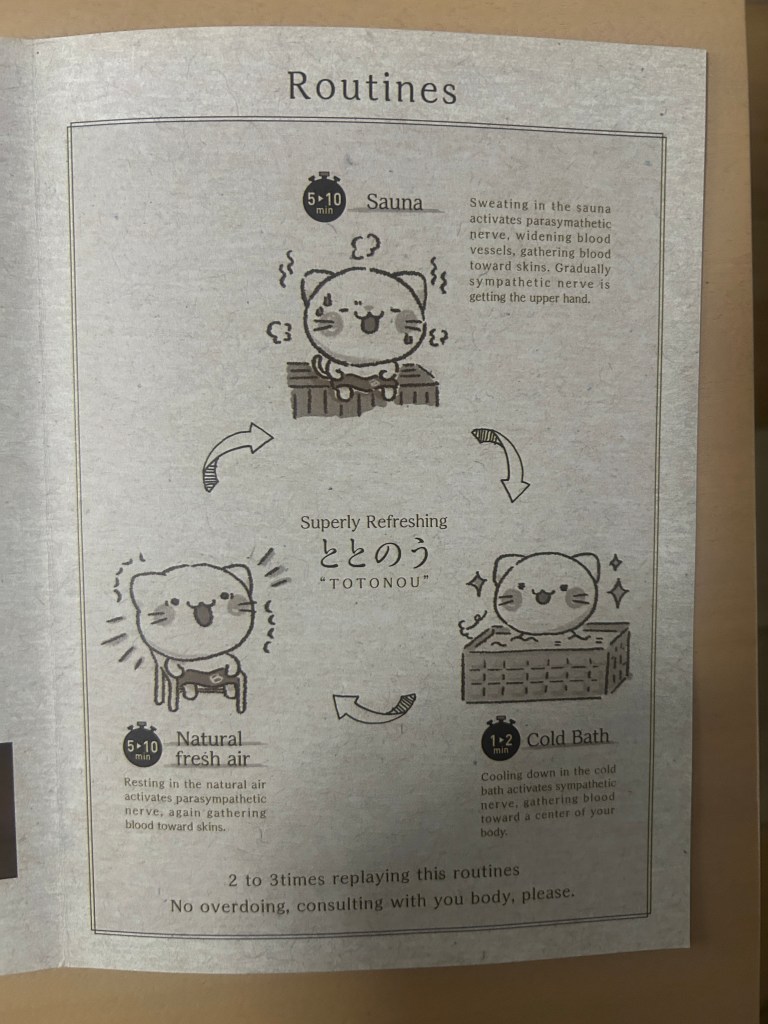
Corridor no yu: (with the cute picture guide pamphlet)
I came across this one while visiting Ginza Granbell Square’s Hotel Sauna. This pamphlet was avaliable at the front desk and I loved it enough to hold on to it!
Sauna Dojo Guide (on the wall in Japanese):
- Dry off before entering sauna
- Enter the sauna. 5-10 minutes.
- Wash off your body.
- Cold plunge
- Relax.
- Repeat.
For those looking for a bit more of a detailed explanation of the standard Japanese 整え方 (Totonou Method)
Conclusion:
My aim is to provide tools to help navigate your sauna journey. While there are lots of options, my goal is not to overwhelm, but to help guide. There are lots of effective sauna tactics, just keep in mind the following as you experiment:
- Use common sense
- Listen to your body
- Stay hydrated
- Keep experimenting and tweaking routines overtime to best suit your needs.
I may continue to add to this guide/write a follow up overtime if this is helpful to readers.
I hope you find some totonou in your week and in your life…. More articles to come soon. Take care and I hope you find a 整え方 that works for you!
 Sauna Sensei