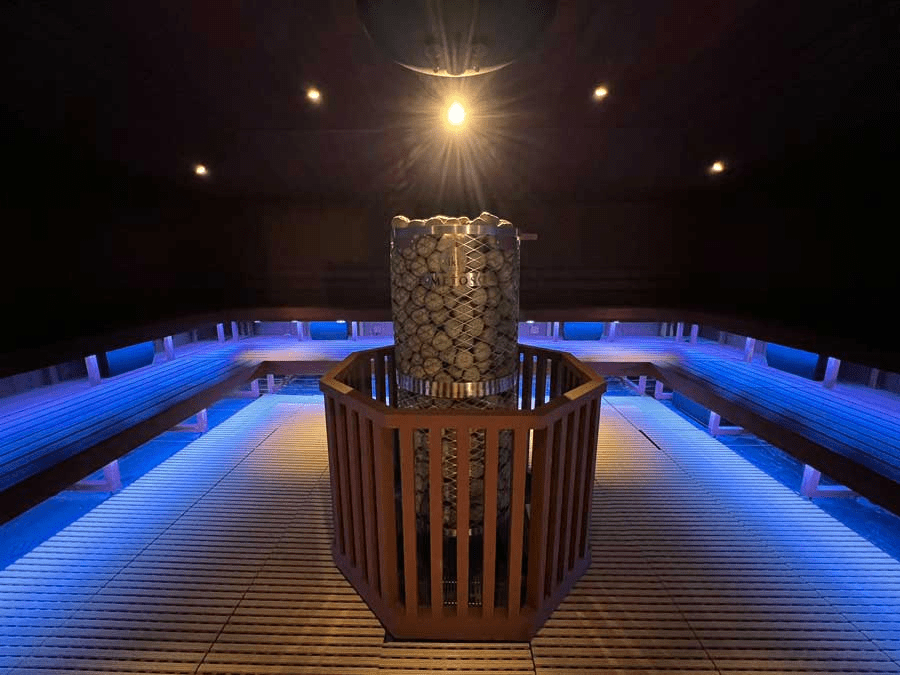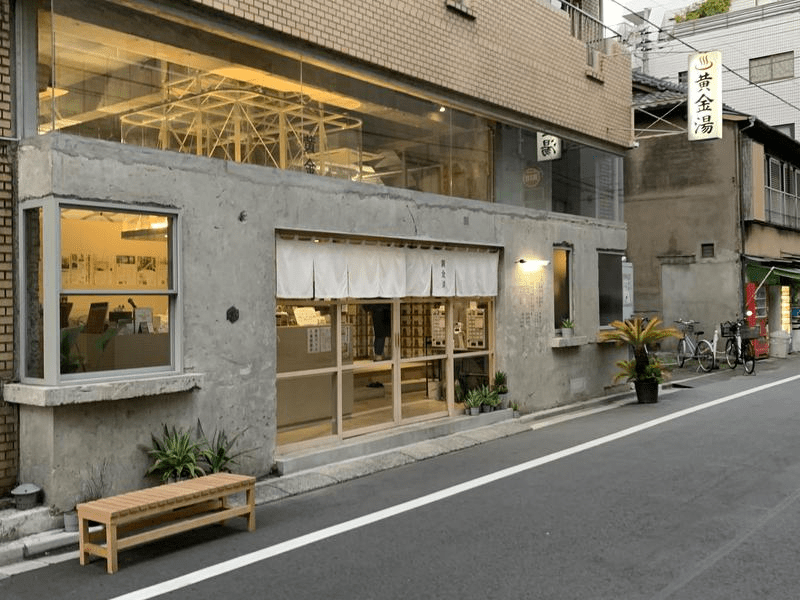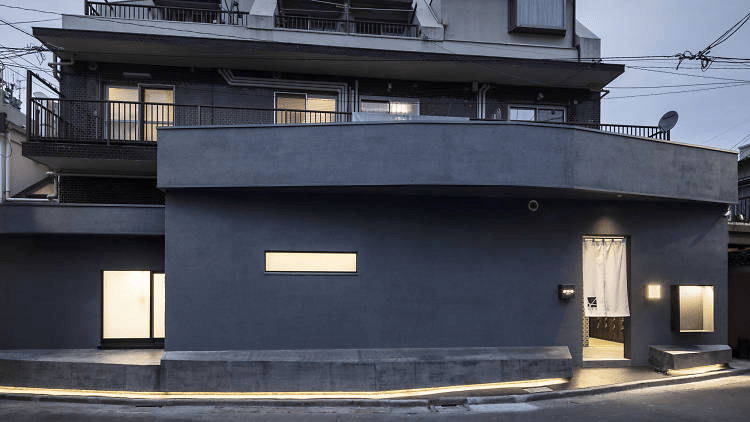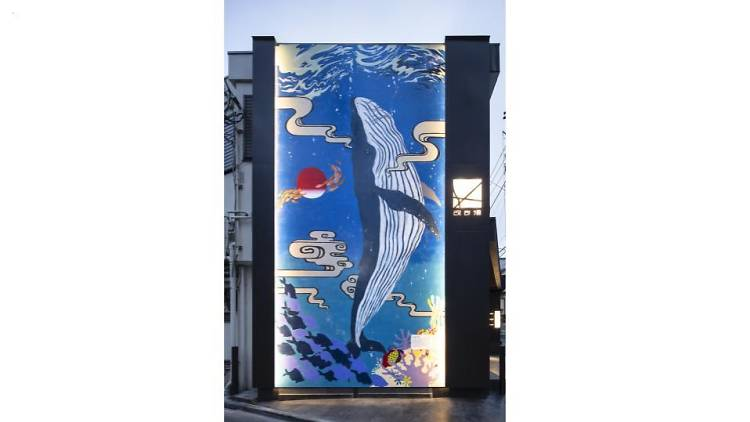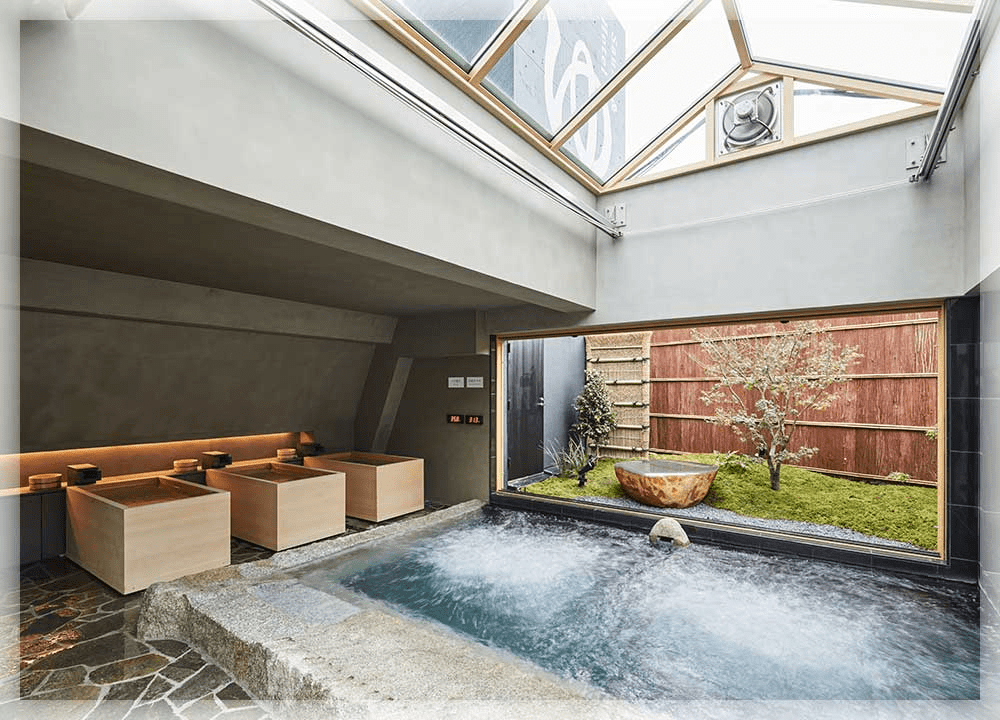
Sauna and Hotel Karumaru

Refined. Modern. Balanced.

Tattoos Okay? No
Sauna? Yes
Price? $$$
Should I bring toiletries? No
Best For? Those looking for an equal balance of high quality baths and sauna. Anyone looking for a capsule hotel destination with a complimentary sauna experience to match.

Nearest Station: Ikebukuro Station. 3 minute walk.

Advertised as one the Kanto region’s largest sauna facilities, Karumaru has been a player on the Tokyo sauna scene for quite some time. Anyone who has been will see why it has made such a name for itself. Featuring a modern yet classic aesthetic, a great balance of baths and sauna, and amenities to match, Sauna and Hotel Karumaru is a sauna destination worth visiting. Let’s dig into what makes it stand out!

Aesthetics
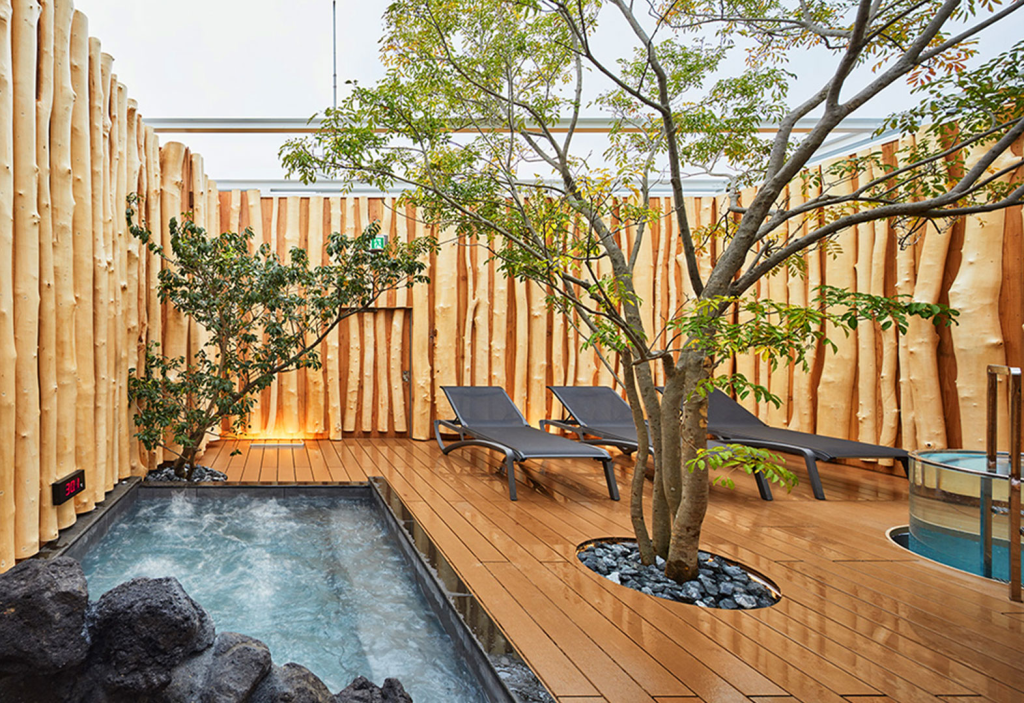
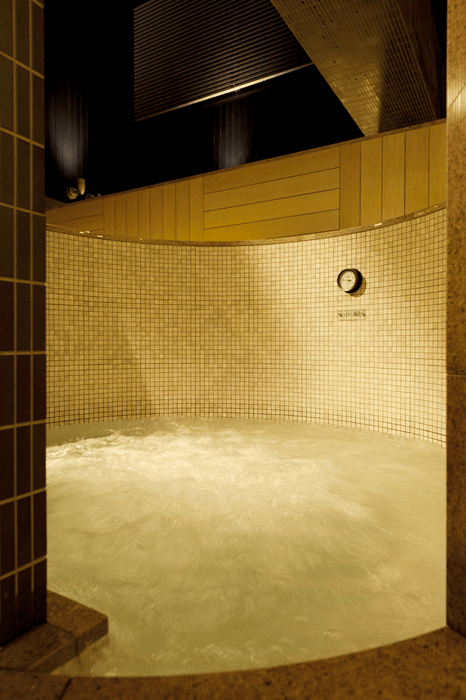
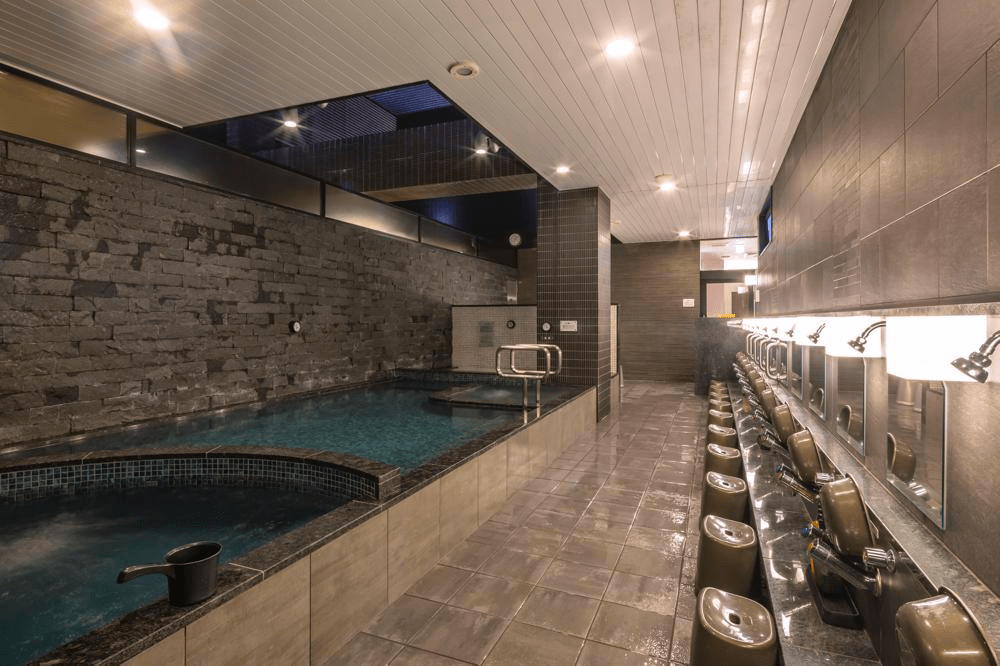
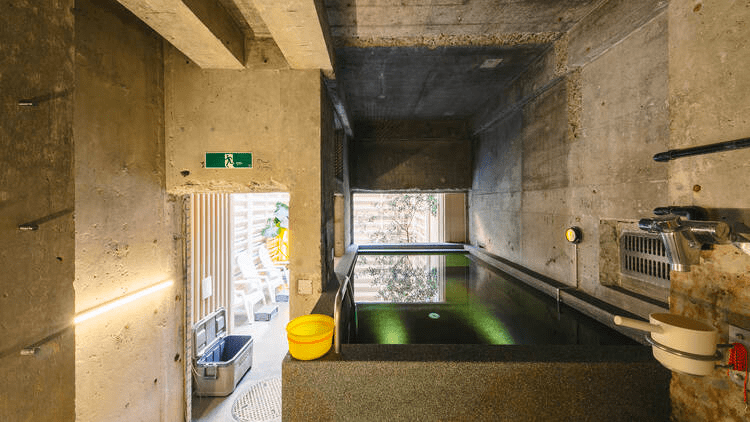
Located on several high-level floors of a multi-story building near Ikebukuro station, Sauna Karumaru cultivates an oasis-like environment in an otherwise exciting and chaotic part of Tokyo.

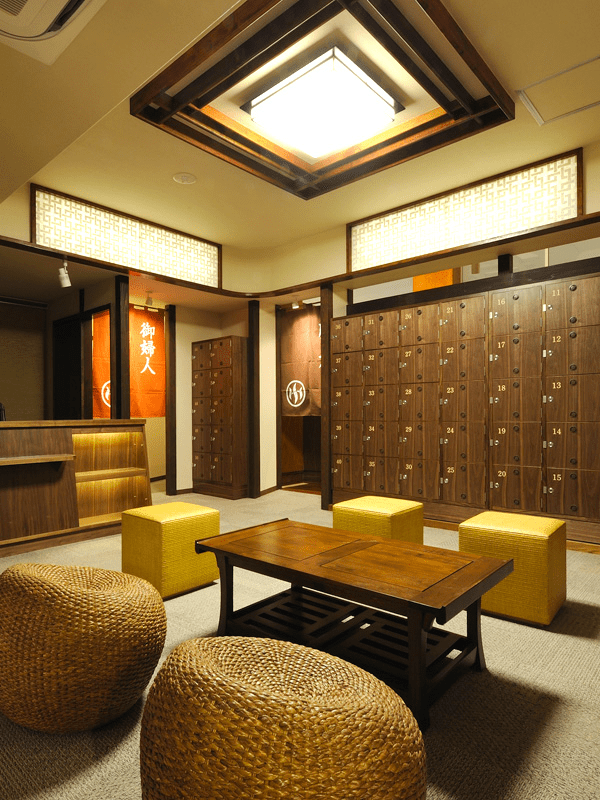
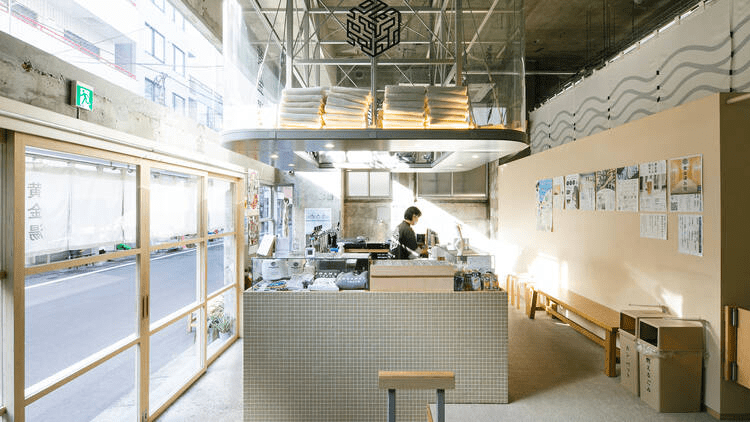
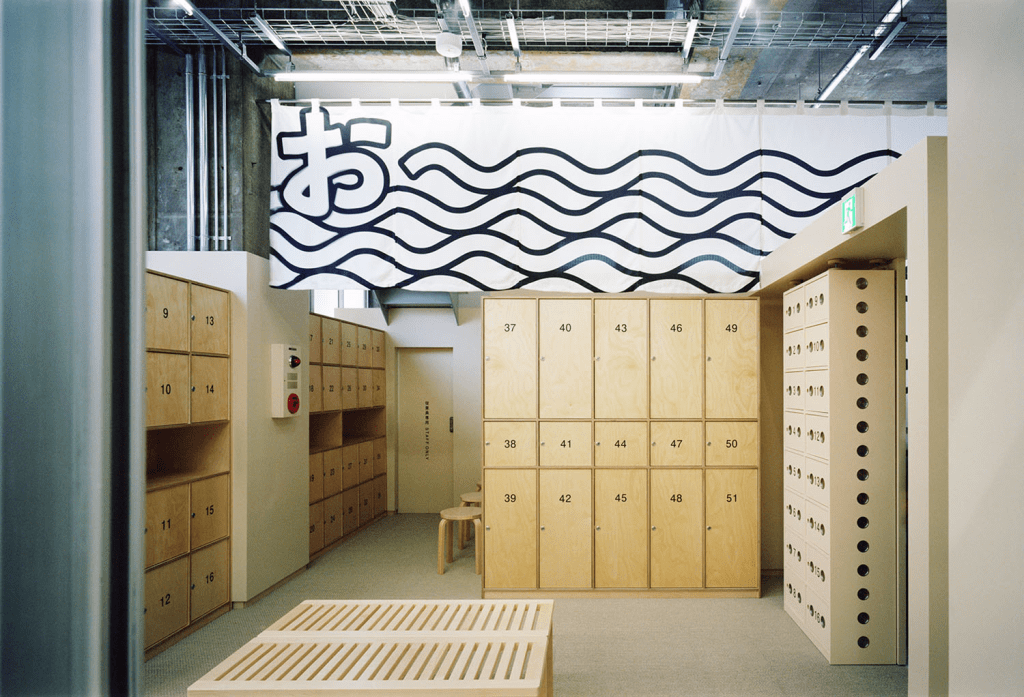
When I think of this facility, its natural stone and wood tones are what come to mind. Maintaining a light wood motif throughout, Sauna Karumaru forces you to forget you are in urban Tokyo, and relax into your natural surroundings. From the bright wood tones in the lobby, to the calm rooftop garden hidden in the center of Ikebukuro, Sauna Karumaru puts bathers at ease from start to finish.

The venue’s overall aesthetic is enhanced by the attention to detail to non-visual senses as well, specifically smell and touch. In particular, I think of the herb selection in the steam sauna, and the use of real wood in the wood-burning sauna. Additionally, the meticulous attention to detail used to craft each of the sauna (more on that in the facilities section of this review) give each and every bath/sauna a unique sensation, not duplicated anywhere else in the facility.

As you ascend up Sauna Karumaru, the amount of greenery gradually increases, a subtle detail I appreciated. From the lack of plants in the lobby, you start to see some loose birch branches in the resting areas, then towards the top floor, you can spot a small bonsai tree, leading to the outdoor rooftop with full trees at the center of the roof. The gradual addition of plants subtly lures you into relaxing and unwinding as you retreat from the city and into the depths of the facility.
Culture/vibe

Sauna Karumaru secured a second place Saunachelin spot back in 2020, as well as a third place spot in 2021. As both an early and well recognized player in the Japanese sauna boom, Sauna Karumaru is well renowned for its variety of sauna, conscious aesthetic choices, and attention to detail. Taking a closer look, there is more going on behind the scenes that makes Sauna Karumaru standout.

Beyond being a business, two concepts are the driving force of everything that happens at Sauna Karumaru: “Human Return” (人間回帰) and “My Place” (自分の居場所). On Karumaru’s “Concept” page, “Human Return is described as:

Nature has the power to bring people back to normal.
Therefore, when people are tired, they desire nature.
However, nature is far away.
So, Karumaru is a place where people can feel nature and return to their normal selves while still being in the city.
That is one of the concepts of Karumaru.

Something I really appreciate about the description is how it emphasizes the value of nature without needing to devalue urban life. As someone who loves cities and values the urban experience, I often see a dualistic “cities are bad/nature is good” at the core of arguments to convince people to spend more time in nature. Both are absolutely important, and I appreciate the balance emphasized here. I also, as someone who loves cities, do not spend nearly enough time out in nature. Whenever I make the time to spend time in nature, removed from the constant noise of the modern world (spare a friend or two that I brought along for the ride), I always come back refreshed and recharged to better appreciate the exciting pace of my urban life.

Living in Tokyo, I have come to appreciate how the city so effectively maintains a balance between bustling urban spaces and dedicated parks, temples, and even sauna that reintegrate nature into your daily life. With essential oils, a wood burning sauna, and plants carefully placed around the facility, Sauna Karumaru does an excellent job of taking you into the woods without having to leave the world’s largest city.

“My Place”, the other motif of Sauna Karumaru, is described as

A place that seems to be everywhere, but surprisingly is not.
However, everyone has moments when they want to relax.
Karumaru is a place where you can find your own place to relax.
That is one of the concepts of Karumaru.

This first line strongly resonated with me. A conversation that I frequently have within the sauna community is how increasingly rare “third places” are. Outside of bars and the occasional gym, many of the conventional places outside of the home and work for people to congregate have disappeared or diminished over the past forty years. Where local community organizations, labor unions, and recreational sports teams previously served as spaces outside of work to form friendships and relax, these spaces are becoming increasingly less common for adults.

While this has been the case in much of the developed world for the past 30-40 years, it seems to have been accelerated by the global pandemic. One of (and possibly the last) bastions of a cell-phone free space, sauna have, oddly enough, emerged as a third place in nearly everywhere I have traveled. Ranging from small towns to the largest cities in the world, sauna provide a third place for a lot of people, including many of my close friends. Free from the constant bombardment of modern technology, you are forced both to connect with people and relax into your body. I don’t think it’s a coincidence that Japan’s sauna boom has coincided with COVID-19 so neatly. People crave a third space and connection deeply, which places like Sauna Karumaru understand.

*For more on this topic, Robert Putnam’s “Bowling Alone” does a great deep dive from a sociological perspective on this issue, focusing specifically on American public life, and its decline into the late 20th century.

Facilities:
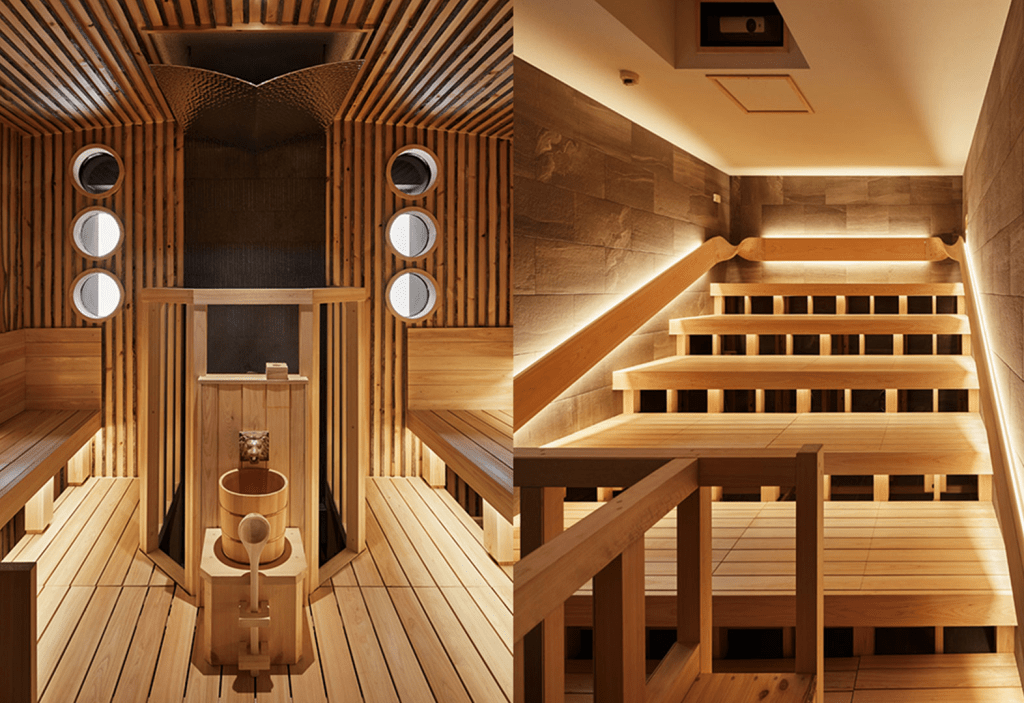
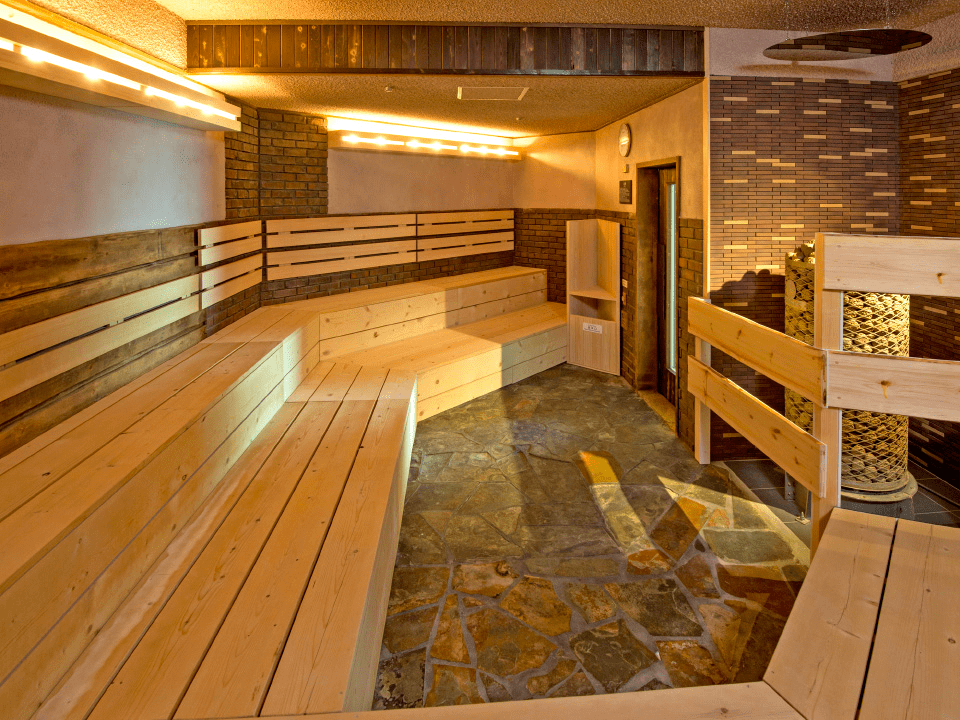
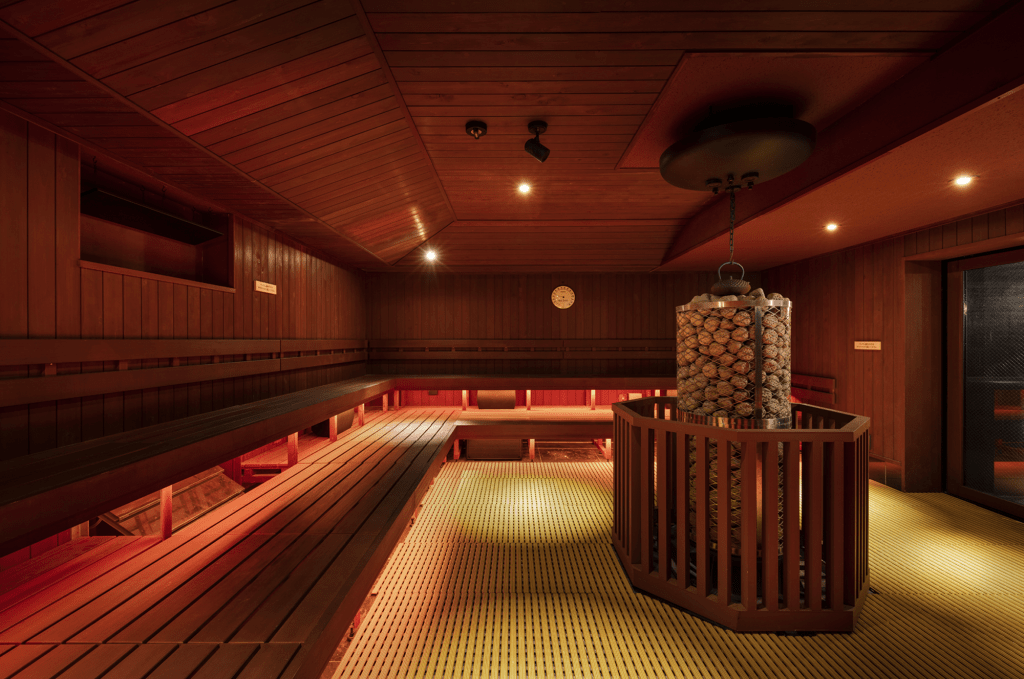
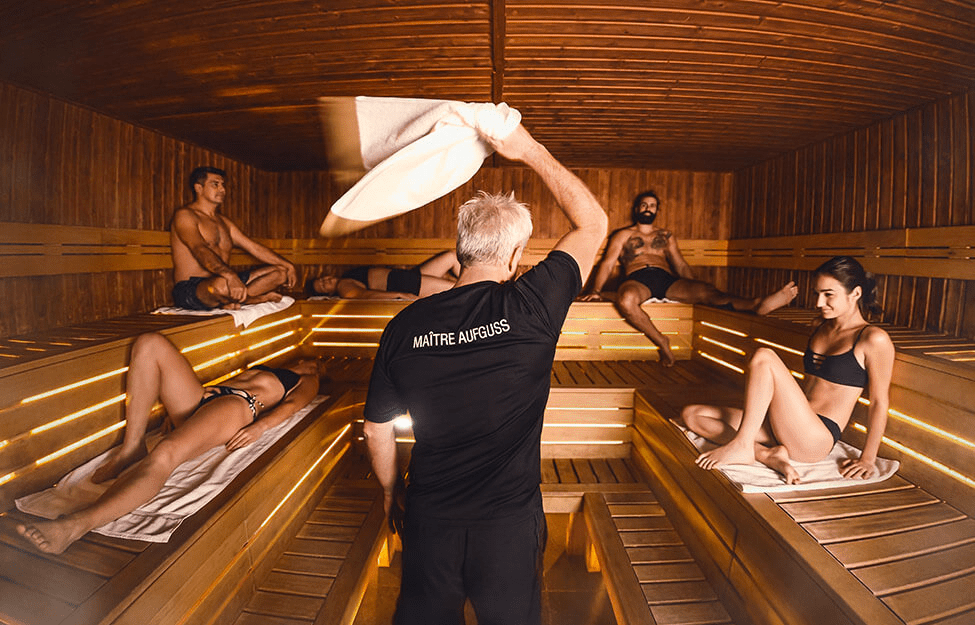
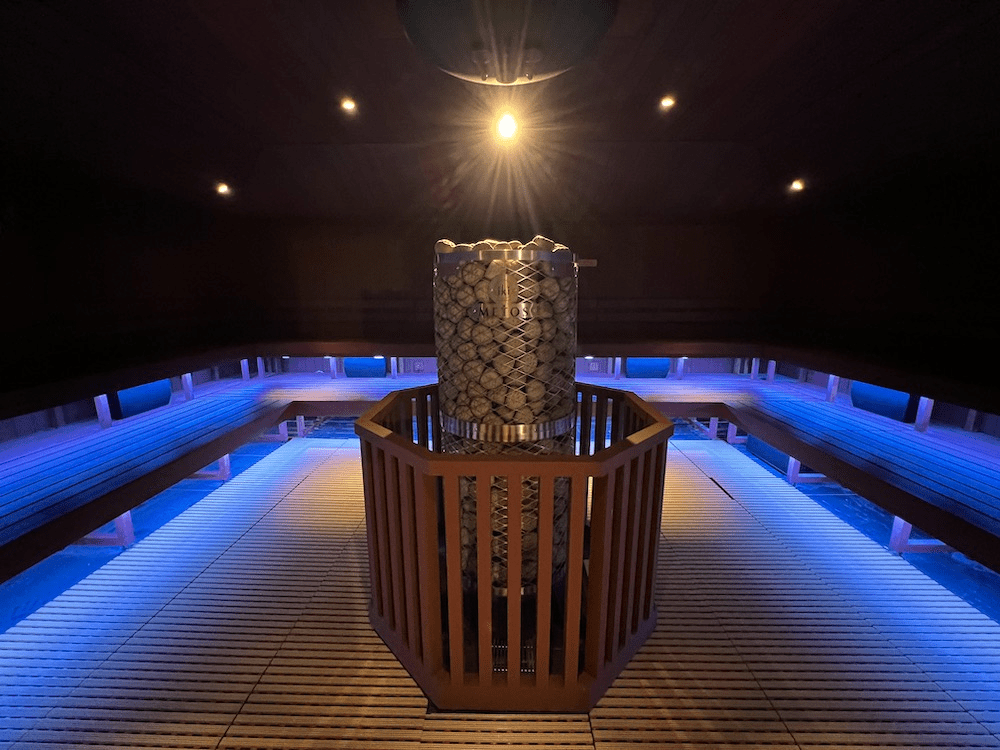
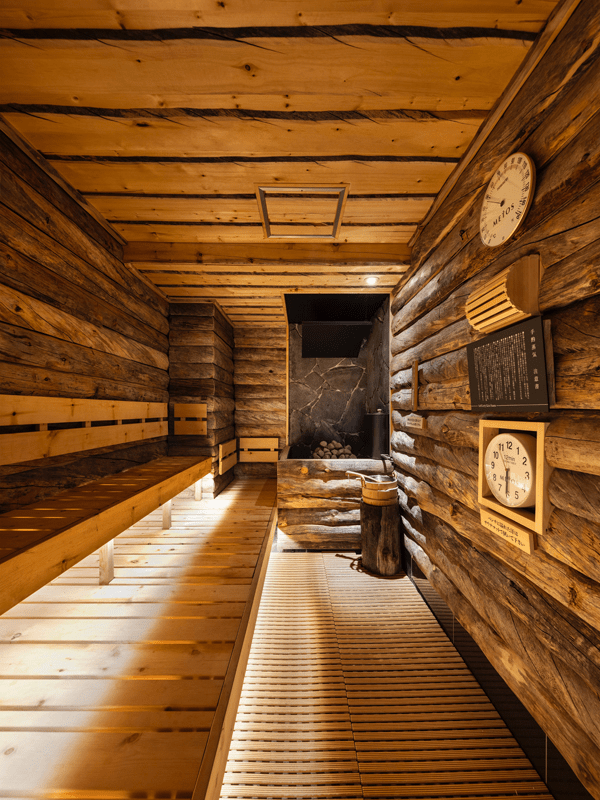
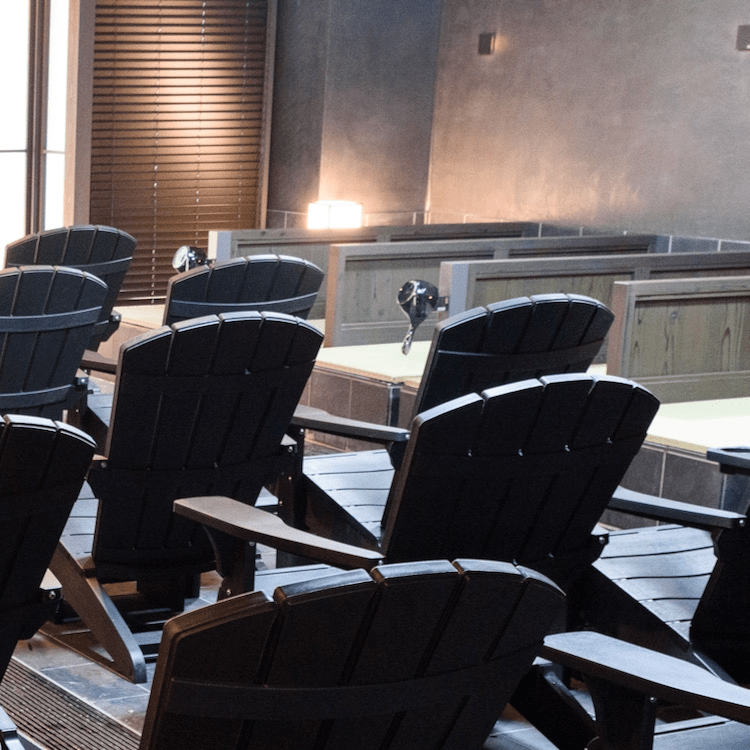
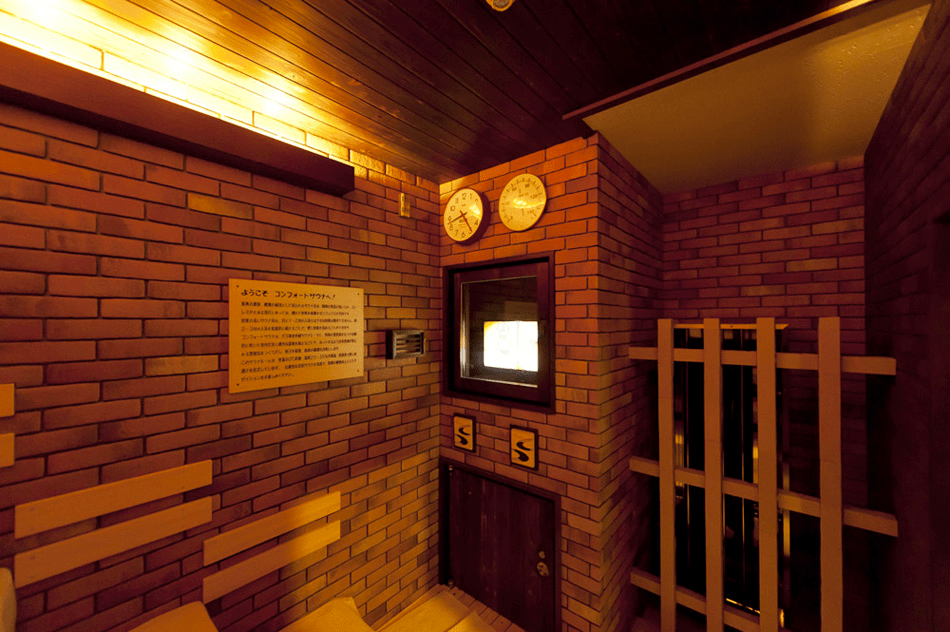
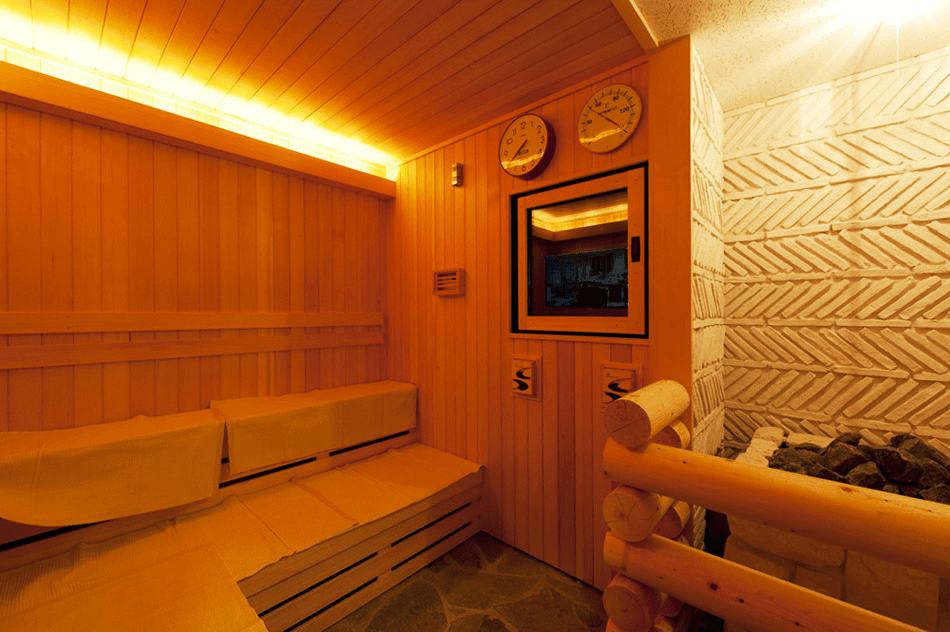
Kero Sauna (left) and Stone Sauna (right)

Kero (Kelo) Sauna:

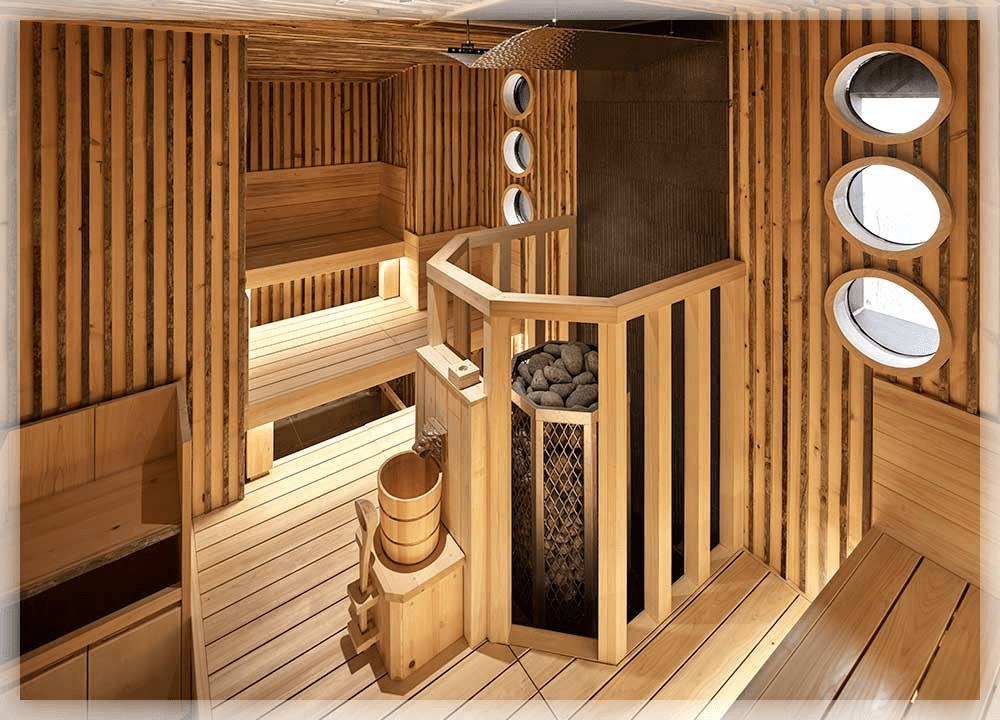
If you’re anything like me, you are probably curious what a “kero” sauna is. The “kero” in kero sauna refers to kelo wood (Japanese doesn’t have the L sound, so it is adjusted here to fit the Japanese phonology). Those who are a fan of my reviews may recognize the term from my Sauna Tokyo review, which also boasts a kelo sauna.

Kelo wood comes from pine trees in Finland that have grown for 300-400 years, then gone through the process of dying and shedding bark for several decades, until it has completed this process, and can then be considered kelo wood. Given how long it takes for “new” kelo wood to emerge, the wood is considered a rarity. Additionally, kelo wood is an incredibly effective as an insulator, and has a distinctly comforting woodsy scent that make kelo wood highly sought after in sauna building.

Sauna Karumaru’s kelo sauna seats just under ten people, and does an excellent job of keeping mid-to high heat paired with moderate humidity. The top and bottom levels are drastically different temperatures than each other, which allows for a more relaxed or intense experience in the sauna.

Stone Sauna:

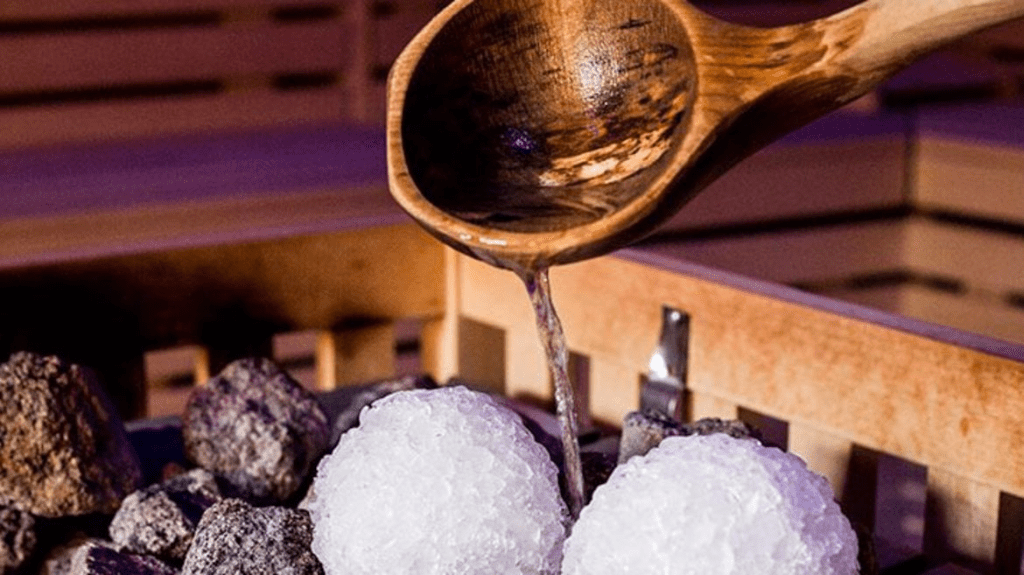
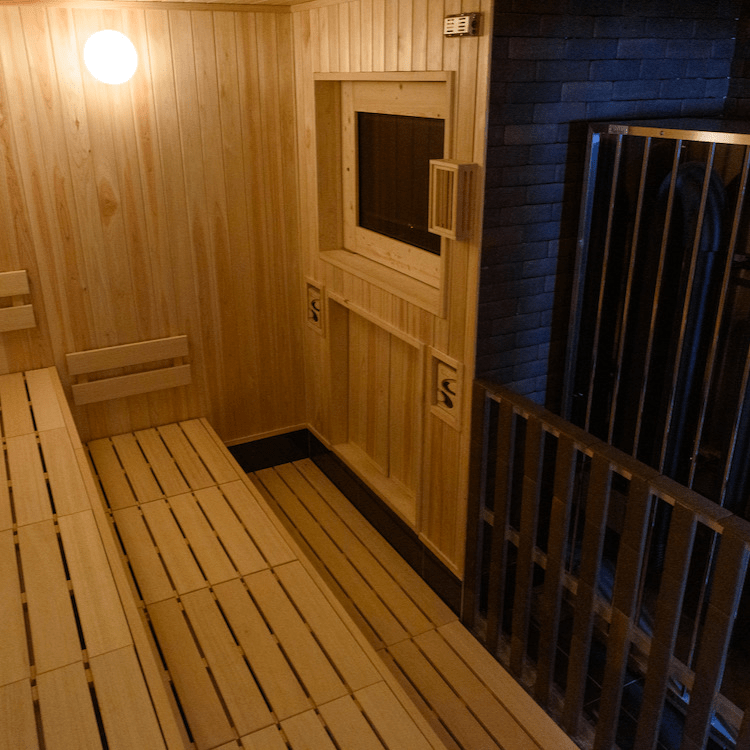
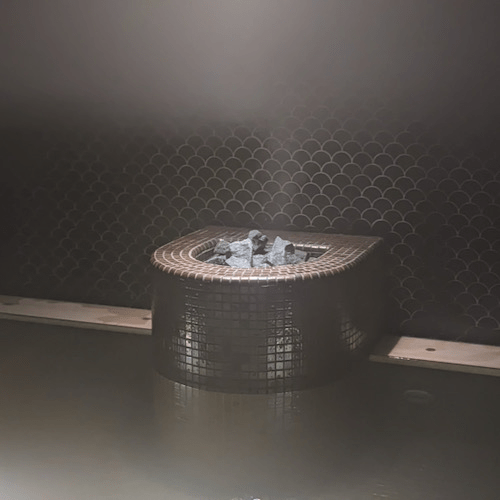
Karumaru’s largest sauna, this stone sauna uses Aji stone, a highly durable type of Japanese granite that is known for its densitiy and durability. The use of Aji stone results in a sauna that effectively retains heat, while also absorbing excess heat to ensure a comfortable sauna experience. They also host Aufguss here, which is a pleasant experience on any of the four sauna benches, due to the stone sauna’s effective heat regulation.

Barrel Steam Sauna:

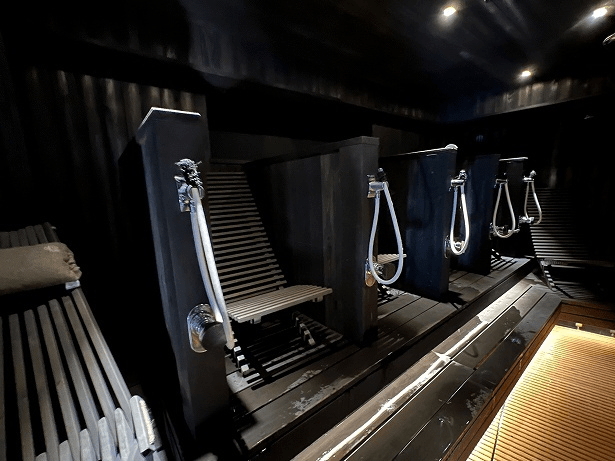
A personal sauna with a capacity for one (be prepared to wait in line), the barrel steam sauna is made of Koya Pine from Wakayama Prefecture in western Japan, as well as Himalayan and Nanyang cedar. These types of wood give the sauna rot-resistance from the steam exposure, as well as a nice woodsy aroma you can smell inside the sauna. Each person only gets around six minutes in the sauna, but trust me: that is ample time. The barrel sauna gets incredibly hot, and will have you running into the near-freezing cold plunge nearby!

Wood Burning Sauna:
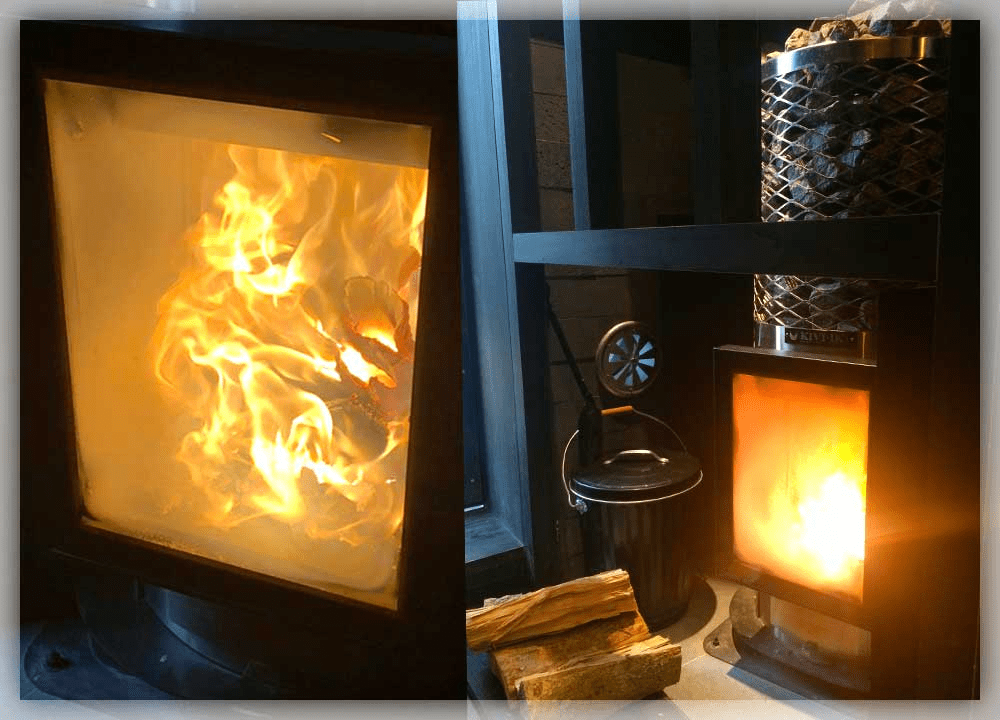
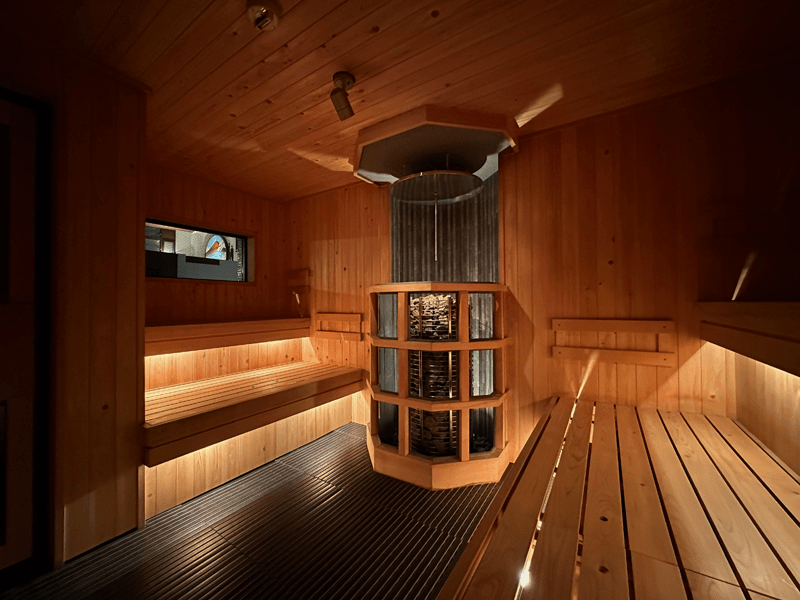
My personal favorite, this sauna lives up to its name and uses an actual wood-fired stove as its heat source. Only groups of five are allowed in at a time, so you enter with a sense of anticipation and excitement. With a temperature around 80 degrees (around 176 Farenheit), the sauna allows you to slowly build up to a steady and comfortable sweat. Used in conjunction with the nearby cold plunge, this sauna is an absolute treat.

*This sauna only seats five at a time, so time slots are booked every hour in the main bathing area, so be sure to keep an eye out for when time slots are called!

Baths:

Note: Due to the sheer volume of baths (nine), this section will just cover the most unique baths. The rest are normal warm, cool, and electric baths that live up to the quality of the other amenities.

Thunder Tornado
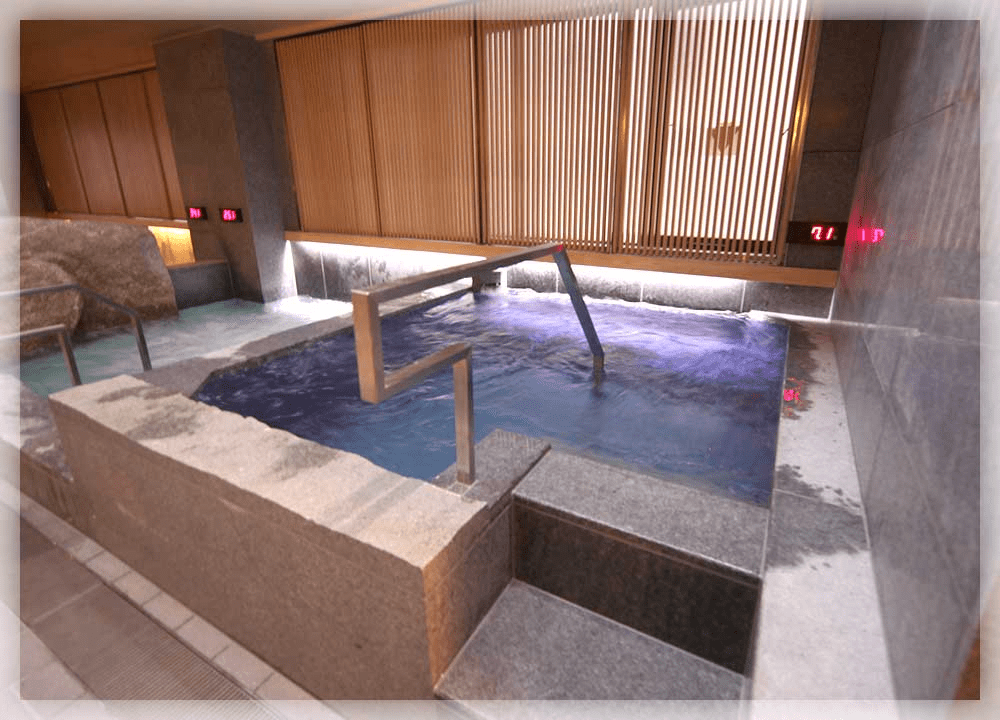
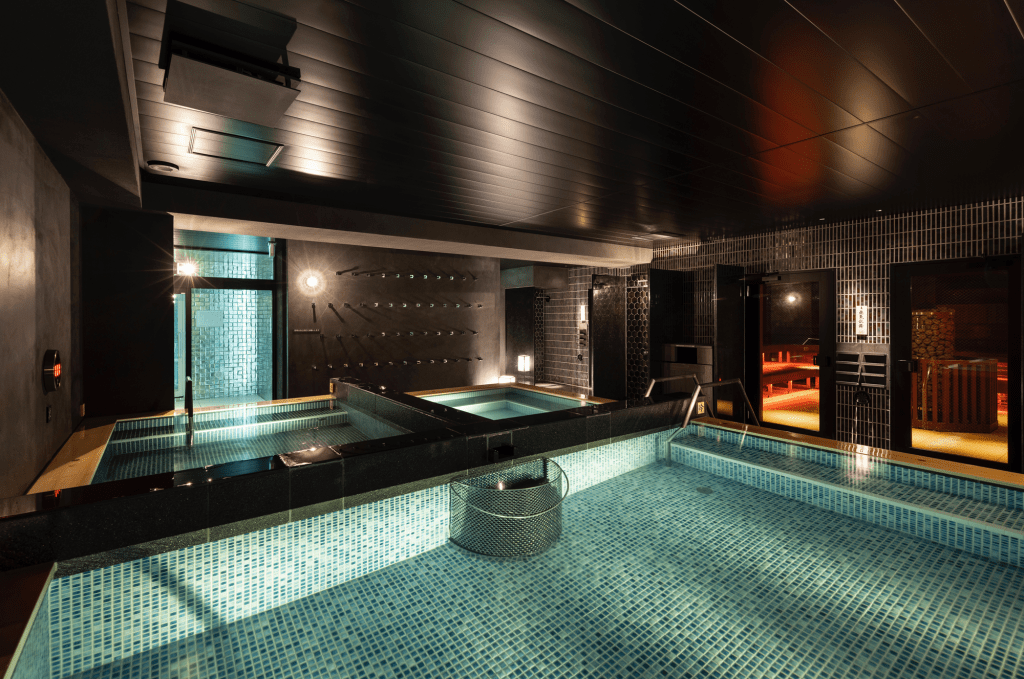
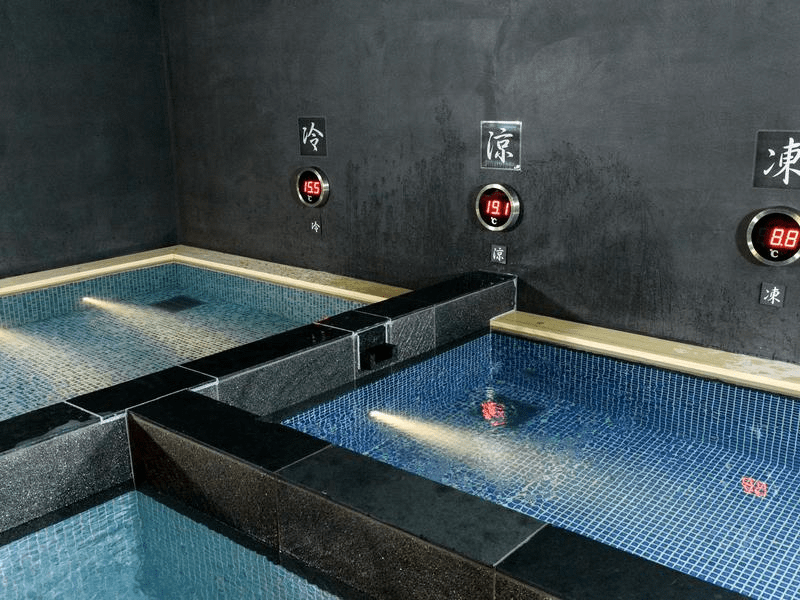
This one is cold! I mean really cold! The temperature is above freezing at around 8-9 degrees (around 45 degrees). On its own, this can be cold but bearable. However, what really takes this pool up a notch is the hot-tub style jets that keep the water moving at all times. This makes the water feel close to freezing for an always exhilarating, often intense experience. Great after a high heat sauna session. Be careful with this one, especially if you are new to sauna!

Acrylic Avant (transparent cold bath/plunge tank)
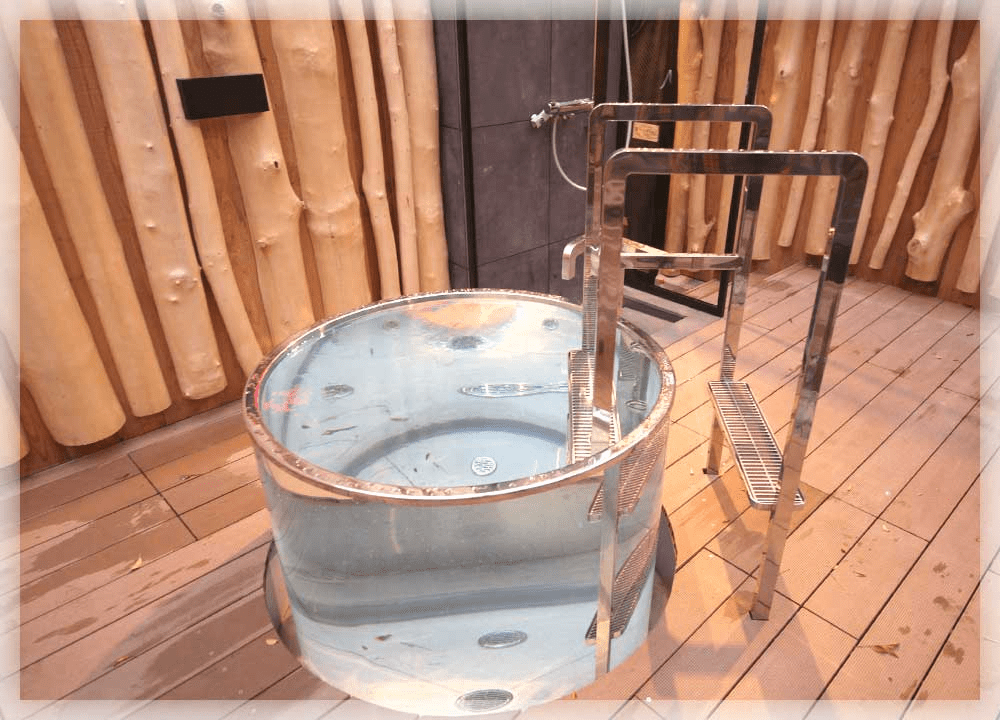
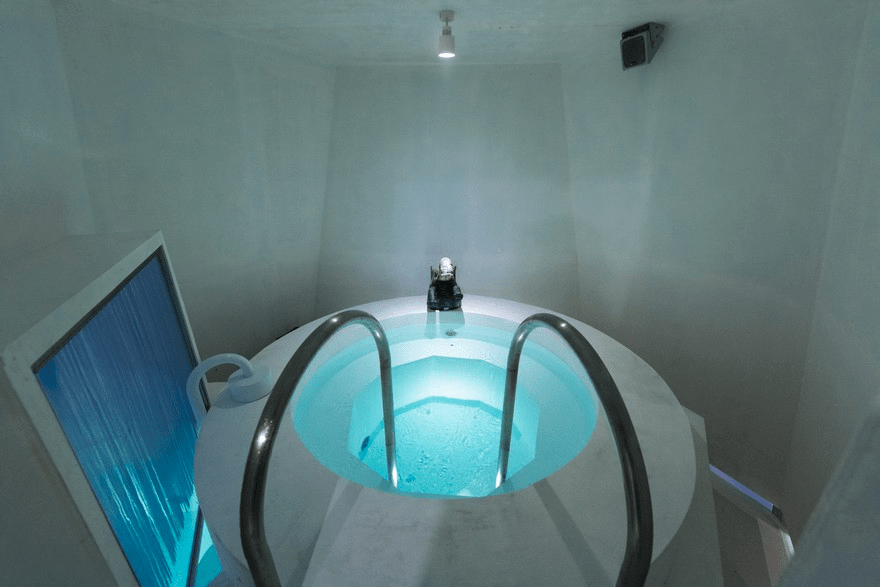
Located on the rooftop deck, this one person plunge tank is designed like an Avant (which means “hole in a frozen lake in Finnish”). Just a few steps away from both the wood burning sauna and several warm rooftop baths, this bath is an absolute treat! With a temperature at around 14 degrees (57 Fahrenheit), the one-meter deep plunge tank matches the surrounding baths and sauna incredibly well. This bath is possibly my favorite amenity from an aesthetic standpoint, as I think its easy to look at, and complements its surroundings well.

Rock and Box Baths:

Situated next to each other, the Rock and Box baths offer the most bathing focused experiences in area up the stairs from most of the sauna facilities.

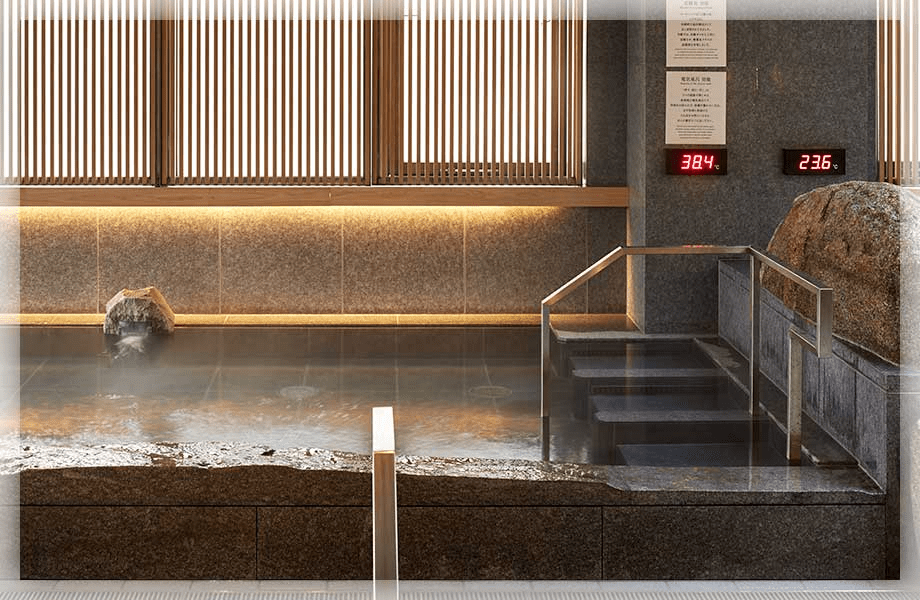
The rock bath is set at a relaxing “neutral warm” temperature of 36 degrees (97 degrees), that make it a pleasant bath to reset and relax in. The bath is made of Kitagi stone from the Okayama prefecture in and around the Southern portion of Honshu, the largest island in Japan. Combined with the serene garden through the window, I really enjoyed utilizing this bath to unwind between intense sauna and cold bath sessions.
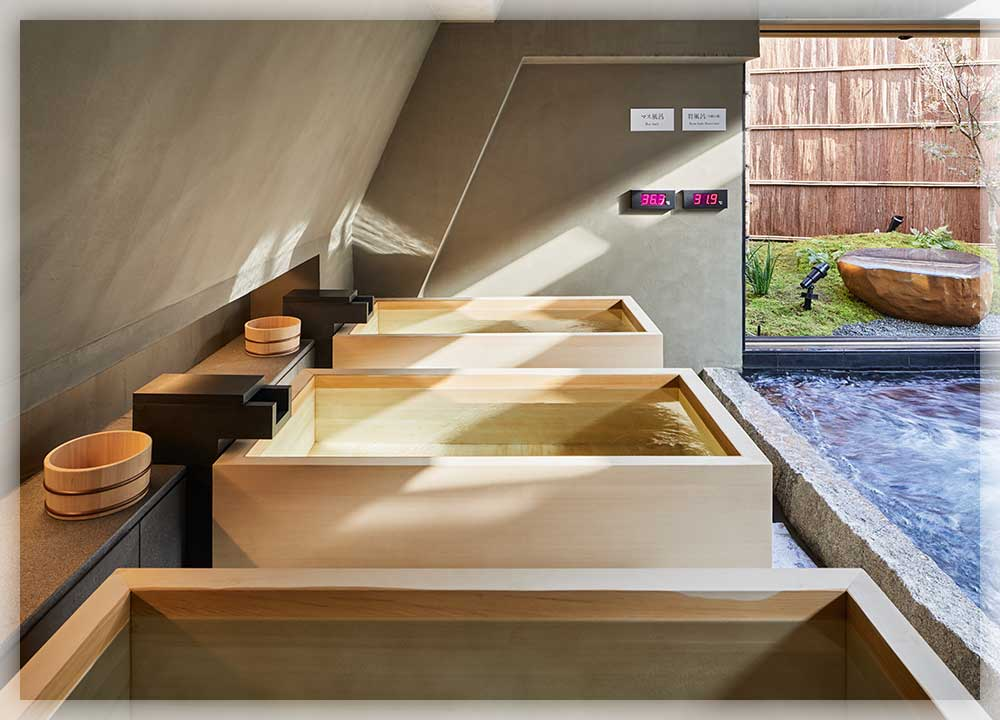
The box bath uses Aomori Hiba wood, a type of Cypress wood historically used in the construction of temples, and has a refreshing aroma well suited for baths. Lying down in the body length bath gives a regal feeling, especially situated next to the visible outdoor garden and up the stairs from the majority of the sauna and baths. These baths are fairly hot at around 42 degrees (107 Fahrenheit), so it does’t take long to get the most out of these baths.

Bonus- Rest Area
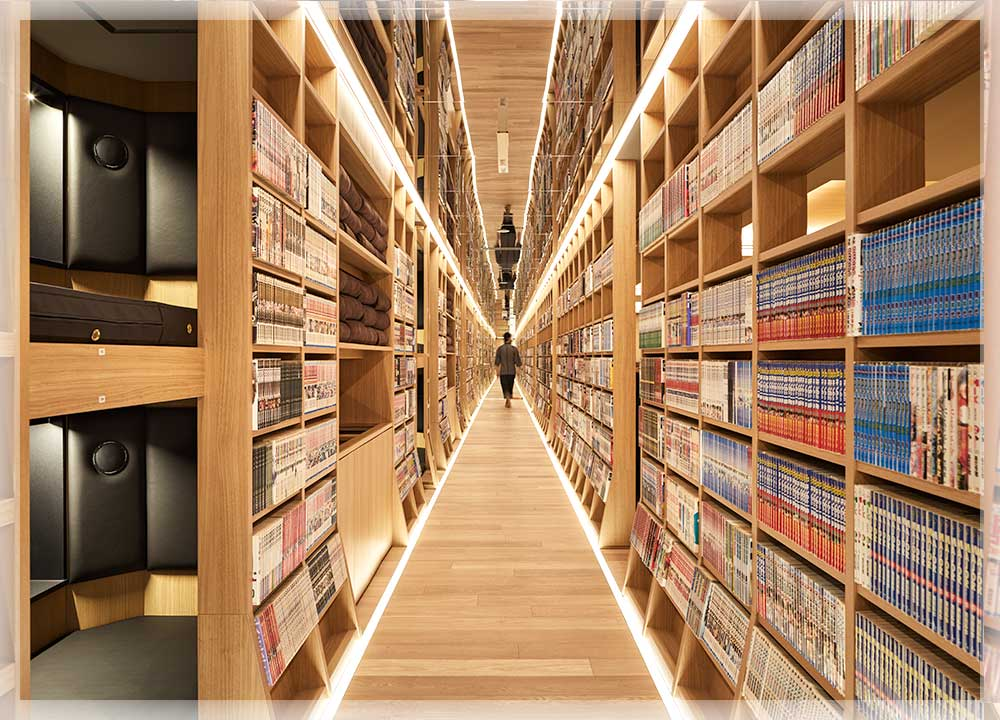
Located a few floors down from the rest of the facilities, you can find one of my favorite parts of Sauna Karumaru- the rest area! Famous for its absolutely massive library with over 10,000 manga and magazines, you could spend nearly an entire day here alone (especially if you can read Japanese!).
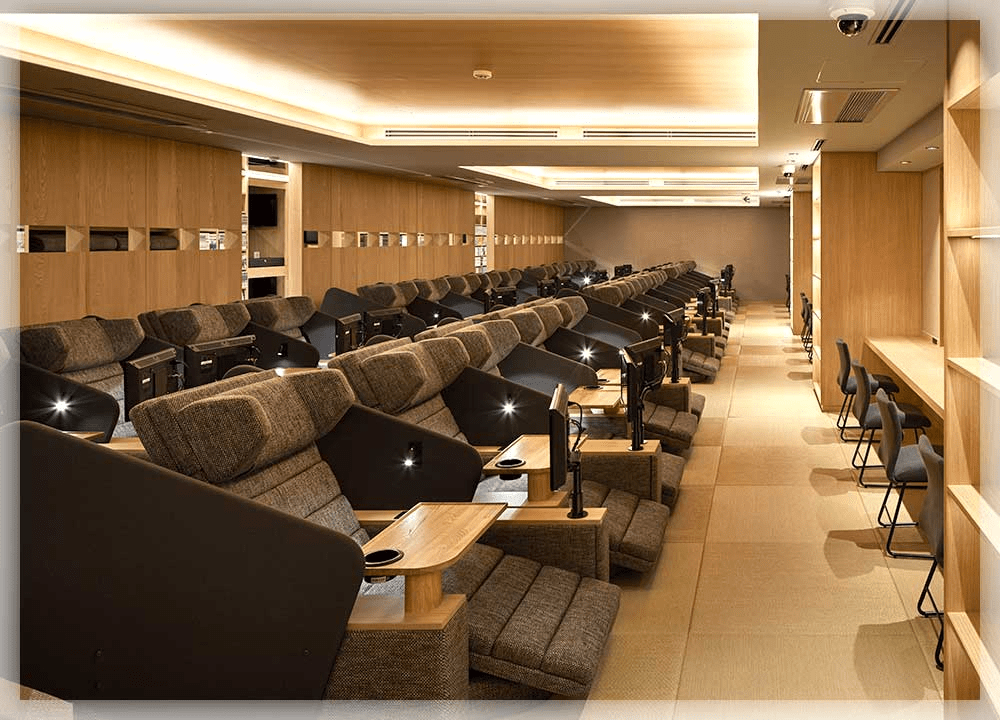
The lounge area itself is excellent as well, with lots of comfortable chairs and places to sit and read. Be sure to stop by at some point on your visit!

Limitations/shortcomings:

While I do sincerely appreciate Sauna Karumaru’s sauna facilities, an issue I have ran into on my trips are the relatively small capacities of most of the sauna. Sauna Karumaru boasts four excellent sauna. However, two of them have a very limited capacity, with the barrel steam sauna seating only one person, and the wood sauna only seating five people. For a facility housing (what I estimate) to be around one hundred people using the bathing facilities at a given time, having only two sauna that fit more than five people can make things feel a bit cramped. Even just one additional sauna fit to hold ten to fifteen more people would give the space a bit more breathing room and make the congestion more manageable.

Lastly, this is a minor complaint, but in my sessions in the barrel steam sauna, I found that it would border on painful to exit the sauna with how much the steam would accumulate. In my experience, my gut reaction to the adding humidity to the sauna (steam, loyly, etc.) should be “aaahhh” and not “ow!”. Again, it’s nothing major, but lowering the steam output by just a bit would make the barrel steam sauna an even better experience than it already is.

Best Moment:
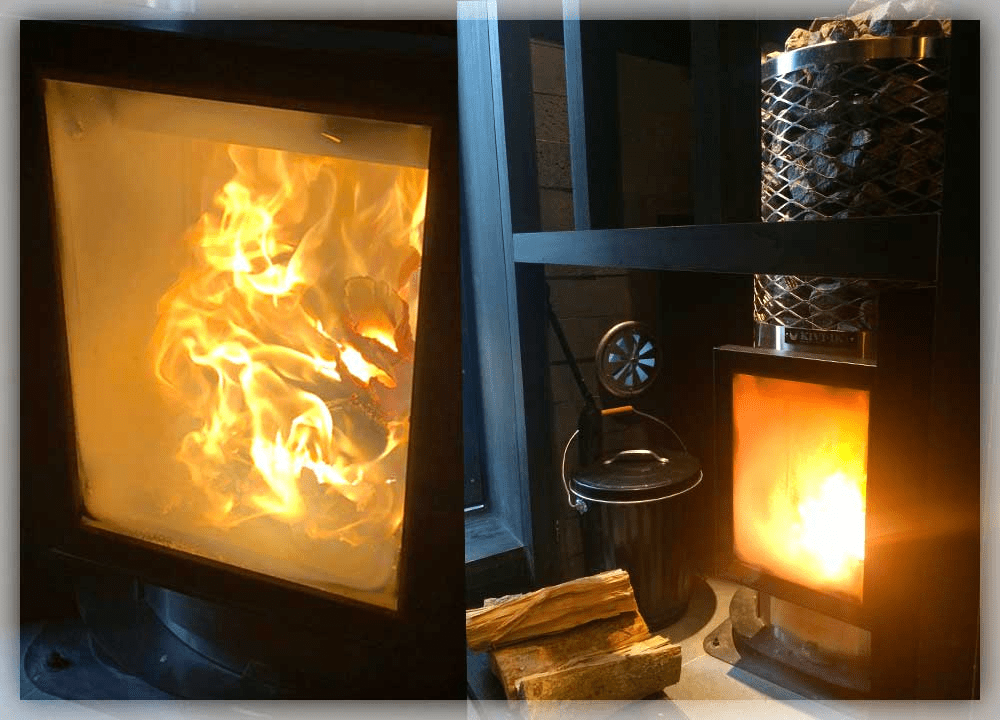
The wood burning sauna is nothing short of magical. While capacity is limited and you will likely only get to use once during your stay, it is absolutely a must during your time at Karumaru. In combination with the outdoor transparent cold plunge/Avant, I left the wood sauna grinning ear to ear.

Verdict

Sauna Karumaru is both a great introduction to the specifics of Japanese sauna culture, and well refined bathing facilities. If you are looking for a balance of sauna and baths, a sauna/bathing oriented capsule hotel experience, and an excellent lounge to unwind in afterwards, give Sauna Karumaru a visit!
Food Pairing:

Anan (Yakiniku next door!)

Right across from the elevator to the entrance is a yakinikku restaurant. For those unfamiliar, yakiniku is similar to korean barbeque. When Koreans intitially imigrated to Osaka in west Japan, they brought Korean BBQ with them. Overtime, this developed some distinctly Japanese characteristics and became what is now yakinikku. If you’re hungry after your sauna session, this couldn’t be more conveniently located.

Greater Ikebukuro station.

While yakiniku is nice and convenient, there are also countless food options near Japan’s third largest (!) subway station. If you’re adventurous, I would highly encourage going for a stroll and seeing what you find! There are lots of both Japanese and international food options, so you’re bound to find something to your liking before too long.
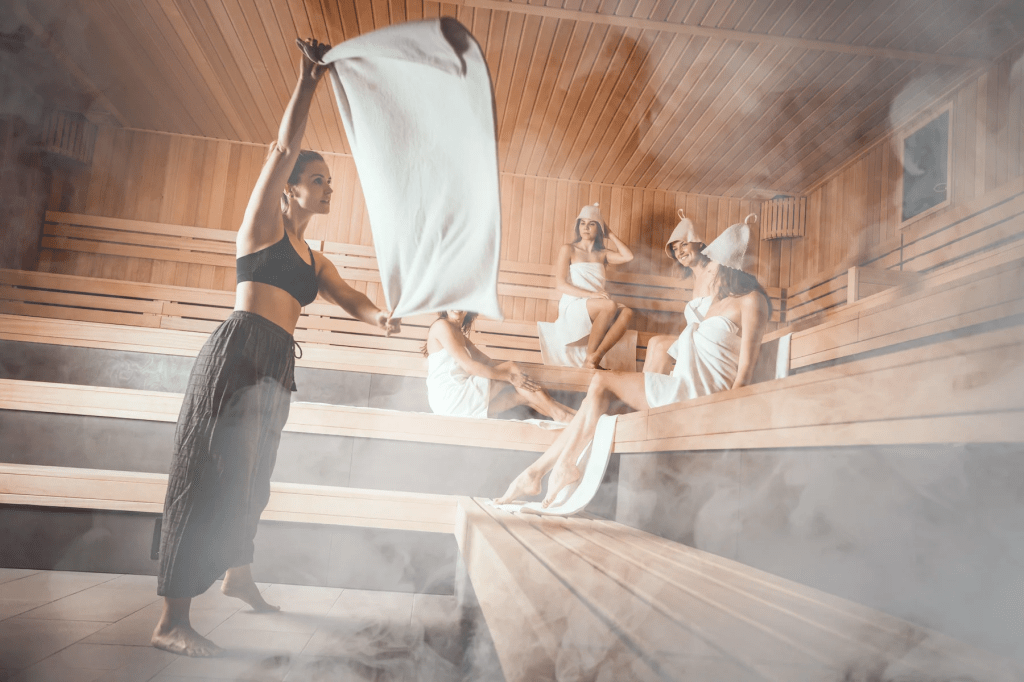
An Introduction to Aufguss: A German Sauna ritual finding new life in Japan

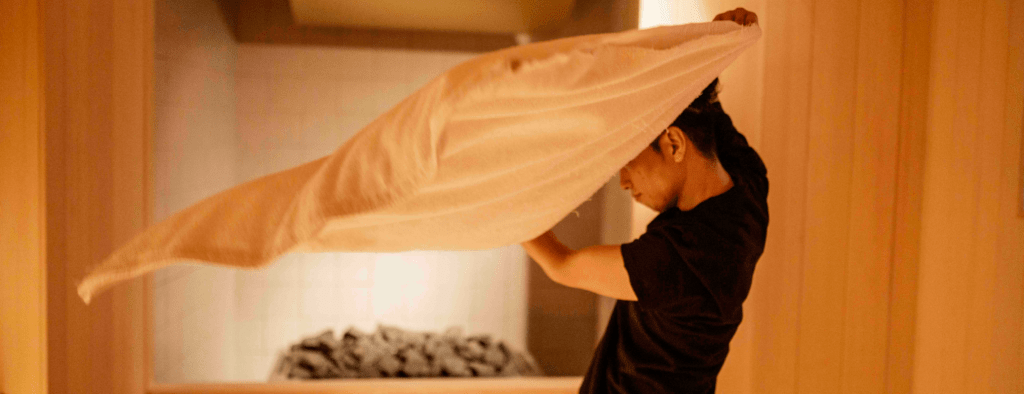
Imagine. One moment, you are sitting in the sauna, quietly enjoying your session. All of a sudden, the heat intensifies. You look up and see flashing lights, a moving towel diffusing essential oils throughout the sauna, and all of this is done in sync to awe inspiring music. Only half-sure of what I was getting myself into, little did I know that I would soon become obsessed with this small ritual within the already specific niche Japanese sauna culture. This is Aufguss.

What is Aufguss?

If I were to sum up Aufguss, I would describe it as such:

The ceremony of towel waving to diffuse essential oils throughout the sauna, often to music, with the aim of providing the audience with an intense heating experience that is often fused with artistic elements (coordinated towel waving to music, flashing lights, etc.).

To provide more clarity, I will also provide a definition that I really liked from Martjin Vanhoorelbelke, a two-time Aufguss World Champion finalist, taken from an excerpt found on Brooklyn sauna Bathhouse‘s website:

“Aufguss is a sauna ritual lasting about 15 minutes. It’s a multi-sensory experience inside the sauna. The Aufguss master works with water to circulate heat throughout the sauna with a towel. The core elements of an Aufguss are heat, essential oils and music.”

Vanhoorebelke then describes the goal of Aufguss as:

“To take you on a trip. It’s about having an experience that extracts the benefits of a sauna session and heightens them: elevated levels of endorphins and serotonin. Additionally, different essential oils can be utilized for different outcomes. For instance, peppermint can be used as a revitalizing oil, lavender for calm, and eucalyptus to clear the airways.”

Beautifully put. Better than I could have myself.

Aufguss in Japan

While Aufguss originates from Germany, it has gained popularity in Japan amidst the ongoing sauna boom. In Tokyo, many of the more reputable sauna/sento host regular Aufguss nights, with slots often booking out several hours in advance. Some of the top saunas even have their own teams that host elaborate Aufguss shows, many of which are used at “Aufguss Championship Japan”, Japan’s Aufguss national tournament.

At the national tournament, Aufguss performances are evaluated based on the following criteria:

  1. Professionalism
  2. Heat rise and distribution
  3. Fan technique [using the towel]
  4. How to use and amount of fragrance
  5. Theme and show structure
  6. Judge’s personal evaluation
  7. Team Spirit (groups only)

(translated using Google)

Teams and individuals that win move on to the World Aufguss Championship to compete on the international stage.

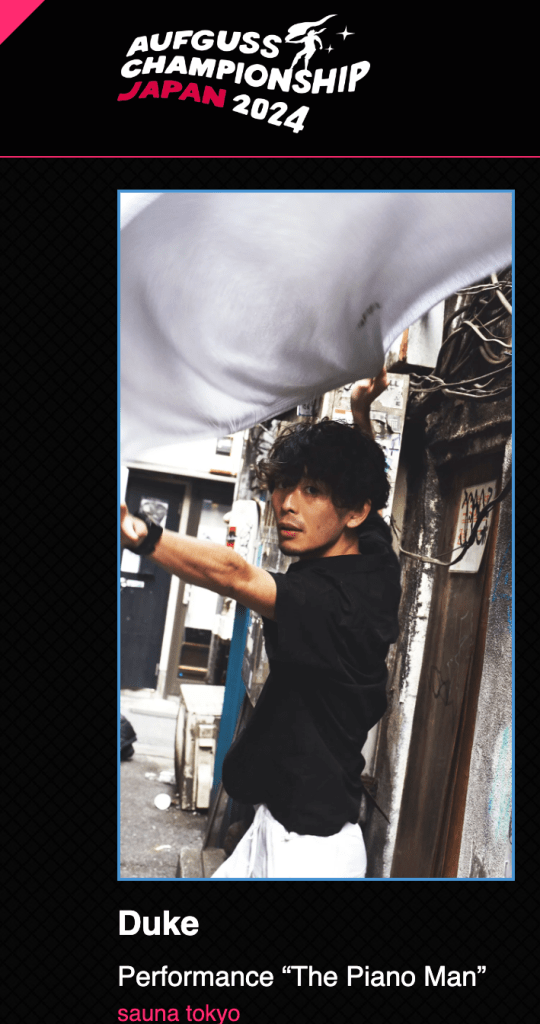
Competitive Aufguss performances are typically centered around a motif, such as a song or story that set the mood for the session. For example, This performer (one I have seen at Sauna Tokyo and is an excellent practitioner) has submitted an entry for the Aufguss Championship Japan for this year, and will use the song “Piano Man” as the centerpiece for his performance.

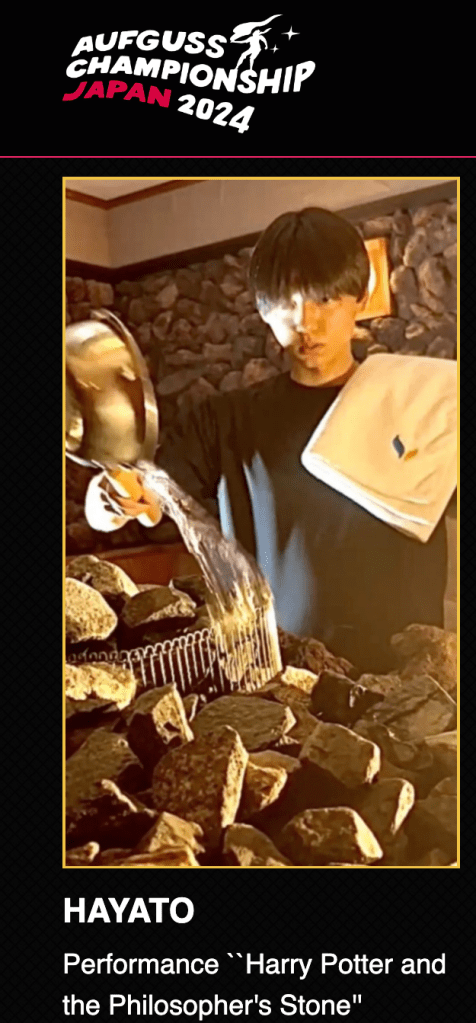
To give another distinct example, I’ll share a submission that really caught my eye. Along with a submitted image that looked like it was taken on a flip phone/potato, the only information for the performance listed is “Harry Potter and the Philosopher’s Stone”. While music can certainly be a driving component in Aufguss, other components like storytelling can also define the Aufguss session. I have to say, I’m quite curious how Harry Potter fits into this, and may have to report back to you all on this if I ever get the chance to find out…

Japan has become a force to be reckoned with in the international Aufguss community, with Yuma Kurokawa & Mayuka Sano from Wellbe Sauna in Nagoya winning the Team Competition category in 2023. Japan’s entrance on the global Aufguss stage has increasingly led to more and more Sauna creating Aufguss teams and programs. Seeing the innovation and creative energies surrounding Aufguss is incredibly exciting, and its inclusion at any given facility is always a highlight at any venue I visit.

From Sky Spa Yokohama, an Aufguss venue that is very high on my to-visit list!

Where can I Experience Aufguss in Tokyo?

Want to try Aufguss on your next trip to Japan, but not sure where to look? Fear not! With Aufguss taking the Japanese sauna world by storm, it can be found at many sauna throughout Japan! Since the majority of my sauna expertise is in the Tokyo area, all of my recommendations will be exclusively for Tokyo.

  • Sauna Tokyo
    • At the time of writing this post, this is easily my top recommendation for experiencing Aufguss in Tokyo. Every couple of hours, you are guaranteed to see a top-notch Aufguss show in their sauna outfitted for 50 people.
    • The aufguss practitioners are listed outside of the main sauna, and rotate every hour, so you have lots of opportunities to see different styles of Aufguss in one place.
    • I will go into more detail on Sauna Tokyo’s Aufguss experience in the next section, but to sum it up: Sauna Tokyo is an accessible, high quality way to see Aufguss that I can recommend to anyone.
  • Shibuya Saunas
    • Recognized as a top sauna team that has competed at the Japan Aufguss Championship, this is on the top of my list for Aufguss that I want to check out next. Unfortunately, their Aufguss offerings are somewhat random and are not on a set schedule. It has not been offered on my last two trips here, but online I only hear great things (on the Japanese side of the internet).
    • Regardless, even if Aufguss isn’t offered during your trip, I can highly recommend this facility (review to come at a later date)
  • Spa Laqua
    • Located right by the Tokyo Dome, this is an excellent option if you are looking for a super sento that also offers quality Aufguss sessions.
  • Sky Spa Yokohama
    • Along with Shibuya Saunas, this is on the top of my list for Aufguss that I want to experience. Much like Shibuya Saunas, Sky Spa Yokohama has sent several contestants to the Japan Aufguss National Championship, and regularly is listed as a go-to destination for Aufguss. I still haven’t paid Sky Spa Yokohama a visit, and it’s one of the facilities I am most excited to check out!
  • Sauna and Hotel Karumaru
    • A more low-key option, Aufguss is offered every few hours in their stone sauna. Similar to Spa Laqua’s Aufguss, less performative than Sauna Tokyo, but still done by quality practitioners. Karumaru also has an attached capsule hotel, so if you are looking to bundle your lodging and Aufguss options into one, this is a great choice.

My Aufguss Experience with a Japan National Champion

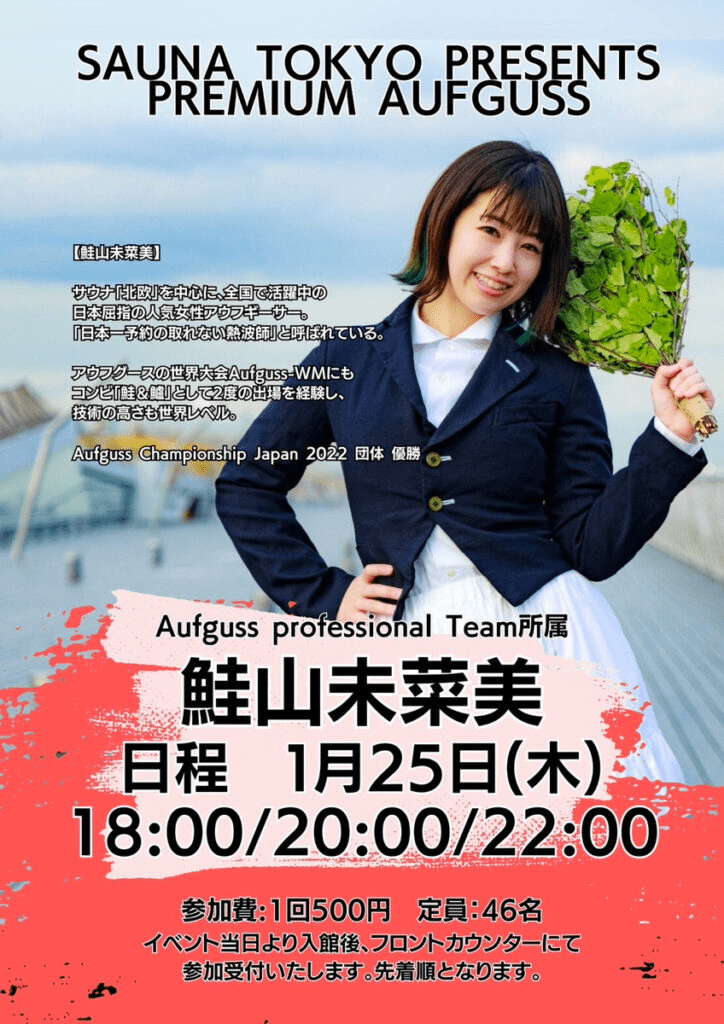
Flyer for the Aufguss event that I attended

While I have been to several Aufguss shows around Tokyo, I had the opportunity (and paid a little extra) to see the 2022 All Japan Aufguss Champion at Sauna Tokyo. While I have been to several impressive Aufguss shows, this one particularly left an impression. To give a taste of the heights of Japanese Aufguss, here is a narrative account of my experience:

After inquiring at the front desk two hours in advance about the Aufguss event, I was given a number (35 out of the 46 person capacity), and was instructed to line up outside the main Loyly sauna five minutes before to prepare.

Jam-packed to its full 46 person capacity (I suspect there were a few more than 50 in reality), the staff strategically placed several conspicuous looking tools near the sauna stove, including an ice block, a speaker, and several essential-oil diffused buckets of water prior to the start of the performance.

Kicking things off, a series of lights turned on and immediately dimmed to a cool blue, then to red. Then, a Japan Airlines announcement cued on the speaker system, with the Aufguss champion emerging in a Flight Attendant Uniform. Announcing in time with the airline announcement, she followed with (in Japanese) “Welcome to the Sauna Airlines! Please locate the emergency exit and enjoy your flight!”. For the next several minutes, classical music played, with ice blocks being melted on top of the center sauna stove in time with the music. A nice warm breeze, relaxing, but not scorching intermittently spread around the room for several minutes.

All of a sudden, red lights started crashing. “Everyone! Everyone! The plane is crashing! The plane is crashing! We are in danger!!!” Immediately following, “Danger Zone” by Kenny Loggins starts to play over the speakers (yes- the one from Top Gun), and the Aufguss practitioner starts to take things up a notch. The towel waves increase in intensity, the collective atmosphere was filled with excitement and awe. As the guitar solo hit, the practitioner started performing one-handed towel spins that went behind the back and thrown mid-air. The audience started to clap to the rhythm, giving the atmosphere more akin to a rowdy sporting event than a “spa day”. This was the point where I had to look at the fifty other naked individuals wearing pointy sauna hats clapping in sync and remind myself that I had not joined a cult.

After the performance concluded, the audience gave a hearty round of applause, and nearly the entire crowd rushed into the nearby cold plunge pools for a much needed cool-off.

A follow up show the next hour included other members of Sauna Tokyo’s Aufguss team. Perhaps the most inventive idea I’ve seen in an Aufguss performance, one performer had a small handheld leaf blower, and used it to help diffuse the heat around the sauna. Backed by the soundtrack from the anime “Death Note”, the practitioner stated (in Japanese) “I am fear! I am fear!” (from what I could translate in my head), and moved the heat around to those with their hands up requesting more heat.

Needless to say, the Aufguss experience at Sauna Tokyo was exhilarating, awe inspiring, and unlike anything I had ever experienced.

Conclusion

While I could write about Aufguss at further length, its appeal is (perhaps even more so than sauna and bathing) difficult to encapsulate with words, and best experienced. If you want to level up your sauna experience, or want to experience a uniquely Japanese take on a tradition with its origins elsewhere (something Japan excels at), give Aufguss a try!

Thank you so much for reading! More content is on the way after a small hiatus, so please stay tuned!

Sauna Tokyo

Cutting-edge. Craftsmanship. Masterpiece.

Tattoos Okay? Yes***
Sauna? Yes. And lots of them.
Price? $$
Should I Bring Toiletries? No
Best For? Sauna enthusiasts looking to have immense thought and care go into every aspect of their sauna experience. Those searching for a sauna focused experience in Tokyo. Everyone who visits Tokyo or Japan.

Nearest Station: Akasaka Station (Chiyoda Line). 3 minute walk.

*Their tattoo policy is a bit weird, so I’ll get into it more in the article. The short answer is that you can go to Sauna Tokyo if you have tattoos, but you will have to pay an extra fee.

Located in the ritzy Akasaka district of Tokyo, the area known for the TBS (Tokyo Broadcasting System and Television) Headquarters, Higawa and Nogi Shrines, and now: Tokyo Sauna. A playground for the Tokyo elite, the area probably won’t pop up on a lot of tourist itineraries, but hosts many of Tokyo’s most expensive hotels and restaurants. And right in the heart of it all is perhaps the best sauna complex in the city, if not Japan. With sento architect Kentaro Imai at the helm, and a mission of creating a facility with sauna enthusiasts in mind, it’s hard not to get excited about Sauna Tokyo. Let’s dig into what makes it so great.

Aesthetics:

The driving philosophy behind Sauna Tokyo was to create a sauna facility that showcased a uniquely Japanese take on saunas. On designer Kentaro Imai’s architectural page, the project is described as:

” [Japan is known for] the rearrangement and redesigning of culture imported from abroad to [fit] Japanese specifications.” This is one of the unique characteristics of Japanese culture. The same is true for saunas, which were first imported to Japan during the Tokyo Olympics in the 1960s.

For this project, six cold/heat saunas have been installed under the keyword of “Japanese style” so that users can enjoy these variously arranged Japanese versions of saunas.”*

*Translated using Deep L.

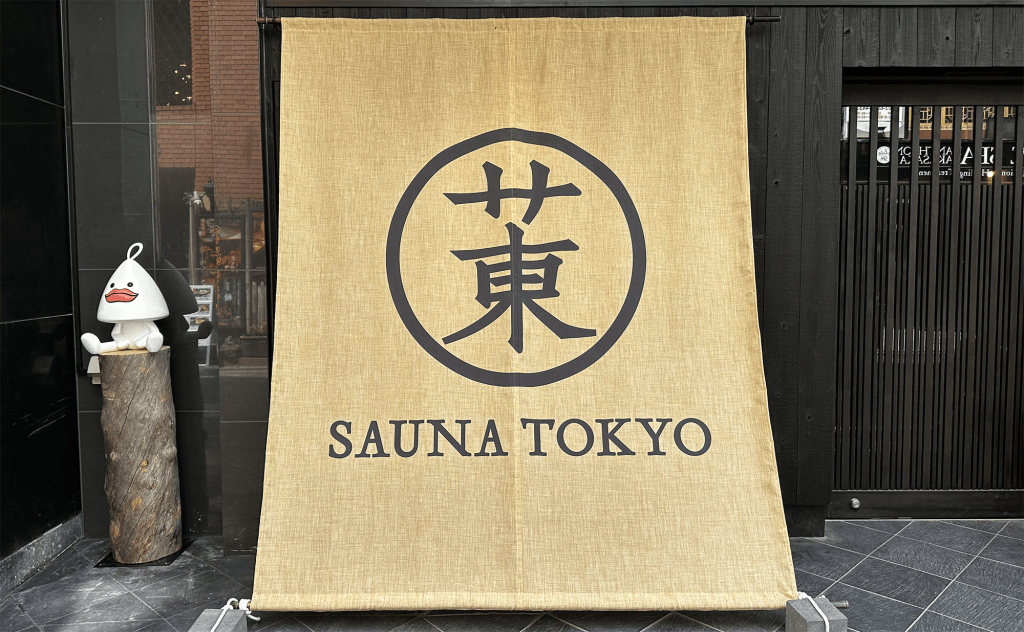
Sauna Tokyo certainly delivers on this front. Apart from the striking, Japanese-inspired entrance, the first floor does a great job of cementing the Japanese aesthetic. With a sleek, black tile finish is present throughout the facility, you are greeted at the bathing area entrance by a black cauldron with water gently overflowing and the same style wash ladle that you would find at every sento across Japan (not pictured).

Upstairs, it’s hard not to be impressed with the contrast of the room’s black finish and the blue glimmer of Sauna Tokyo’s three cold plunge pools.

Aside from the upstairs hub hosting the plunge pools, the interiors of the sauna are just as sleek as the rest of the floor. Using high quality wood that is well kept after, each of the four saunas and the steam room are simultaneously portals into different parts of the Sauna Tokyo experience, while remaining grounded and cohesive feeling within the facility.

Culture/vibe:

Sauna Tokyo’s culture can best be summed up with two core ideas:

  • Japanese Style Sauna
  • Saunners (sauna enthusiasts)

Japanese Style

As covered in the Aesthetics section, Sauna Tokyo was designed with the aim of creating a distinctly Japanese adaptation of sauna. This can be seen in the design choices described above, such as the sento stylings of the first floor, and its adaptation of Aufguss (!).

For those unfamiliar, Aufguss is a sauna ritual originating from Germany (Aufguss literally translates from German as “infusion”) that uses coordinated towel movements to diffuse essential oils around the sauna, and is often done to music. While Aufguss is a topic worthy of its own article, Sauna Tokyo’s top-notch Aufguss is a noteworthy example of a distinctly Japanese take on the sauna experience.

Outside the Löyly sauna (largest sauna hosting up to 40 people), a list of times as well as names of Aufguss practitioners are listed. Rather than using real names, stage names are used for the practitioners. A personal favorite of mine was サDuke, an adaptation of Sir Duke, or “Sa-Duke” using the Japanese phonology.

In my several trips to Sauna Tokyo, each Aufguss experience has been completely different. The music selection ranges from both Western and Japanese music (I even heard anime music on one occasion), providing a Japanese spin on a Sauna tradition originating from Germany. Story telling elements have even been present, with one seeming (from what I could hear in Japanese) to “take place” on a Japan Airlines “Sauna airplane”! I’l save more of the specifics of the experience for my Aufguss article (stay tuned…), but these are just a few examples of the Japanese quirks of Sauna Tokyo.

A sample image of an Aufguss experience (not from Sauna Tokyo)

Saunners

Besides the “Japanese Style” motif found throughout, Sauna Tokyo is clearly made for the diehard sauna fans in mind, or “Saunners” as they are called in Japan.

The visitors guide for the Minato-Ward of Tokyo describes Sauna Tokyo as “a new holy place for Sauna enthusiasts”. Sauna Tokyo’s merchandise line is a great example of the venue’s dedication to the sauna community. Ranging from Sauna hats, clothing items, and figures of Sauna Tokyo’s mascot Totonon, its a seemingly small detail that really took the experience to another level for me.

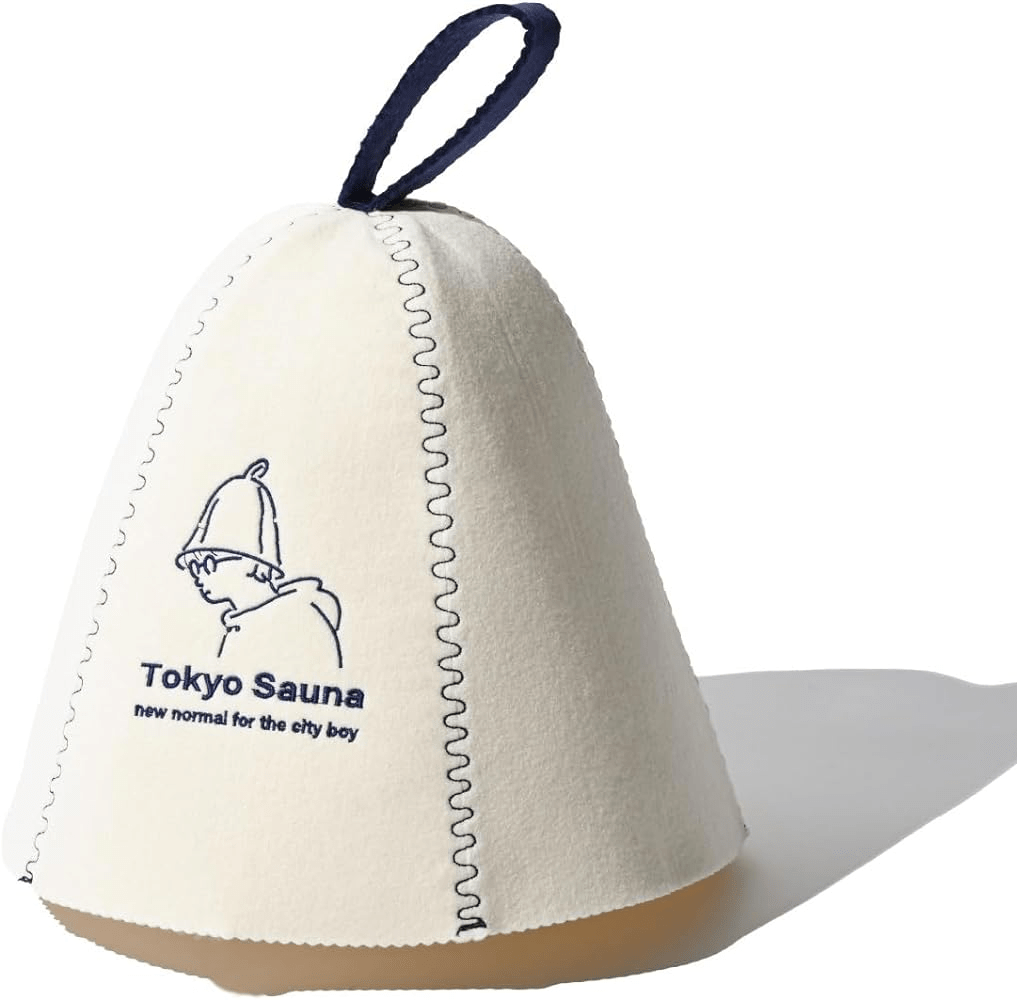
Sauna Tokyo‘s official Sauna Hat

Additionally, flyers for events around both Sauna Tokyo and the greater Sauna community can be found in the locker room. Ranging from special Aufguss shows to sauna pop-up events around Japan, one gets the sense that Sauna Tokyo holds a place in the Tokyo Sauna community, and despite being open less than a year, wants to be a staple.

Facilities:

Sauna Tokyo’s facilities are some of the best I’ve found in the city, as well as Japan. Among other spaces, the upstairs portion has five saunas. The loyly sauna, the main “hub” sauna of sorts, is massive and seats up to forty people according to Sauna’s Tokyo website (anecdotally, I’ve seen closer to what seems like 50+ packed in during some of the Aufguss shows, which I will explain later). Aside from the Aufguss and special events, the sauna is open for general use, and has an auto loyly mechanism that keeps the sauna at a consistent 96 degrees (205 Fahrenheit).

Just next door to the Loyly sauna is the Meditation Sauna. Aside from the main Loyly sauna with its incredible Aufguss shows, the Meditation Sauna is probably my favorite. Set at a lower temperature with hanging birch leaves on the wall and bird sounds playing in the background, you get the sense of being in the middle of the Finnish countryside without a worry in the world. It’s a great place to take a break from the often-intense hot-cold cycles at Sauna Tokyo.

Across the hall, you can find the self-loyly Kero Sauna, the Super Dry Sauna, and the Cupboard steam room.

The Loyly Kero sauna is set at a medium humidity, medium heat, and uses Kero wood sourced from the Lapland region of Finland. As implied by the name, self loyly* means the heat and humidity in the room is regulated by a self-serve water bucket that can be poured on the stove.

*Loyly refers to the pouring of water on the sauna rocks to heat up the sauna

Super Dry Sauna

Just like the name suggests, this is a high heat, low humidity dry sauna. I don’t care for this one as much, but that comes down mostly to personal preference. Sauna Tokyo’s website describes it as “reminiscent of the Carakara-style high-temperature saunas of the Showa era”.* The sauna has a retro gym sauna feel that may be familiar to anyone coming from a Western country that had a similar type of sauna at their gym or health-club.

*For those unfamiliar, the Showa era refers to Japan’s longest lasting Imperial Era under Emperor Showa. While the era lasted from 1926-1989, it typically refers to 1946-1989. “Showa Japan” is often shorthand for old or retro Japan.

Cupboard Steam Room

This one is super interesting. What at first seems to combine a hot tub and a Turkish steam room, the room is actually inspired by the “cupboard bath” that was popular in Edo period Japan. I loved the concept, and I often start here when I make my way to the upstairs portion of the facility.

Besides the saunas, there are four cooling areas, including a cold sauna and three cold pools. The cold “sauna” (not pictured) is a dry room with fans going and a few chairs. Not much to write home about, but I appreciated the space. The cold pools are set at 8, 15, and 22 degrees (46, 59, and 71 Farenheit). Anecdotally, these each feel much colder than their listed temperatures, and I appreciated the variety of temperatures available.

The upstairs also has a rest area, with space for around 60 people, and serves both Detox Water and Pocari Sweat.

Limitions/shortcomings:

Sauna Tokyo’s largest shortcoming is easily that the facility is, unfortunately, men only. This is a huge disappointment for any female bathers looking to experience this great contemporary piece of Japan’s sauna culture.

The silver lining is that Sauna Tokyo has hosted a few Women’s only nights. However, these are infrequent, so I unfortunately would have to rank a few other facilities higher as my go-to recommendation for Sauna facilities in Tokyo solely because of this.

I don’t factor in whether a venue allows tattoo’s or not into any of my reviews. As tattoo’s in Japan are historically associated with organized crime, I don’t think it is fair to judge it based on that criterion. That being said, I found Sauna Tokyo’s tattoo policy to be a bit…strange……

If you are visiting Sauna Tokyo, you are still allowed to use the facilities. However, you have to pay an additional 500 yen fee. Additionally, you are required to wear a sticker that says “Respect the Rules!” for the duration of your stay. During my several trips, I have seen staff members urgently stop guests, with either one small tattoo or tattooed from head to toe, only to put a 3×5 inch sticker saying “Respect the Rules” on their upper back, and walk away.

It seemed silly, and I’m not sure what the end goal of the policy is. It just seemed strange and unnecessary to me. Like a weird compromise that didn’t solve any prospective issues. It’s not a huge deal (partially becuase I haven’t had to deal with it myself, as I don’t have any tattoos), it just struck me as odd.

Verdict:

Sauna Tokyo is an absolute must visit. If you’re a sauna die-hard like me, you’ll be in heaven. If you’re just curious, you’ll walk out inspired and refreshed. From Kentaro Imai’s brilliant aesthetic choices, to the awe-inspiring Aufguss performances, there’s something for everyone at Sauna Tokyo.

Food Pairing:

For this food paring, I am trying something a little different. I am listing a local recommendation, which is something I would be more inclined to grab a bite at on my way home. My visiting recommendation is designed with tourists/visitors to Japan in mind. It may be slightly further than walking distance, but noteworthy enough to add to a tourist itinerary.

I may implement this into some of my reviews of larger venues, or locations close to particularly noteworthy restaurants (Michelin, major tourist attractions, etc).

Local Recommendation:

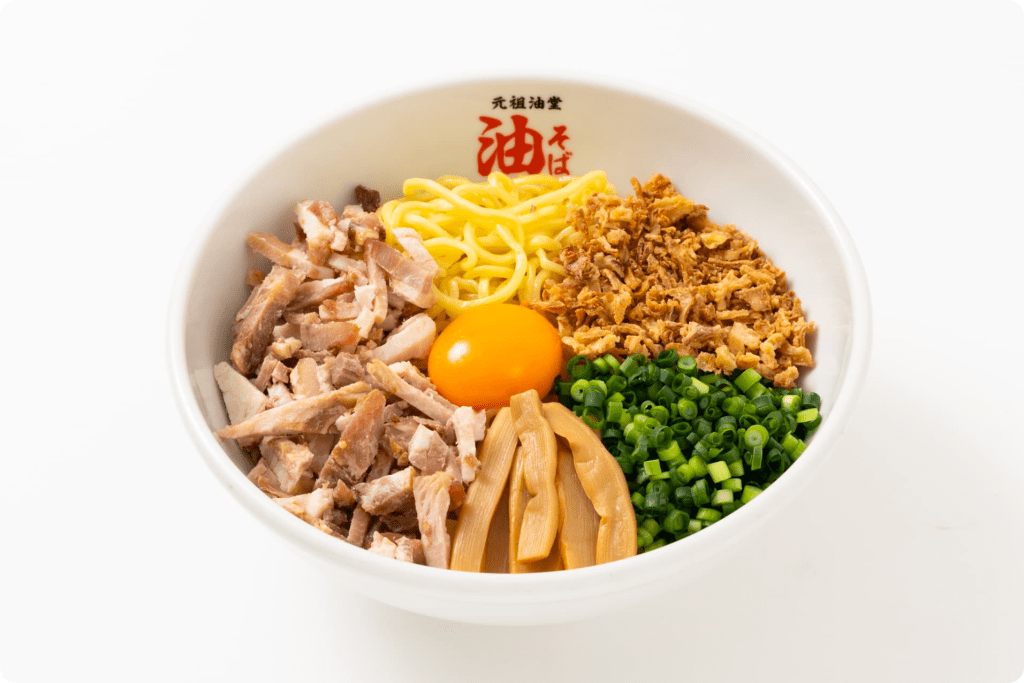
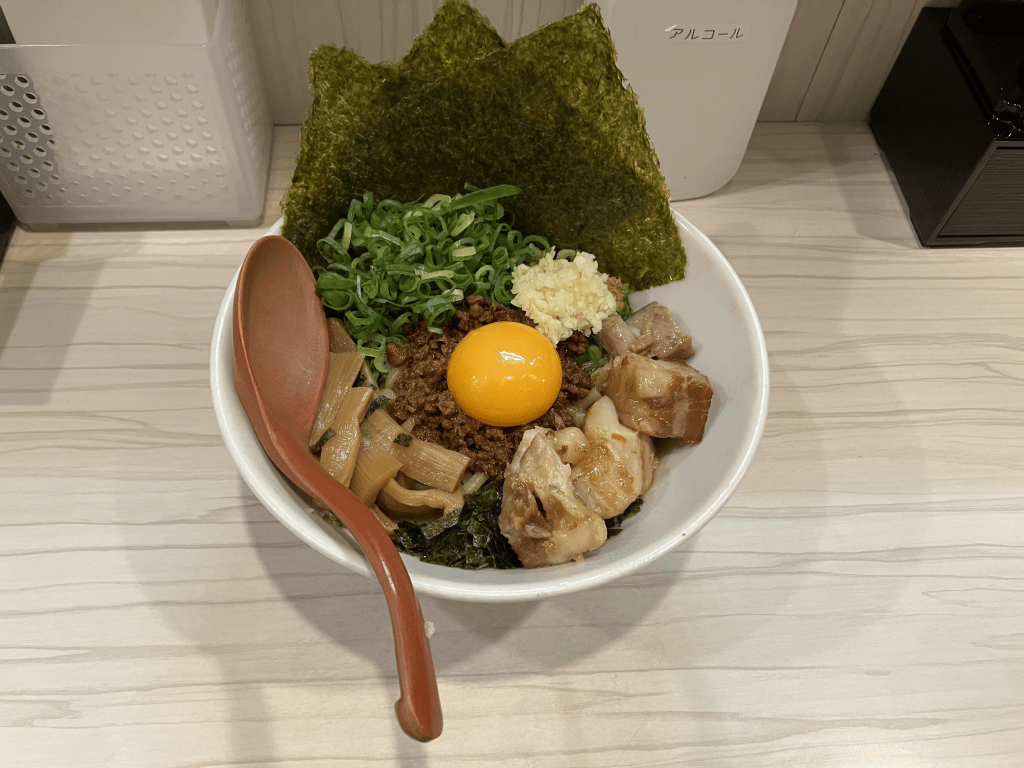
Genso Aburado (Maze Soba)

Maze soba has become a go-to post sauna/sento meal for me. And Genso Aburado is conveniently located a block away from Sauna Tokyo! Hosting an extensive spice bar, this maze-soba chain really hits the spot after a long sauna session. The wide variety of options, combined with the comfort-food feeling that a good spice-filled maze-soba bowl provides make Genso Aburado my go-to after Sauna Tokyo.

Visiting Recommendation (Great for Tourists)

Gonpacchi.

I think that Sauna Tokyo is the kind of experience that should be savored. As such, I think having a dinner that leaves an impression is essential for this pairing, particularly if you are visiting Tokyo from outside Japan.

Located about 1.2 km/just under a mile away, Gonpachi famously inspired the ending scene of Kill Bill: Volume 1, where The Bride fights The Crazy 88. While it’s certainly on the touristy side, I think it’s a lot of fun. Also, the staff here are fluent in both Japanese and English, so for travelers, this is particularly worthy of note. The menu is extensive, and you will almost certainly find something to your liking on the menu.

Minato-Yu

Elegant, hidden, modern.

Tattoos Okay? No
Sauna? Yes
Price? $
Should I Bring Toiletries? Some. Body wash and shampoo provided.
Best For? Those looking for a luxurious, bathing forward experience for a reasonable price.

Nearest Station? Hatchibori Station (Hibiya Line)

Tucked away in Tokyo’s wealthy Minato ward, Minato-Yu is one of the classiest neighborhood baths in the city. Thoughtful aesthetic choices combined with extensive bath options make Minato-Yu a destination to visit.

Aesthetics

Minato-yu excels in this department. The entrance looks like if Team Lab designed a speakeasy entrance leading to a sento. “Unassuming” and “sparkling jade” don’t sound like they would go together, but Minato-yu makes it work.

Entrance to Minato-yu

Once the automatic, secretive door opens, you find yourself in a cozy lobby. Similar to most local sento around Tokyo, albiet a bit nicer. The small hallway leading into the locker room is a highlight of the venue. Using the same sparkling jade motif as the front door, the hallway sets the tone for the venue, emphasizing that while this is a public bath, that doesn’t prevent if from being luxurious.

Absolutely breathtaking. Looks more like an art exhibition than a public bath hallway.

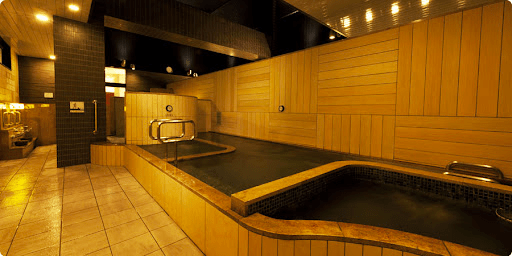
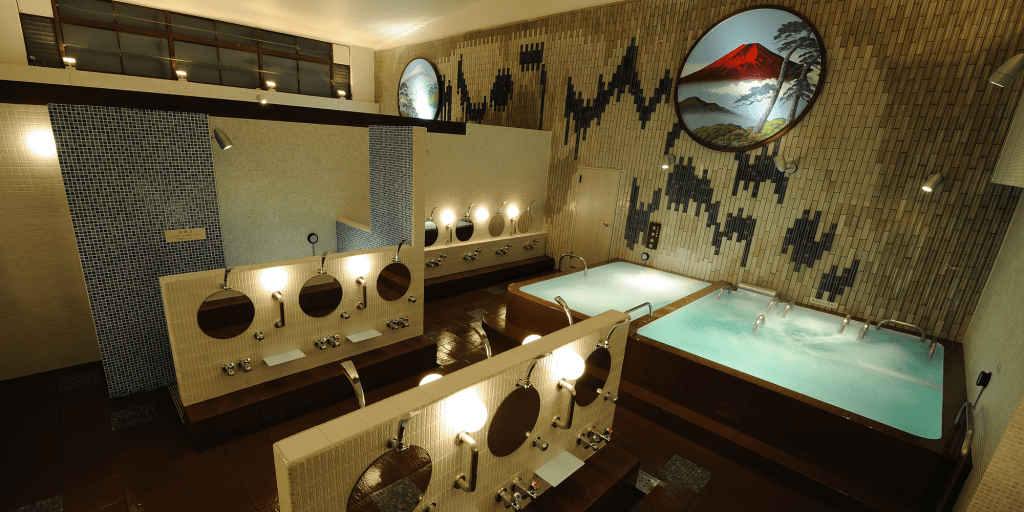
Thankfully, this idea doesn’t stop at the hallway. The baths don’t pull any punches either. With a black tile finish complimented by a grey tile and wood exterior, the baths fulfill the luxurious image provided by the entrance and hallway of the venue.

Right at the bath entrance to wash yourself. Another great aesthetic choice that elevates the experience.

Culture/vibe

Minato-yu is, as the name suggests located in the Minato ward of Tokyo. This is widely known as one of the wealthiest parts of the city. Despite how nice Minato-yu is, it is still a public bath. The wealth of the community is on full display here, and you can clearly see the contrast between a lot of dying public baths around Japan and Minato-yu. While many baths houses are dated, near empty, and thirty years overdue for a renovation, Minato-yu the complete opposite. Modern, lively, and state of the art, Minato-yu reflects the affluence of the neighborhood it resides in.

What I really appreciate about Minato-yu is despite how nice it is, it’s still priced at a standard sento rate (520 yen for a bath, an additional 500 yen for using the sauna). When I feel like I want to treat myself to a slice of luxury and don’t want to break the bank, I have found Minato-yu to be a great compromise.

Despite how luxurious the venue is, it has a certain subdued nature that I find comforting. Maybe the secretive door found on an unassuming side street contributes to this, but I found myself really able to mentally disconnect from the outside world and let any thoughts from the outside world pass me by here. Much like a zen garden, finding a small aesthetically pleasing space to pause and relax in a relatively busy area can really add a sense of peace to the day.

Facilities

The baths are a highlight of the facility, and stand out above all else. I appreciated the variety at Minato-yu, with the left side (typically men’s) of the venue hosting four different baths: one cold bath, a jaccuzzi, a warm bath (with sections for a jetted bath and electric bath attached) and a hotter bath nearby (pictured below). The warm bath water felt especially nice, with the circular jacuzzi coming in at a close second (found behind the left circular wall pictured below).

Men’s side of the baths (right side- switches on Sundays)
The spherical Jacuzzi bath isn’t something I’ve seen at many sento before, and trying Minato-yu’s made me want to see more!

The right side (women’s, except on Sunday’s) (pictured below) is a touch smaller. No circular jacuzzi bath), but it compensates with a better sauna.

Women’s bathing area

The sauna differed between sides, with the mens (right) side sauna being an infared sauna, and the women’s being a stone sauna. The men’s sauna is sufficient, but nothing to write home about. It’s a nice addition and pairs with the cold plunge well, but isn’t a definitive part of the experience.

The women’s (left side) sauna however, is a different story. Thankfully, I was able to go on a Sunday where sides are switched and try it myself. A larger stone sauna, the heat is hot without being suffocating, and is located right next to the cold plunge pool. A bit more spacious and a higher quality heat, the stone sauna definitely wins out from its counterpart.

Limitations/shortcomings

Each side is fairly different. Thankfully, both have strengths. As mentioned above, one side (typically the women’s) has a better sauna, the other has better baths. That said, in a bathing focused facility, the side with better baths wins out, creating a discrepancy between the two sides. The “better” side with more baths is currently men only except for on Sunday’s, so keep this in mind when visiting. There is conflicting information on the website about if the baths rotate weekly or just on Sundays. It currently appears like the rotation is just on Sundays for now, but if anything changes, I will update this section accordingly.

Additionally, while the sauna on the men’s side certainly isn’t bad, I think the baths certainly outshine the sauna here. It’s still a solid sauna, but if you’re on the fence about using it or not/on a tight budget, I would just go for the baths. The bathing here is top notch, and you can have a great time just using the baths. That said, it’s certainly not a poor quality sauna. Not sure why the sauna varied so much between sides, but it is something to note.

Verdict:

Minato-yu is a unique, modern public bathing experience that is worth a visit, especially if you want to focus on bathing. Minato-yu’s aesthetics are top-notch, and the low price point make this an even more enticing option in the otherwise expensive Minato-ward of Tokyo. For those wanting a bathing-forward experience and luxury on a budget, pay Minato-yu a visit.

Food Pairing

Menya Kokoro

A chain of maze soba restaurants, I always treat myself to Menya Kokoro whenever I visit Minato-yu. This was my first introduction to maze soba, which is a Taiwanese style dry noodle dish typically served with vegetables, raw egg, and meat. Menya Kokoro serves the dish with a spice blend that always hits the spot. Dishes are relatively affordable here at around 1000 yen (around $8.00 USD). While it is a chain, I often find Minato-yu’s proximity to Menya Kokoro as a deciding factor when choosing between sento to visit! You won’t be disappointed.

Bathe Yotsume Brewery

From the minds behind the smash-hist Sento “Kogane-yu”, a brand new Sento themed brewery!

This post covers my visit to the newly opened Sento brewery “Bathe Yotsume”. Affiliated with nearby Sento Kogane-Yu, I have been excited to check it out ever since I saw the opening notice on my most recent Kogane-Yu visit. Let’s dive into what my first impressions were!

*Author’s note: This isn’t my usual “review of sorts”. I have a more methodical process I use for my reviews, including several visits and certain criterion. This post just covers my visit and a few of my initial thoughts. With that in mind, please enjoy!

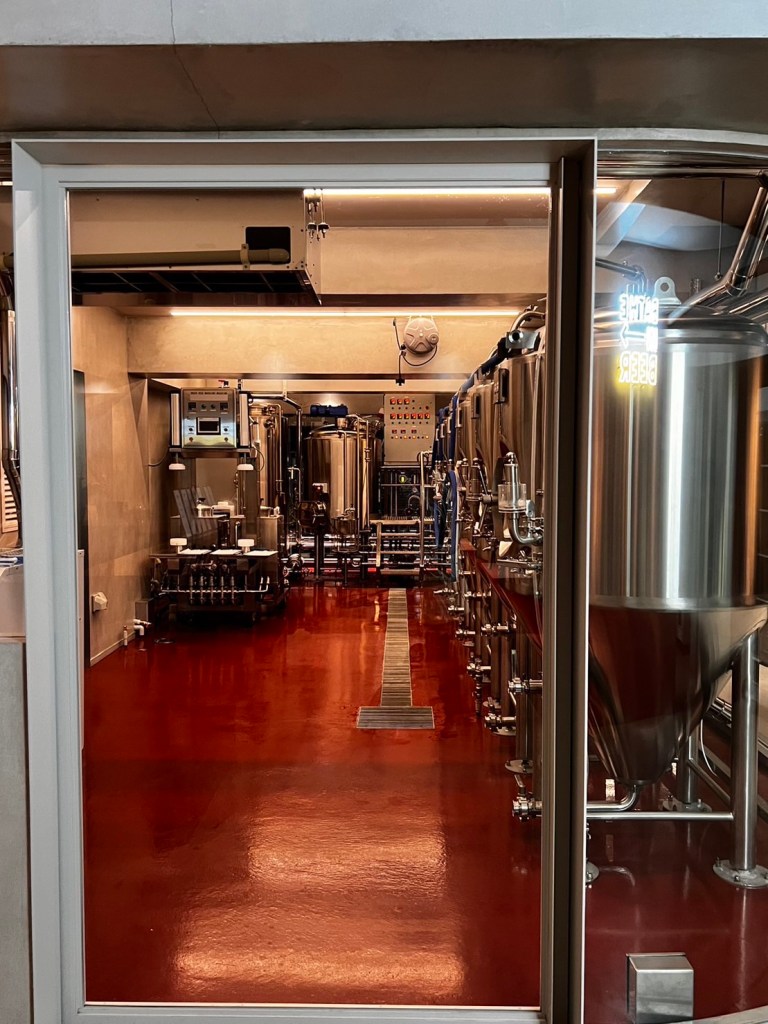
BATHE: Yotsume Brewery

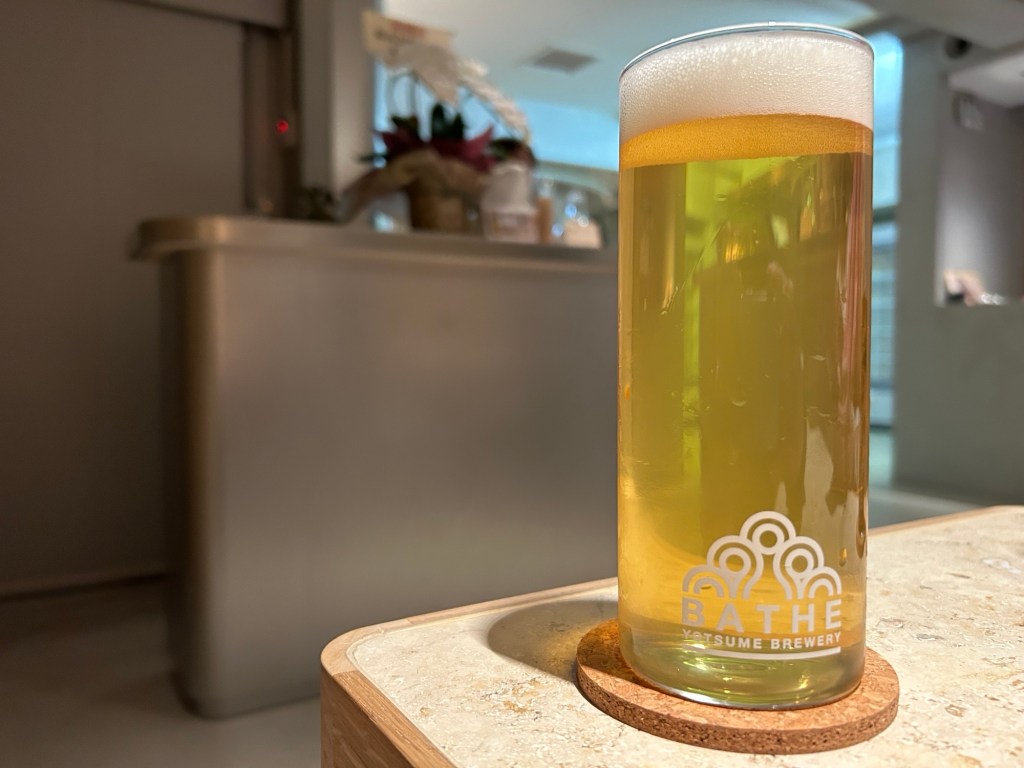
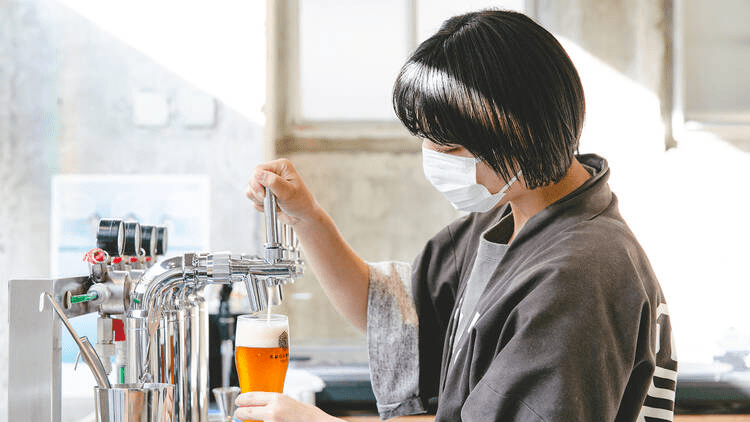
My beer at BATHE (this one is an IPA).

For those who haven’t read my review (click here), “Kogane-yu” is a trailblazing Sauna and Sento in East Tokyo near the Tokyo Skytree. Once a dying bath house, it now has two hour plus long waits to use its’ outdoor cold plunge pool, cutting edge Sauna, and craft beer selections with a DJ carefully curating the vinyl selection in the lobby.

Today, “Kogane-yu “is also affliated with nearby “Daikoku-yu”, another recently revived Sento in Sumida-ku (about a ten minute walk from “Kogane-yu”). With the popularity of both venues taking off, a successful crowdfunding initiative to establish a Sento-themed brewery has led to the creation of BATHE.

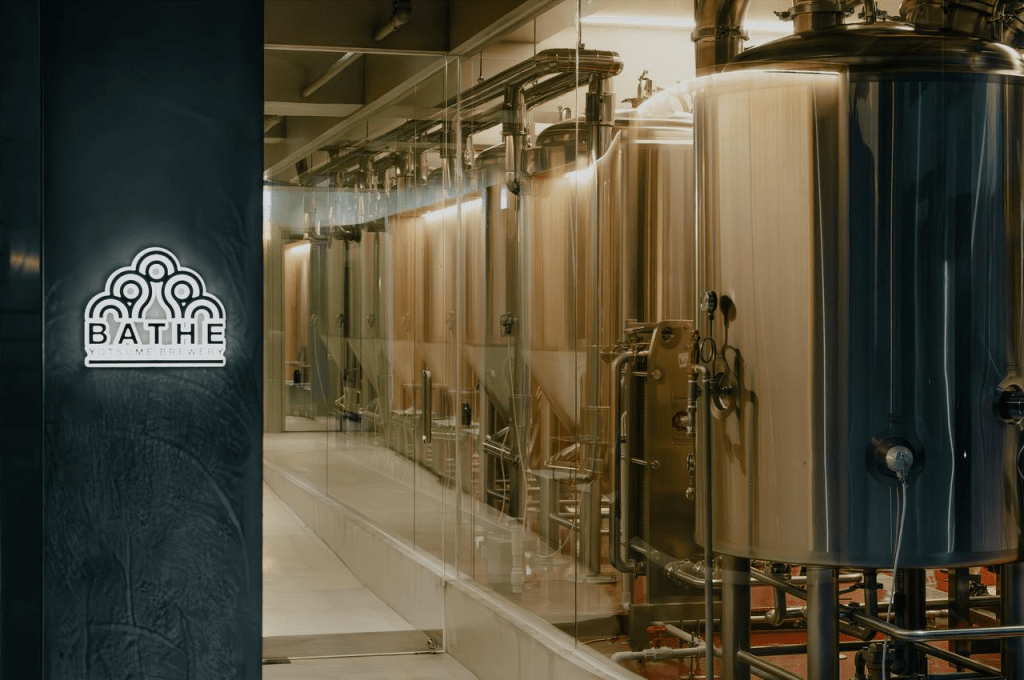
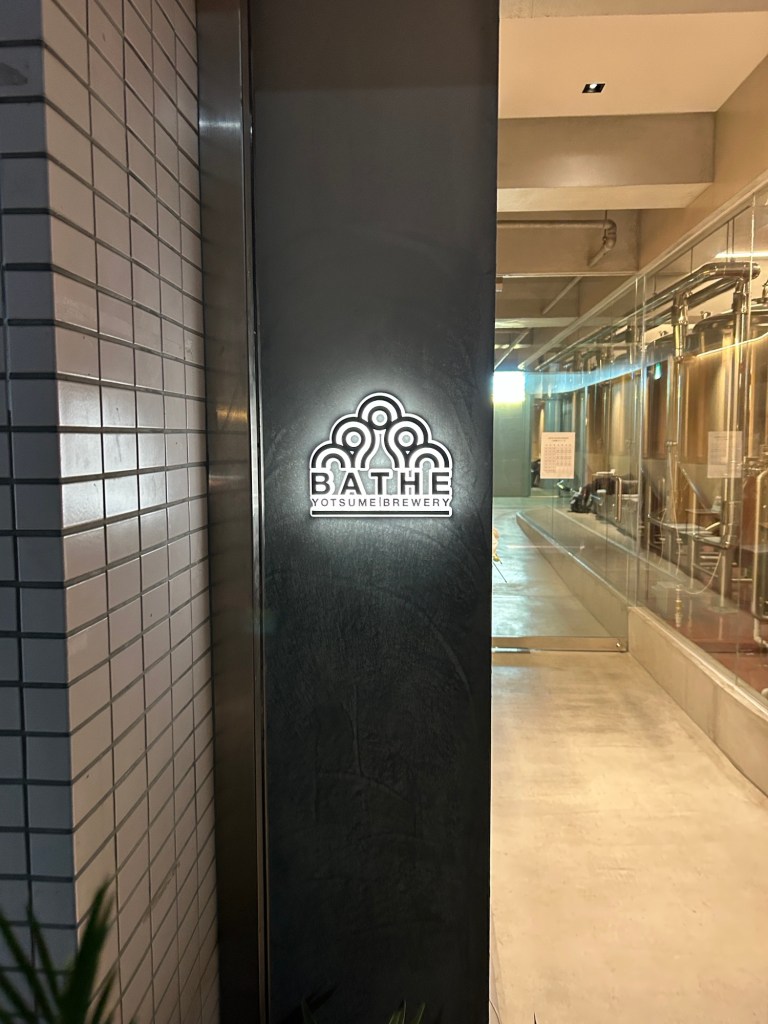
Entrance Sign for BATHE

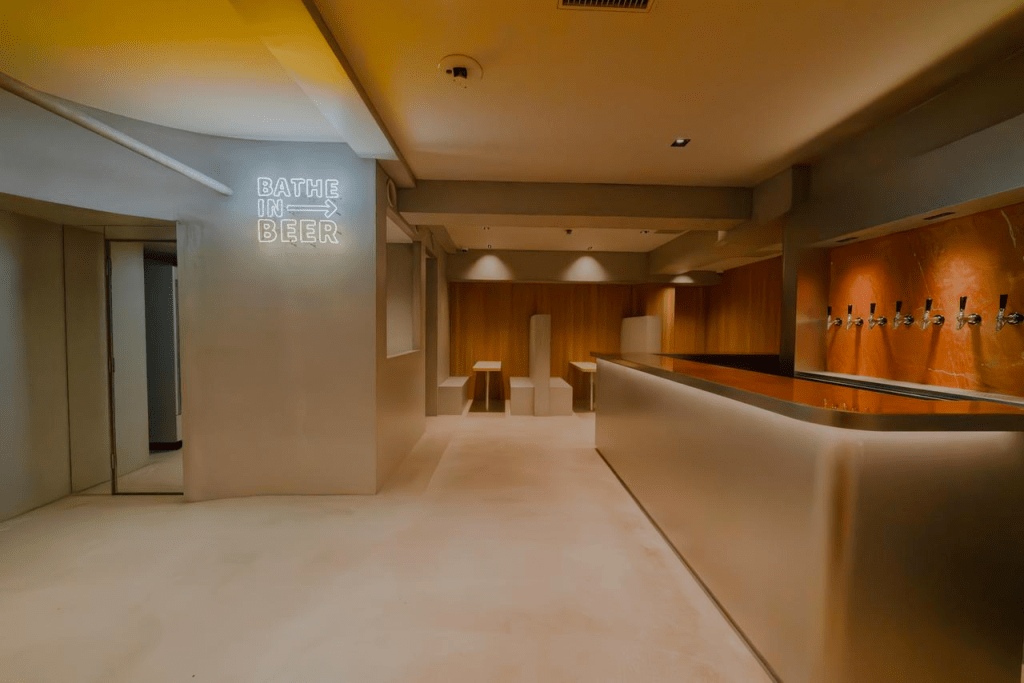
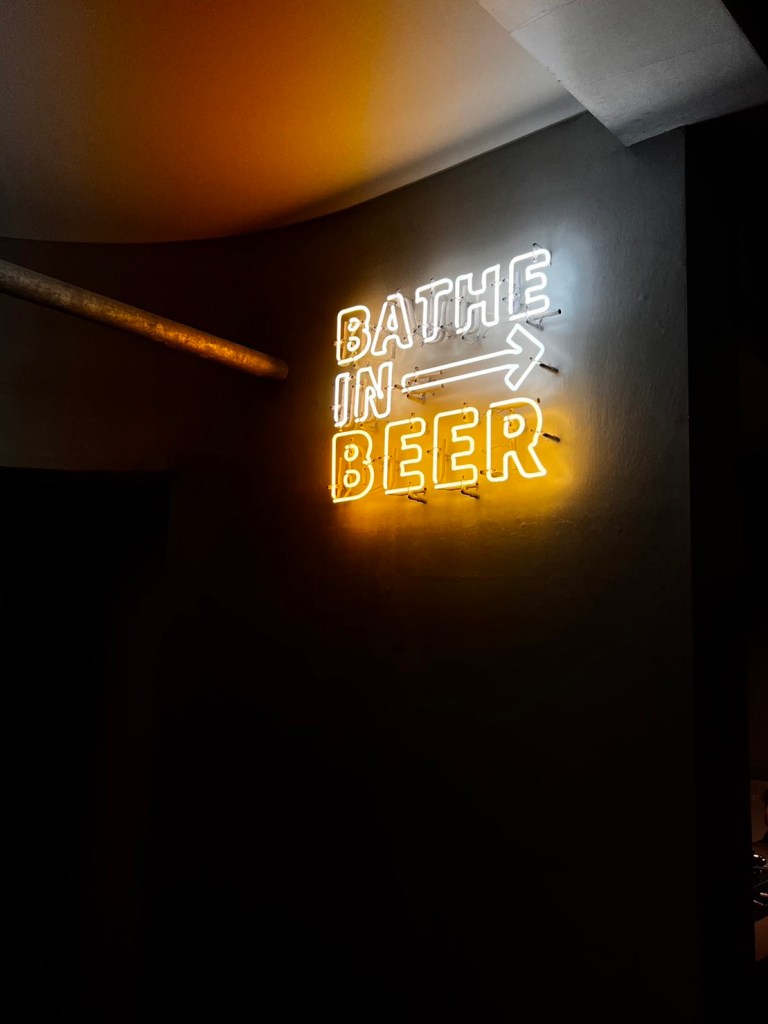
Located about half way between “Kogane-Yu” and the Tokyo Skytree, BATHE is located on an unassuming one way street off of a main road facing Oshiage Station. I was instantly struck by how minimalist the entrance was, using a similar concrete motif as “Kogane-Yu” that wouldn’t feel out of place in Brooklyn, New York. Leading up to the bar, one can see a neon “BATHE IN BEER” sign, as well as the actual brewing portion of BATHE.

Upon entering, I went ahead and asked the bartender what they suggested and ordered their recommendation. After grabbing my drink, I took a look around and soaked in the atmosphere (pun intended).

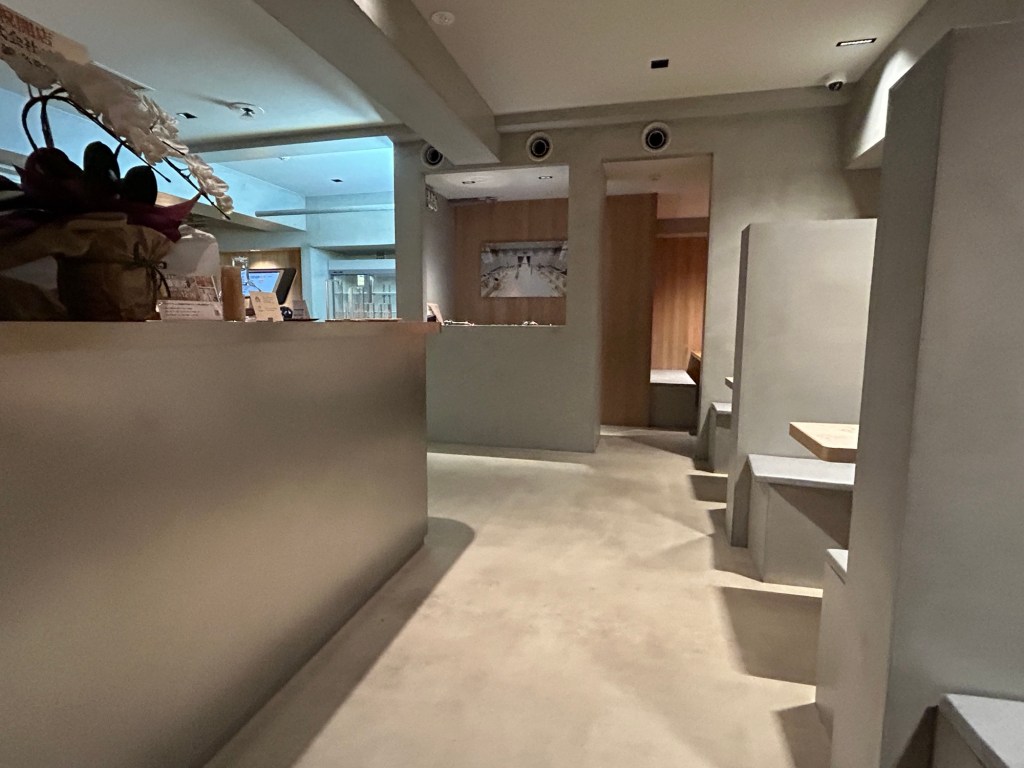
View from my seat

I was immediately struck with how new the space felt. BATHE has only been open for a month, so combined with how clean everything was, I felt like I was still at a soft launch for the venue. The main sights to see included the DJ booth (much like the one at “Kogane-yu”), the brewing area, and the bar itself.

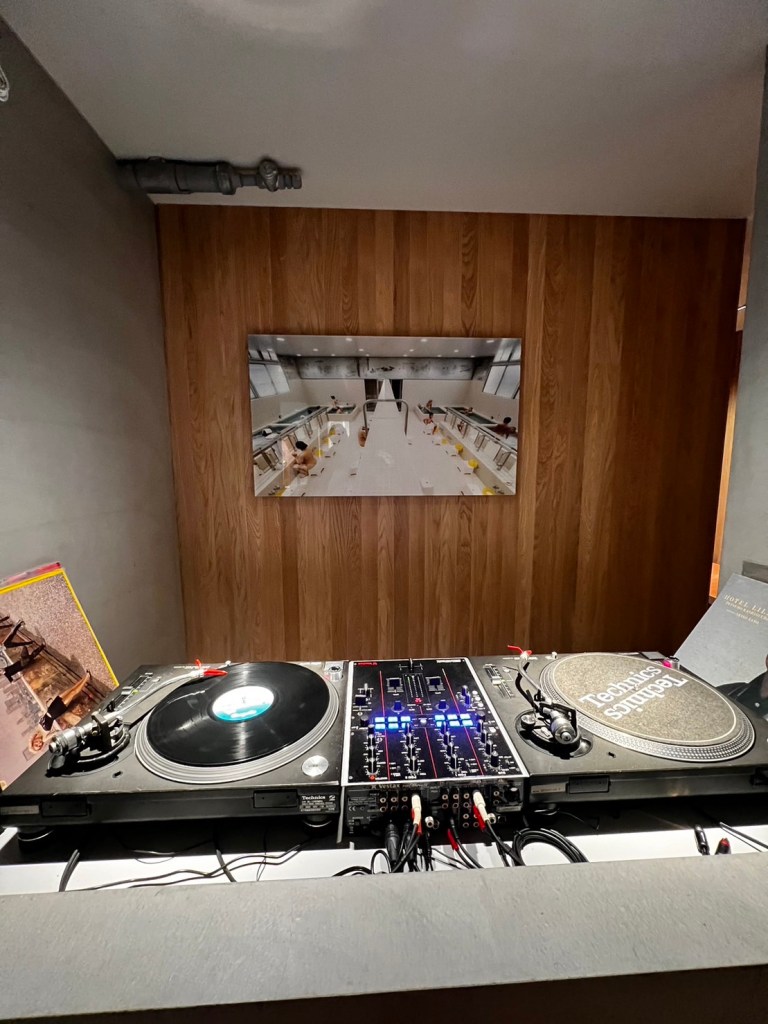
The DJ booth had records playing throughout my visit. During my time there, a mixture of a Blondie album and a Japanese artist that I hadn’t heard of played. Above the DJ booth, you can spot a picture of “Kogane-yu”. I have to admit, it felt a little bizarre to be in a nearly empty space and just see a DJ booth with a picture of a public bath above it. Nonetheless, I appreciated it.

You can also spot a few other pictures of the bath around the brewery in some of the seating areas. It almost felt like visiting a character’s house in a video game, while the character isn’t at home. A bit like someone is missing, but after a minute, you shrug it off and enjoy the moment.

Pictured: Pools from Kogane-yu

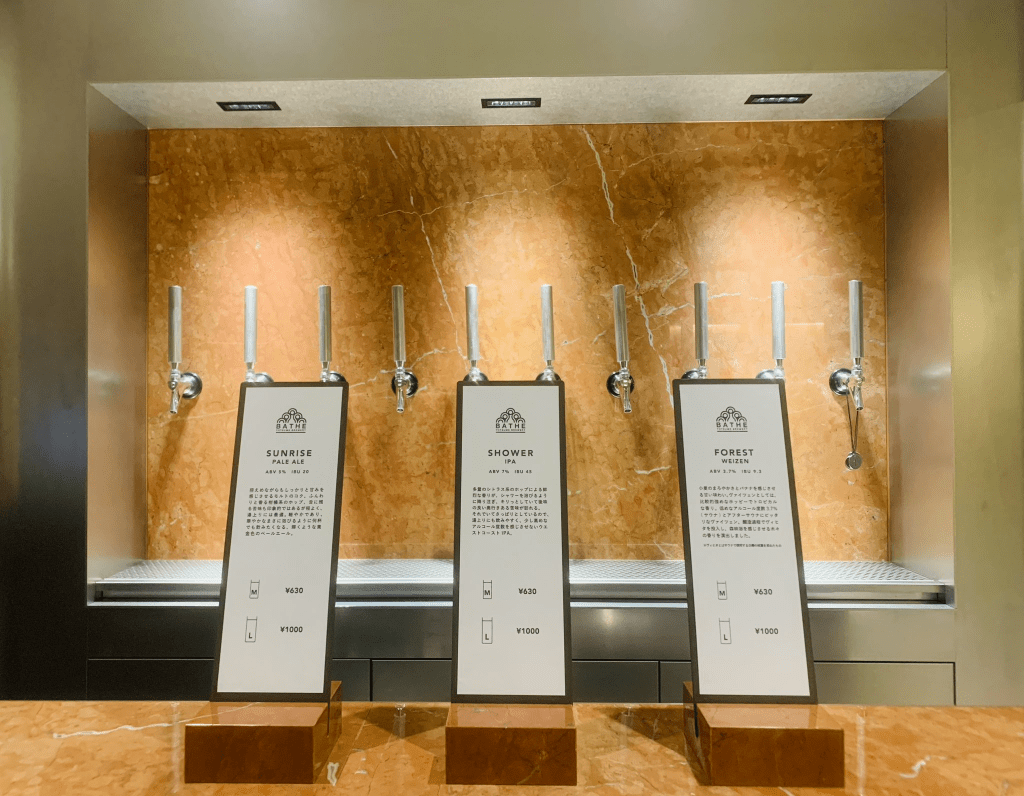
Minus the seating areas and DJ booth, the bar takes up the most space in the facility. Sleek and minimal with a nice marble finish and a visible menu on display, I found the bar to be approachable and conveniently located. During my visit, I tried the Forest Weizen and the Shower IPA. The first drink (disclaimer, I like an occassional beer, but I’m certainly not a big drinker or beer connoisseur by any means) was well made, but not within my usual palette for a beer. I enjoyed my second drink, the Shower IPA a bit more. It tasted like a standard, American West Coast IPA (closer to what I have on the occasions when I do drink).

From my understanding, the beers on tap at BATHE are also the ones available at Kogane-yu, minus a few additions. The beer “was developed as the craft beer most suitable for after a bath”, which I thought was a really cool concept. While I did sento earlier on the day of my visit, it was several hours afterwards, and not at nearby “Kogane-yu”. I will have to revisit in the near future with this in mind.

A few of BATHE’s tasting options

After finishing my second beer, I thanked the bartender and let them know I was excited about the brewery’s opening, and left.

Final Thoughts?

Overall, I enjoyed BATHE. The staff was friendly, the beer was decent, and I sincerely appreciated the concept behind BATHE. It did feel a bit empty, but considering that the venue received extensive crowdfunding online, I don’t think this will be the case for long. If I have any critiques, it’s just that it might take a few weeks or months for BATHE to fully settle into its vibe. It has a lot of potential, and I think they are going in the right direction.
If you are by the Tokyo Skytree, or visiting a Sento in Sumida-ku/Kinshicho area (Kogane-yu, Daikoku-yu, Mikoku-yu, etc.), I would recommend visiting for anyone who is curious! I had a lot of fun visiting, and hope that BATHE sticks around!

Sauna Ikitai- Japan’s Premier Sauna Database

Overtime, finding new Sento and/or sauna to visit can become a challenge. Once you get past a few “Top Three Sento for your visit to Tokyo!!!” articles, navigating further options can be daunting, especially if you can’t read Japanese.

That’s where Sauna Ikitai (litreally translating to “Let’s Go to the Sauna!”) comes in. Perhaps one of the more ingenious creations to come out of Japan’s ongoing Sauna boom, Sauna Ikitai serves as a sauna database logging almost every sauna facility in Japan. Let’s take a look at what that entails, and how to use Sauna Ikitai.

*Author’s Note: This article uses Google Translate extensively. For the purposes of this post and providing images of the web pages that were not originally in English, I decided that using Google’s Translate feature to generate English language versions of the pages would be the best fit for the article. All features of Sauna Ikitai are designed for use in Japanese. Please keep that in mind when you see any translations that may look a bit strange.

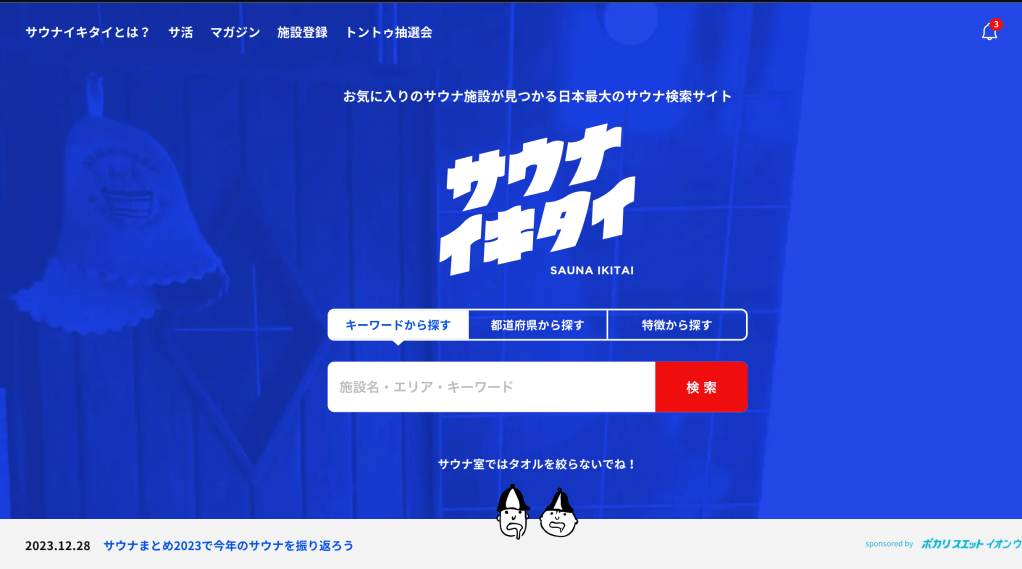
Sauna Ikitai Home Page

The Primary Functions of Sauna Ikitai are (as listed on its website):

  1. Easy to access Sauna database
    • The most common use, and the feature I take the most advantage of. Sauna Ikitai logs over 5,000 sauna (and counting) across Japan, and is the resource for finding information on nearly any given sauna in Japan.
    • Information provided includes (but not limited to):
      • Sauna and cold bath temperatures
      • Sauna auto-heating mechanism time intervals (known as “auto loyly”)(ex. automatically heats every ten minutes)
      • Payment methods (cash, card, electronic money, etc.)
      • Rental availability (towels, sauna mats, etc.)
      • Hours and days open
      • Parking availability
      • Cost
  2. Sauna Ikitai Magazine.
  3. Serving as a community space for sauna enthusiasts (known in Japan as Saunners). Concretely, this is done in two ways: community message boards on the site, as well as Sauna Ikitai’s presence at in-person events.
    • Online: You can create an account that allows you to log which sauna facilities you have visited, as well as leave written reviews for facilities. It even has a system similar to Reddit Gold, in which the Finish sauna deity “Tontou” gives you “gold” in exchange for your good deeds (leaving reviews, engaging with the community, etc).
    • Offline: Sauna Ikitai supports in person events. Sauna Ikitai members even get perks at certain saunas, such as a free Pocari Sweat (for those unfamiliar, Pocari Sweat is Japan’s equivalent of Gatorade) or small piece of merchandise. Not too shabby!

What can I use it for?

Looking at Sauna Ikitai’s homepage can be a little intimidating, especially if you can’t read Japanese. I’ll break down its core functions that I use, so you can get some ideas on how it might best suit your needs. A lot of the Google Translations are fairly egregious, (Sauna Ikitai regularly gets translated as Sauna Nike Thailand), so I have gone through with my limited kanji knowledge and sorted through each page.

As a Sauna Database

This is the feature that I use Sauna Ikitai the most for. Here’s how I like to utilize it to find the top rated Sauna in my area

  1. Starting at the Sauna Ikitai Home Page, select the middle button above the search bar (please refer to the picture of the Sauna Ikitai Home Page above).
  2. Using Google Translate, select which area/prefecture you would like to visit (for this example, I will use Tokyo Prefecture).
    • Author’s note: If you are searching in a larger metropolitan area (Greater Tokyo, Kansai Region, etc.), keep in mind that you may need to select multiple Prefectures to best optimize your results. For instance, Yokohama, Japan’s second largest city and host of a Saunachelin winner, is not included in the Tokyo listing, despite it being 30 minutes away from Downtown Tokyo by train.
  3. A list of Sauna’s in your selected prefecture(s) will pop up on your screen. The default sorting will be by the most popular, but you can sort by other categories, including by highest or lowest sauna/cold plunge temperatures, highest rated by each gender, and more.
    • Please note that Sauna Ikitai only includes facilities that have saunas. Many otherwise great facilities that only have baths are not included on Sauna Ikitai.
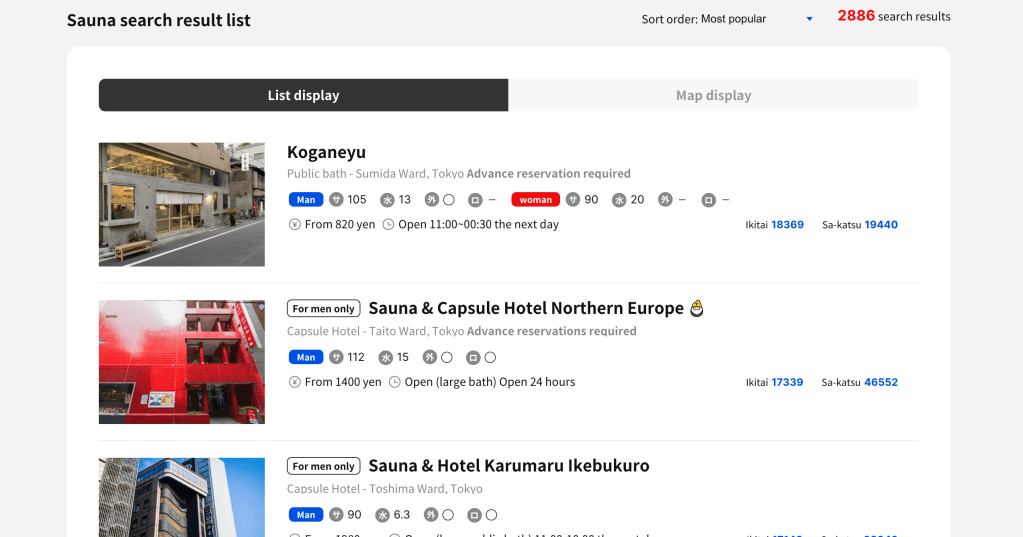
Your end result should look something like the above picture. Mine is translated into English for the purposes of this article, but the page looks a bit cleaner in its native Japanese.

As a Community

Sauna Ikitai has several components that allow you to interact with other sauna lovers (saunners) around Japan.

  • Logging Saunas and leaving reviews
    • If you look at the above picture of the “Sauna Search Result List”, there are two words with numbers following the Sauna listings on the right hand side of the page: “Ikitai” and “Sa-Katsu”
      • “Ikitai” loosely translates here to ” Let’s Go”. Here, this is used to demonstrate that you have went to the listed sauna.
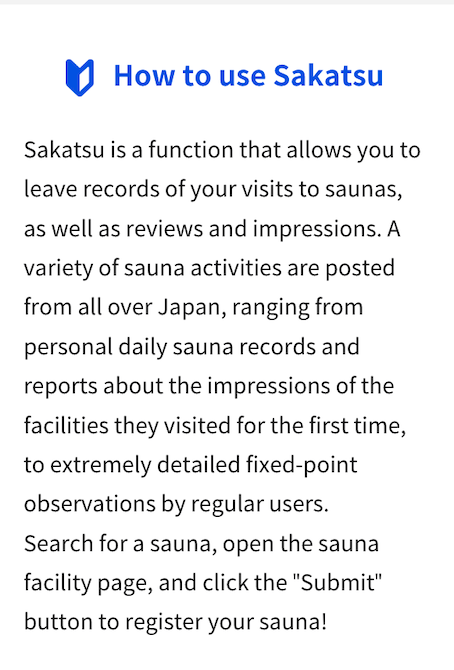
      • “Sa-katsu” here is a bit tricky to translate, but I believe it means “Sauna Life”, with “サ” standing for the “sa” in “Sauna” in Katakana (one of the two Japanese phoenetic alphabets, most commonly used for foreign loanwords), and “Katsu” coming for the Kanji “活”, for “Life. This is the review section of Sauna Ikitai, where users can share their experiences at the sauna. While all in Japanese, I really enjoy reading from time to time to gain insight into how the sauna community interacts with the venues they visit.
Translation of How to Use Sakatsu from Sauna Ikitai (Translated using Google)
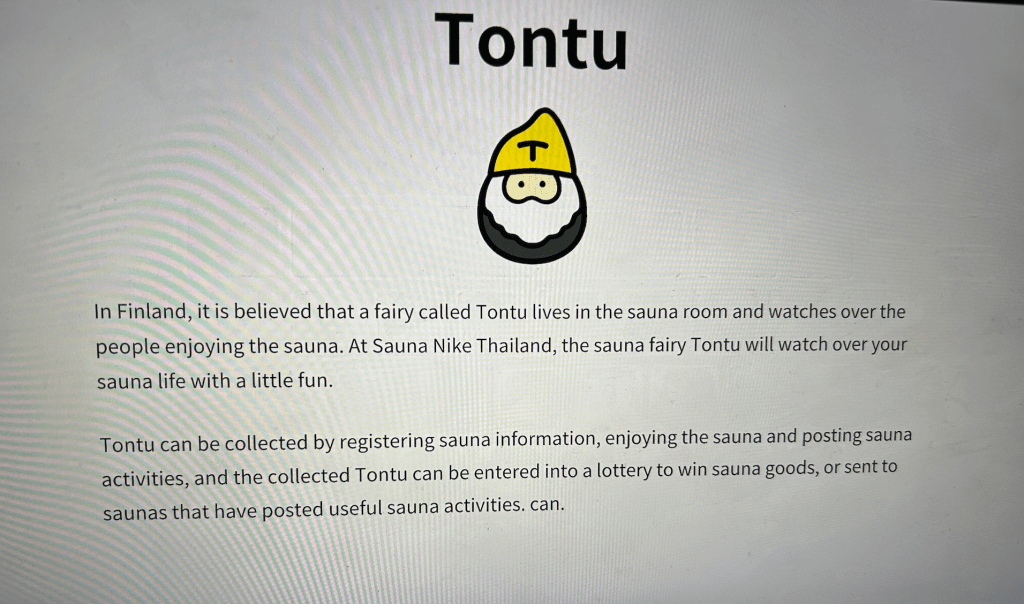
  • Tontou!
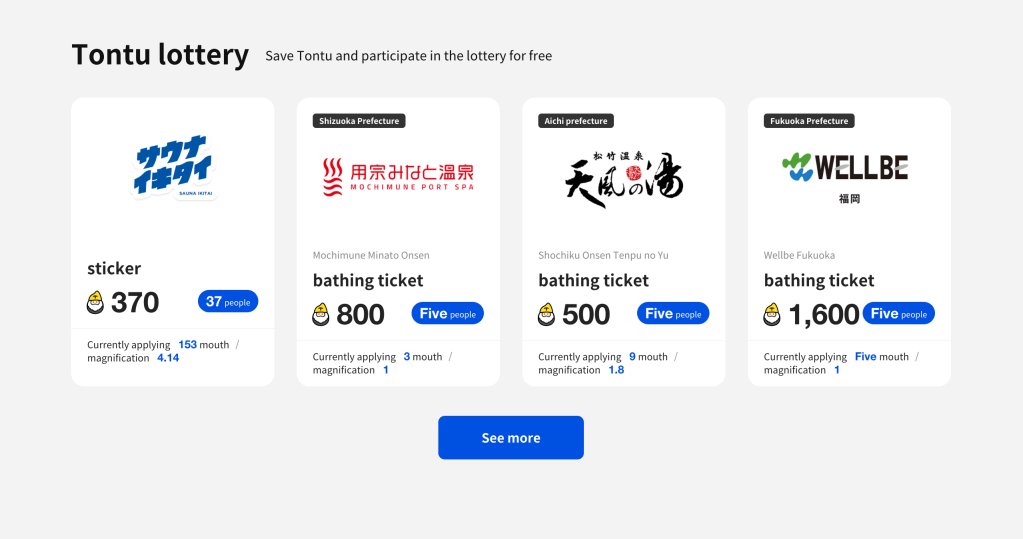
    • Similar to Reddit’s “Gold” feature where users gain points for doing good deeds, Tontou does the same for Sauna Ikitai users with the help of Tontu! Accruing Tontu allows you to enter lotteries to win various goods from Sauna Ikitai.
    • You may be asking “who is Tontou?”. Tontu is a sauna Elf with its origins in Finnish folklore that looks after sauna goers, and rewards those who uphold sauna etiquette, and punishes those who are disrespectful of the sauna. I promise, I’m not making this up. You can find more info on the Finnish Wikipedia page here .
I found my Google translation to be particularly entertaining….

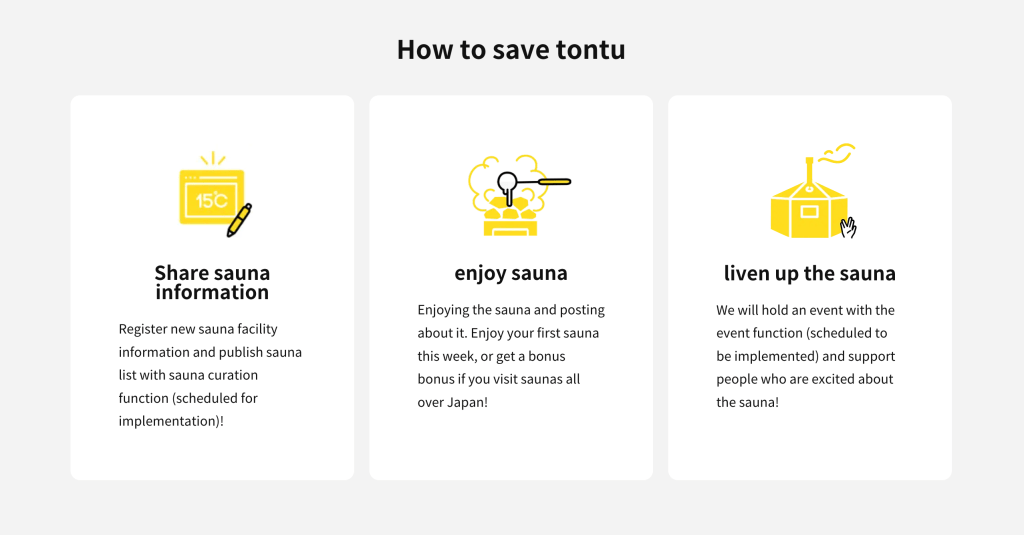
In the spirit of Tontu, Sauna Ikitai users earn Tontu by adding value for other users on the platform. This can be done by adding information to the page of a given sauna that has missing information (or better yet, adding a facility that isn’t yet on Sauna Ikitai), sharing about your experience, or attending in-person Sauna Ikitai events.

Earning Tontu!

Using in Sauna Ikitai in Person (!)

If you don’t speak Japanese, this probably won’t be super applicable, but I thought it would be interesting to share that it exits! Sauna Ikitai members often get certain benefits at venues partnered at Sauna Ikitai. While normally small, these can include:

  • A free towel rental
  • Free Sauna Hat rental
  • Free Pocari Sweat (for those unfamiliar, think Japanese Gatorade) or drink

Not anything major, but a lot of nice little boosts!

Additionally, using Tontu can earn you free merchandise, and even Sauna visits! Accrued Tontu can be spent in Sauna Ikitai’s Tontu Lottery. The lottery options often include merchandise (sauna hats, stickers, sauna mats, etc.), free entry, and complimentary food/drink vouchers.

Some of the Tontu Lottery options for January 2024.

User Guide- Using your Sauna Ikitai Account

If you either live in Japan, or are particularly interested in the sauna community in Japan, you can create an account on Sauna Ikitai! For privacy purposes, I won’t be sharing my profile, but I will show you what I have found having an account as useful for:

  • Logging visited Sauna
    • I visit enough sauna that it becomes hard to keep track at a certain point, especially if I visit several in the same area that use the same kanji. That’s where Sauna Ikitai comes in. I can check back on which sauna I’ve visited based on the pictures provided, which really comes in handy for when I want to revisit a sauna that I can’t remember the name of.
  • Tontu
    • Having an account allows you to accrue Tontu, which you can use to enter the Tontu lottery. I have started to build up a bit, and am very excited to potentially earn some rewards!
  • Updating Profile Information
    • There are several fun pieces of information you can put on your Sauna Ikitai Profile, including
      • Your Home Sauna
      • Your ideal sauna
      • The date of your first sauna or “Sauna Debut”
      • Self Introduction
    • While small, I feel like these help me feel like I belong on the site a little bit more, and it adds あpersonal touch to the experience.

Concluding Thoughts

I regularly use Sauna Ikitai to search for what sauna I am going to visit next. I wish more countries had somethign similar, and I have a lot of fun using Sauna Ikitai for my various Sauna needs. I hope that this guide is helpful in getting you started on your sauna hunting needs in Japan. Thank you for reading, and I hope you can find some totonou (sauna enlightenment) in your week!

Remember, act like Tontu is watching you…

Bunka Yokusen

Classy, cozy, sublime

Tattoos okay? Yes
Sauna? Yes
Price? $
Should I Bring Toiletries? Yes. Shampoo and soap not on site, but are available for rent. Same with towels. Bring your sauna hat!
Best for? Those looking for a refined venue with excellent facilities, while experiencing a slice of the more quiet side of Tokyo.

Nearest Station? Ikejiri-ohashi Station (Den-en-toshi Line)  

Located in the posh residential Meguro Ward, Bunka Yokusen provides a classy experience, while cultivating a neighborhood feeling that prevents it from feeling too pretentious.

Aesthetics:

A work of the legendary sento architect Kentaro Imai, the aesthetics of Bunka Yokusen match the quality I have come to expect from his works. His signature spaciousness, meditation bath, and sleekness are all present here and do not disappoint.

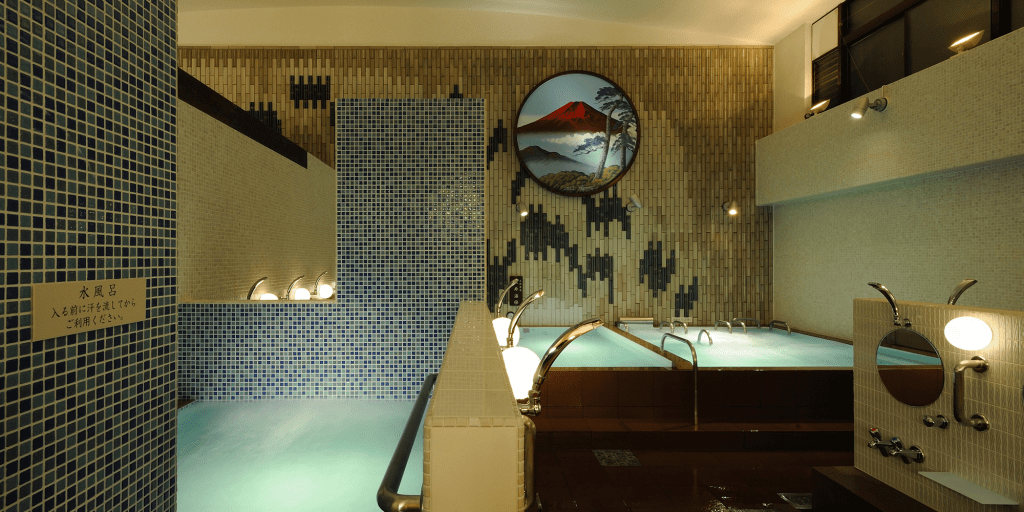
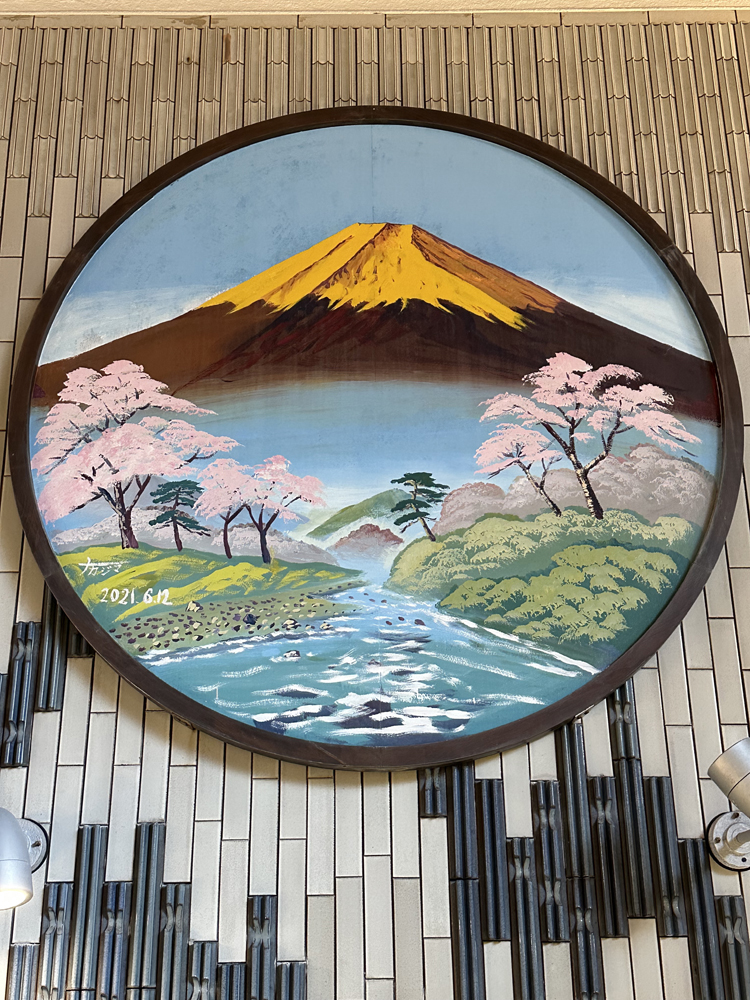
A note on Imai’s architectural page for the venue that stood out discussed the artwork of the facility. While wall length paintings of Mount Fuji are a staple at sento throughout Tokyo, they are notably absent at Bunka Yokusen. Instead, the bath portion adorns two (one on the men’s side, one on the women’s side) circular, 1.8 meter long painted pictures of a mountain on each. While a small detail, the paintings are beautiful, and gives Bunka Yokusen a different flair that sets it apart from other sento.

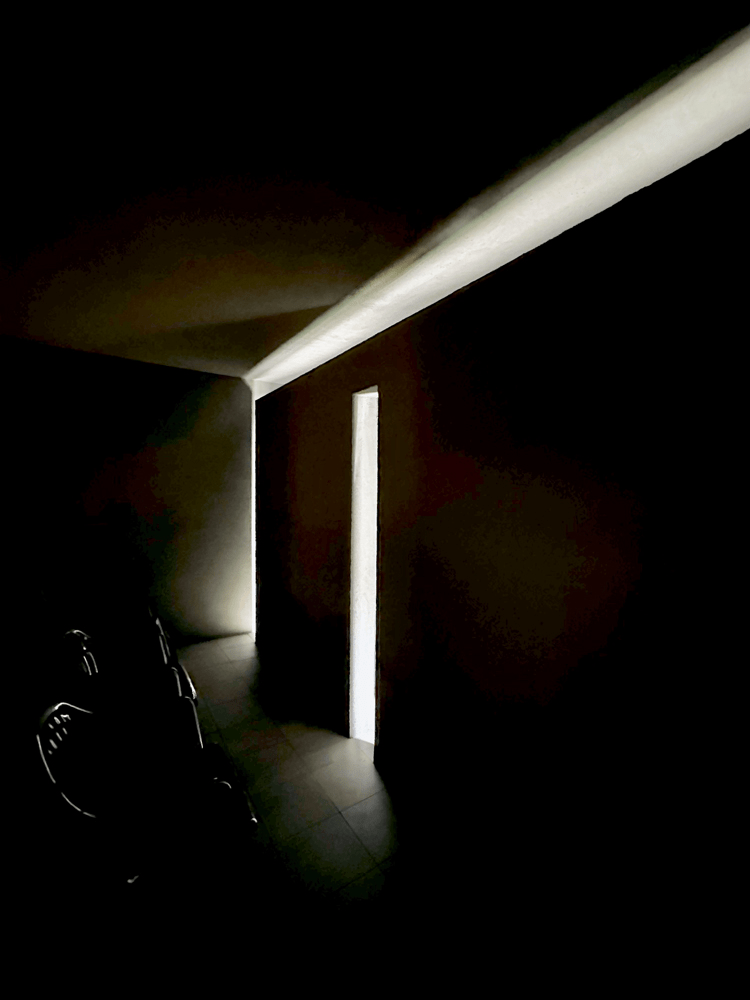
Bunka Yokusen excels at striking the balance between comfortable and cool. A key example of this can be found in the venue’s relaxation room. Nestled in the corner next to the warm baths, often packed with chatty families and patrons, the relaxation room transports you into what seems like another world. Serene, simple, and sleek, the room allows bathers to enter a state of totonou/relaxation undistracted by what feels like a family living room right outside. With essential oils/lit incense in the back and the Monolith from “2001: A Space Odyssey” aesthetic (my personal favorite movie), I found the space to be one of the highlights of my several visits.

I’d be pressed to imagine a better space to zone out post-cold plunge…
I can’t be the only one who sees the 2001 similarities…. (*cue Also sprach Zarathustra*)

A lot of the aesthetic portions of the venue overlap with the culture, so I will chose to write more about relevant aesthetic features in that section. As such, this section is a bit lighter than what I usually strive for.

Culture/vibe:

In Japanese, Bunka Yokusen literally translates to “Cultural Bath”. On Bunka Yokusen’s website, more information is provided on the venue’s mission statement that I found to help explain the naming choice:

“Since its founding in 1932, Bunka Yokusen has been supported by the patronage of everyone, and has reached its present state. In 2011, the bathhouse was completely renovated, and while retaining its old-fashioned public bath features, it was reborn as a modern public bath that pursues healing and comfort”

“The concept behind the renovation is “SLOW,” and we aim to “provide a space where our customers can stay for as long as possible.” As part of this, we play jazz background music not only in the lobby but also in the bathtubs, an initiative that is difficult to find at other public baths.”*

*translated from Japanese using Google

I found “slow” as the perfect word to hone in on how Bunka Yokusen felt so cool and cozy all at once. Classy without trying too hard, the renovation seems to have served the sento well, breathing new life into the facility.

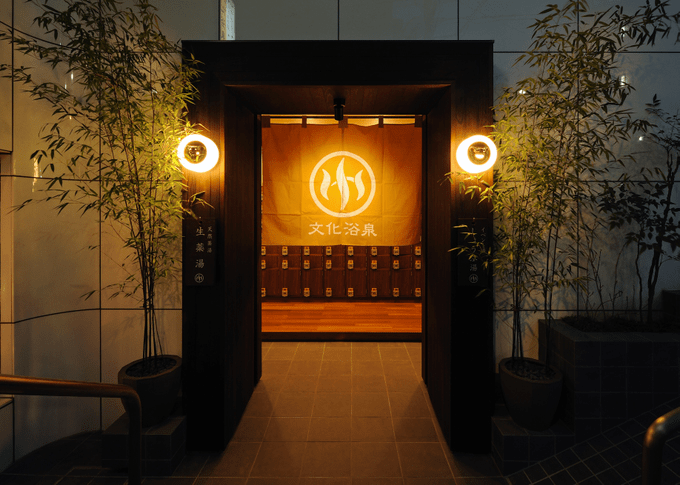
Walking into the venue, you immediately notice the all-wood finish of lobby, adornished with minimal furniture, as well as a merchandise display with t-shirts and sauna hats donning Bunka Yokusen’s logo (also on the entrance flag at the door). The end result is something between your midwestern aunt’s house and a trendy coffee shop with wicker furniture (hard to pull off, but trust me, Bunka Yokusen pulls it off).

Imai’s architectural page, strangely enough, gives some insight into this:

“For budget considerations, this project was premised on existing parts being reused as much as possible. So, the main issue was coordination of existing parts and new parts, those were integrated in an interesting mismatch sense”.

Further expanding on this, Imai explains that:

“Of course, less waste is preferred from an ecological angle, and used materials have a nice charm from aging that new materials do not have”.

This consicely put into words what gives Bunka Yokusen an older feel, while simultaneously feeling modern and incredibly well refined.

Facilities:

Inside the bathing area, the retro charm slowly transitions into serene, masterfully crafted bath and sauna facilities.

The bathing area features two prominent warm baths, as well as a cold plunge pool. The larger bath is a relatively standard heated sento bath. Clean, well kept, and relaxing. The smaller bath adjacent to it requires a bit more explaining. The cloudier looking, lighter bath utilizes “nanobubles”. On the Bunka Yokusen website, they are explained as such:
“Our bubble bath contains many nano bubble particles. Nanobubble particles have been proven to have a variety of effects, including ultrasonic waves, weight loss, thermal effects, and even the possibility of inhibiting the formation of arteriosclerotic lesions..”*

*Translated from Japanese using Google and Deep L

While I don’t entirely understand all of the description and imagine some of the meaning is lost in translation (from what I could read in Japanese, it did talk about diet effects and I believe anti-aging), the bath felt fantastic on my skin, and certainly added to my experience.

The sauna, featuring an auto loyly* that lights up an otherwise dimly lit room, is top notch. Living up to its name (Bunka Yokusen meaning Cultural Sauna), the sauna has selected jazz music playing at an audible, but not distracting volume. In combination with the dim lighting and small window with a view of the baths, entering the sauna feels like stepping into another world; more relaxed and a bit cooler than the one before it.

*Loyly: water pouring on the sauna rocks to increase the heat and humidity of the room

Directly across the room from the sauna lies a cold plunge pool (not pictured) in the opposite corner. Jets move the cold water around to make for a chilly, moderately deep (probably around three to four feet) cold plunge experience. The temperature is cold, and contrasts well with the high heat suana temperature.

Limitations/shortcomings:

If you want to use the sauna, be prepared to wait! On my two weekend trips, I have had to wait around 45 minutes to use the sauna. Both waits were well worth it, but if you want to avoid the lines, I would recommend arriving right as they open, or visiting on a weekday.

While I wouldn’t consider this a shortcoming, the cold plunge pool felt like it may have used chlorine. While this is is standard in some countries, I haven’t been able to smell any noticable chlorine in any of the baths in Japan. May have been something else, but it did stand out on one of my visits (I may amend this after future visits if I feel this is unwarranted).

Verdict:

Hip, cozy, and amenities to match, Bunka Yokusen is a must visit in Tokyo. The venue’s melding of hip and comfortable gives Bunka Yokusen an unmatched vibe. If you’re looking for a sento experience that is cool, while also a relaxing change of pace that a standard trip to Tokyo may not include, give Bunka Yokusen a visit.

Authors note/bonus tip: I won’t factor this into the review, but if you visit Bunka Yokusen, I would highly recommend visiting the pizza restaurant next door, Parantesi. Just five steps away, you have access to Michelin Star Pizza for an incredibly reasonable price (for a full pizza, appetizer, and cappuccino, I paid 3800 yen, or about $25). For a Michelin Star meal, I would consider this a bargain! A little known fact about Japan, some of the best pizza in the world is in Tokyo. Several Michelin star pizza restaurants are located in Tokyo, and are a great way to enjoy high quality food on a budget.

Saunachelin (yes…. really!)

Most people are familiar with Michelin Stars, the most sought after restaurant accolade in the world. You may not be familiar with, however, Saunachelin stars!

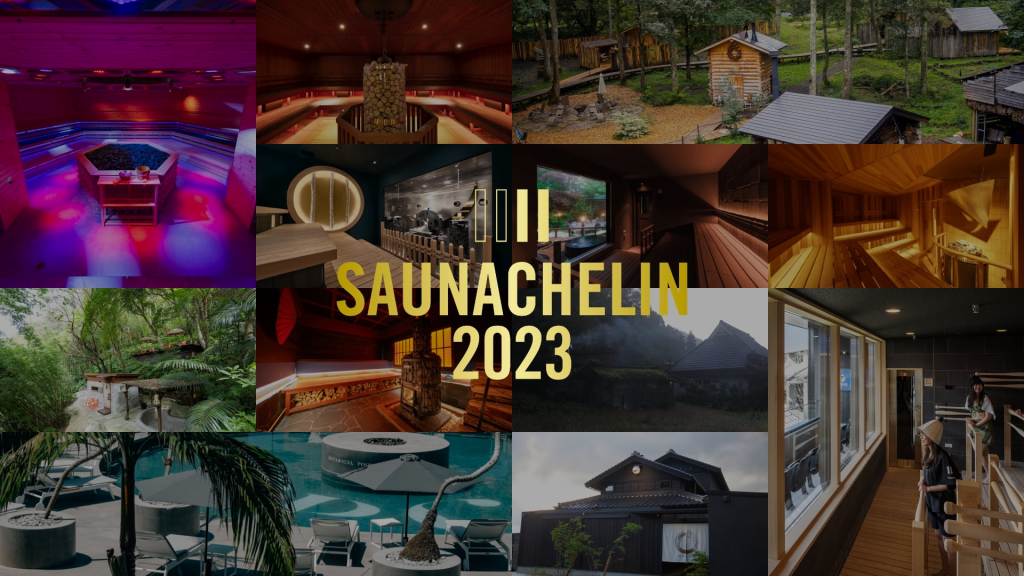
Taking full advantage of Japan’s sauna boom, Saunachelin has ranked the eleven most outstanding saunas across Japan every year since 2018! Let’s take a look at what it takes to earn a Saunachelin star.

Who is Behind Saunachelin?

When stumbling upon Saunechelin, I couldn’t help but think “who came up with such a brilliant idea?”.

The Japanese sauna organization TTNE are the minds behind Saunachelin. The organization’s name is an abbreviation for the Japanese word “totonou” (ととのう), which refers to the state of temporary enlightenment and peace achieved by several rounds of alternating between hot and cold.

In 2017, TTNE was founded Dai Matsuo (松尾 大) and Daisuke Akiyama (秋山 大輔). Founding TTNE as a brand specifically for sauna culture, Matsuo and Akiyama sought out to create a space for sauna enthusiasts (particularly in their 20-30’s) to embrace and spread sauna culture within Japan. Through their collaboration, the two bring their experiences from the corporate world to their endeavors in the sauna sphere. As a part of TTNE, the two have founded not only Saunachelin, but established “The Sauna Society of Japan”, “Sauna FES Japan”, launched a sauna-apparel line, and served as brand ambassadors for Finnish sauna brand “Harvia”. Taking a look at the various projects the two are involved in, their enthusiasm for sauna is palpable, and is clearly a major factor behind TTNE’s success. I found the following quote from the TTNE website to really sell the company’s passion and vision for sauna in Japan:

“Surfers have a brand of surfers,
Skaters have a skater brand.
Sauna brand for sauna …”

Today, TTNE has several offices (two in Tokyo, one in Sapporo), and has eighteen employees listed on their website. I have found that the majority of sauna related events around Tokyo are in some way affiliated with TTNE. If you are ever curious about what is happening in the Japanese sauna world, looking at any of TTNE’s projects will likely put you in the right direction.

Annual Rankings

Each year on November 11th, also known as “Totonou Day”, Saunechelin announces its 11 top saunas in Japan. To make the cut, a venue has to stand out among the 12,000 other sauna across Japan to be considered innovative or noteworthy in the world of sauna.

To see what I mean, let’s take a look at a few of this year’s winner’s for 2023:

  • Sauna Tokyo (サウナ東京)
    • “The largest sauna facility in Kanto [the greater Tokyo area], opened in Asakusa. [It has] five types of saunas and three temperatures of baths”
      • Many of these facilities, such as its steam room with a “cupboard bath” inside, take inspiration from traditional Japanese culture and the Edo period.
    • “The main sauna “Steam Dance’”, which automatically controls lighting, sound, and 6 special speakers and woofers and is compatible with the Aufguss [the process of diffusing essential oil throughout the sauna, often done in a flashy manner with a towel] show, is full of power. It’s amazing that it’s not just flashy, but also comfortable, with the introduction of a ‘CO2 concentration automatic detection ventilation system’ that automatically controls ventilation using AI.”
      • Frankly, I’m not entirely sure what all of the specific jargon refers to here, but I found it demonstrates the kind of specificity that Saunachelin venues have in their spaces.
        • Quoted portions are translated from Japanese using Google
  • Annetai Sauna (亜熱帯サウナ)
    • “A sauna in the jungle, owner Tetsuji Sakamoto was moved by a garden spa that utilized an entire mountain that he came across in Thailand, and based on that experience, created Annetai Sauna. Enjoy an outdoor bath surrounded by subtropical nature.”
      • Translated from Japanese using Google
  • Wellbe Sakae (ウェルビー栄)
    • “We recreate the environment of Finland, the home of saunas, with a `Forest Sauna’ that resembles a sauna hut in the forest, and an `Ice Sauna’ where you can experience the cool outside air (minus 25 degrees Celsius) and a lake.”
      • Translated from Japanese using Google

As seen above, Saunachelin winners consistently outperform by both refining and innovating their sauna experience in ways that push the boundaries of Sauna culture in Japan.

Saunner Of the Year

In addition to ranking the top saunas, Saunachelin also celebrates outstanding contributors to Sauna culture in Japan, commonly referred to as “Saunners”.

For example, some of the 2023 nominees include:

  • Katsuki Tanaka
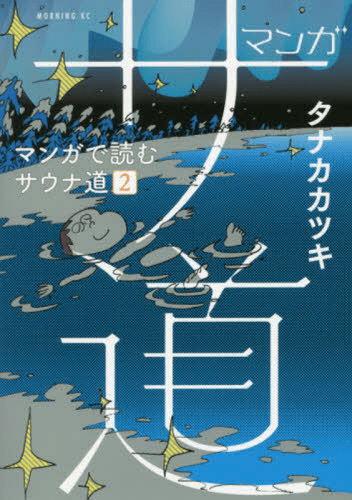
    • Manga author and creator of “Sado” (literally translates to “Way of the Sauna) (サ道).
    • The series (which I am yet to read, unfortunately) follows the main character’s visits to a local gym sauna, where he discovers the joys of sauna and makes lasting friendships through the power of sauna (as you do). Sado is often attributed as one of the driving factors of the sauna boom in Japan (a topic for a later date).
  • Misato Shimizu
    • Japanese actress who is also a huge “saunner” herself. She has frequently worked with popular sauna website “Sauna Ikitai” (literally meaning “Let’s Go to the Sauna), and has been on several radio shows and interviews discussing sauna in Japan.
  • Jin’s Co LTD
    • An eyewear company with a line of glasses specifically designed for use in the sauna. Heat and fog resistant, this product line is a great example of the kinds of unique sauna merchandise that are coming out of Japan right now.

The list goes on, but essentially, candidates are not limited to those working in the sauna industry, and can be awarded to anyone who advances and contributes to sauna culture in Japan.

Closing Thoughts

While Saunachelin seems almost too good to be true, in Japan, it is a highly respected accolade that reflects the nation’s booming sauna culture. I regularly refer to Saunechelin not only find new venues to visit, but also to gain insights into contributors in the Japanese sauna world.

I hope you enjoyed this week’s dive into Japanese sauna culture. Have a great week, and I hope you can find some “totonou” in your week!

Kogane-yu

Innovative, distilled, grounded.

Tattoos okay? Yes
Sauna? Yes
Price? $
Should I Bring Toiletries? Optional. Shampoo and soap on site. Towels for rent. Bring your sauna hat!
Best for? Those looking for a skillful blend of the old and the new, and an accessible look into Tokyo’s booming sento revival/sauna culture.

A success story tucked away between the Tokyo Skytree and Kinshicho Station, Kogane-yu manages to preserve the core of a 100+ year old sento, while adding a few special twists that give Kogane-yu a buzz that is making waves in the Tokyo sento scene

While it may be hard to believe looking at the two-hour long lines to get in, it was not long ago that Kogane-yu was a run-down, old-school bath house on its last legs. After a crowdfunding initiative and COVID-19 related delays, Kogane-yu received a major facelift in 2021. A true success story, Kogane-yu is now one of the trendiest sento in town, complete with a bar serving craft beer and an in-house DJ (no, that was not a typo).

Aesthetics:
Kogane-yu’s design sandwiches the old and the new, with the front and back of the facility carrying the lion’s share of the modern upgrades, and the bathing portion/center part of the sento remaining mostly intact as a traditional sento, minus some refinished wall murals and general upkeep.

Approaching Kogane-yu, patrons are greeted with an open glass window and sliding door, with a view of the shoe lockers, front desk, and the facility’s standing bar/DJ booth. With a staff member manning the record selection and serving up Kogane-yu’s line of craft beer to customers, the venue’s sleek aesthetic is matched by the modern, hipster-esque offerings at the front.

The lobby ceilings extend fairly high as well, revealing some intentionally exposed pipes, giving a vibe reminiscent of a trendy business in modern Brooklyn. While the lobby packs a lot into a modest space, the open air design of the lobby kept the space focused and sleek.

The locker room matches the sleek, light wooden brown aesthetic that adorns the exterior of the facility. The bath/main sento portion of the facility does not break too far from the mold of a standard sento, minus the addition of a sleek, modern art mural by artist Yoriko Hoshi. The aforementioned mural features a brush stroke depiction of Mount Fuji and what appear to be Japanese villagers in the countryside, all plastered on a modern concrete finish on the far side wall. The modern take on a classic sento art trope (Mount Fuji) is a small, but much appreciated touch.

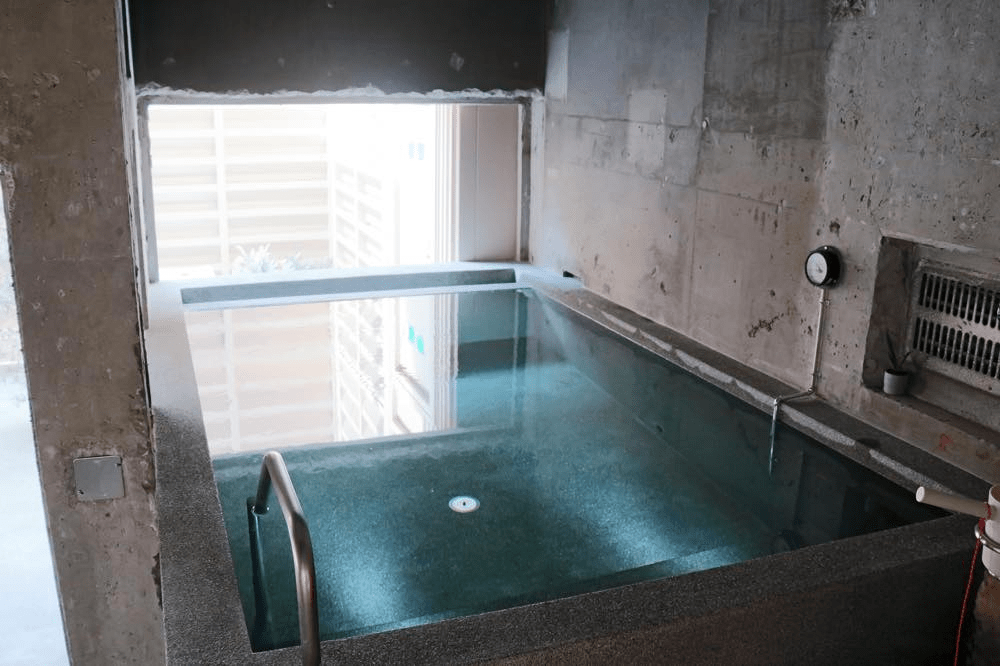
The back portion of Kogane-yu reveals, after journeying through a sleek concrete tunnel, a sauna deck with a lit blue cold plunge pool directly across, complete with a lit atrium lined with plants surrounding the nearby lounge chairs. Exiting the bathing area and entering the sauna portion of the facility feels like finding a hidden area in a Legend of Zelda game, or finding an unexpected $50 in the pair of pants you put on in the morning. Hidden away, elegant, and surprisingly spacious, Kogane-yu’s outdoor atrium gives the facility a sense of completeness that nicely ties the experience together.

Culture/vibe:
Perhaps the most intriguing aspect of Kogane-yu, is the sento’s ability to simultaneously stay trendy, while providing an inclusive experience for all prospective guests. Families with children, older residents of the neighborhood, and inked Japanese sento hipsters have all been present in my several trips to Kogane-yu. Striking the balance of trendsetting without forcibly shunning long-time patrons, Kogane-yu manages to create a unique space that (from what I could garner) keeps its community feeling intact.

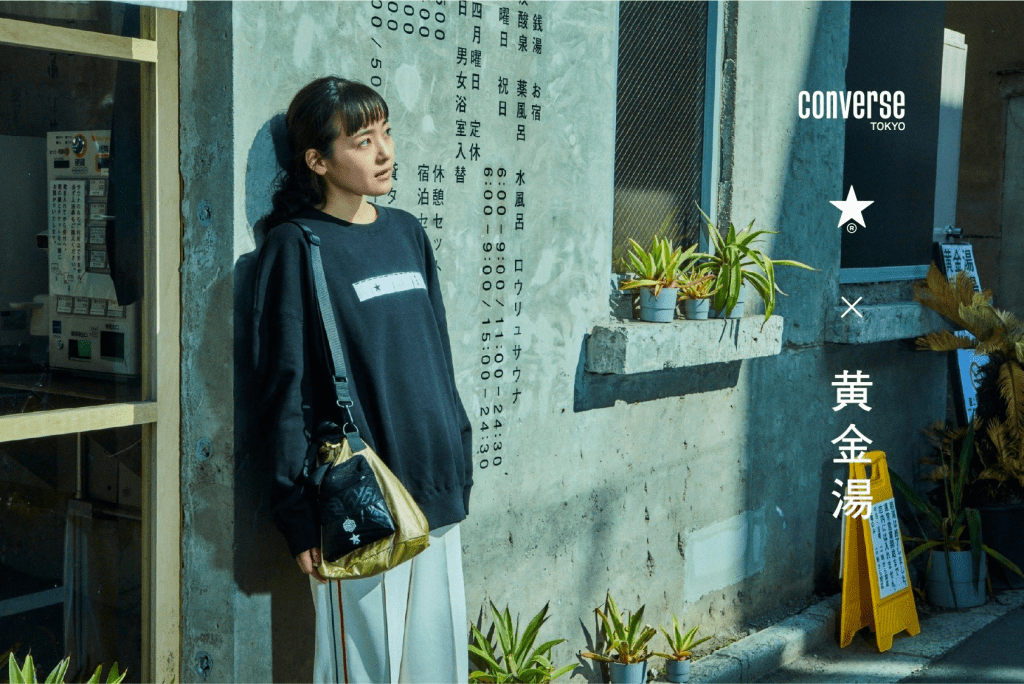
At the heart of Kogane-yu’s ethos is a focus on the facility as a community space. Plastered throughout the space, guests can see numerous collaborations with local businesses on various posters. One featured near the entrance even showcased a Converse Japan x Koganeyu collaboration event!

The space’s community centric ethos is on prominent display throughout the facility, giving the space a certain warmth that (otherwise great) “super sento” complexes can lack, such as Spa Laqua, or Thermae-yu.

Flyers and a calendar for local meetups/events hosted at Kogane-yu are visible throughout the facility. While my limited Japanese admittedly inhibited how much I could garner from the flyers, what I could manage to read showed how much effort Kogane-yu puts into being a community space, rather than just a trendy sento that serves craft beer.

While the space maintains a communal feel, make no mistake; Kogane-yu is hip to its core. When finishing up at the sento, Kogane-yu is best enjoyed by ordering a drink at the bar (alchoholic or not) and soaking in the atmosphere. The bar serves an excellent sparkling Poccari Sweat mocktail that, paired with an always on-point vinyl selection curated by the DJ, allows visitors to end their visit on a high note.

Facilities:

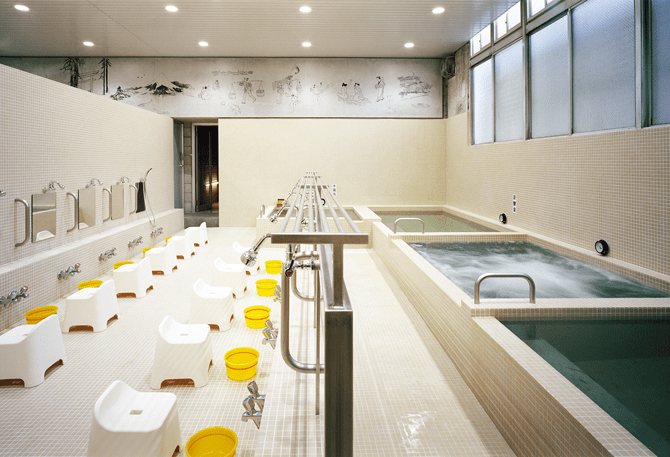
Kogane-yu’s baths are simple, yet effective. True to a traditional sento, the facility features your standard row of sitting showers, two hot pools (one hot, one meant to scorch your skin), a heated lounging pool, and a cold plunge. Nothing too flashy, but everything executes its purpose well. The temperature ratio between the hot and the cold provides an effective contrast that left me satisfied.

The sauna portion in the back is where Kogane-yu’s bathing experience particularly stood out. The sauna itself is quite toasty, and well heated. This no-nonsense sauna is complemented by an outdoor cold plunge right across the walkway. The cold plunge is situated above the nearby lounge, giving the body length pool an almost regal feeling, standing above bathers taking a break in the lounge cove.

The lounge itself has a water fountain and beverage cooler, with five to six chairs for bathers to take a break from the grueling yet invigorating hot/cold cycle. The feeling of the fresh air on my skin combined with the post-sauna/cold plunge high felt nothing short of euphoric. Bringing a cold electrolyte drink (Pocari Sweat and Aquarius are favorites in Japan) adds to this experience even further!

The well laid out hot-cold combination, combined with the outdoor setting that the lounge and cold pool find themselves in sold me on the Kogane-yu hype. I understood the often several hour wait times to use the sauna portion of the facility.

Limitations/shortcomings:
While a good problem to have as a business, Kogane-yu has clearly garnered fans. As a result, availability for the sauna is often several hours. Thankfully, there is an online portal that allows you to check the wait and reserve a spot ahead of time. That said, the long wait times do make me less inclined to pop in on a whim, and my visits tend to involve a bit more preemptive planning.

Additionally, for hosting an excellent lobby and bar, the seating itself is limited at two standing tables and a few stools. In my view, it seemed like a bit of a shame to have such great amenities with relatively little room to enjoy them to their full potential. Especially considering how long wait times can be, expanding the lobby could be a great opportunity to take full advantage of the excellent bar space

Authors Note: The outdoor portion of Kogane-yu is only offered to one gender at a time. Unfortunately for female guests, the outdoor sauna portion is generally only on the men’s side every day but Wednesday. There is an indoor sauna on the other side of the facility, but pales in size compared to its outdoor counterpart. If you are interested in the outdoor sauna area, I would suggest checking Kogane-yu’s website to make sure you are visiting on a day where you will have full access to the facilities.

Verdict:

Trendsetting without losing its footing, Kogane-yu manages to preserve a neighborhood bath house while creating a new vision for Japanese public bathing in the 21st century.

Kairyo-yu

Trendy, sleek, hip.

This trendy sento epitomizes Shibuya’s energy in bathhouse form. Kairyo-yu is an excellent example of how renovation can breathe new life into traditional spaces.


I have been following both the renowned sento architect Kentaro Imai and declining sento attendance trends amongst younger Japanese for quite some time. So when I heard that Kairyo-yu is both designed by Mr. Imai and drawing in primarily younger crowds, I headed toward Shibuya as soon as I could to see Kairyo-yu for myself. Located a 5-10 minute walk from Yoyogi station, I couldn’t resist the allure of a sento right in the heart of Tokyo’s “cool capital”.

Aesthetics:
Kairyoyu is nothing short of breathtaking. While the traditional layout of a 100+ year old bath house remains intact (two to three baths on one side, a line of seated showers on the other side of the room, a wall mural with Mount Fuji, etc.), Kairyoyu radiates the vibrance of Shibya, and its time-tested status as a hub for youth culture.

Right from the get-go, Kairyo-yu stands out from its peers as a hip and modern space. Upon finding the building in an alleyway about half a mile from Ebisu station, you will find a whale mural that adorns an entire wall of the building.

This does not stop just at the building, as several works of modern art are on display throughout. On the architectural description of Kairyo-yu given on Imai’s website, he describes the motif for Kairyoyu as “cultural crossing and cultural exchange”. This is manifested throughout the space, with its’ signature modern flair featured in the lobby and the mural along the sento/bathing area adorning a futuristic, graffiti style Mount Fuji mural.

The sento itself has a cohesive black marble and tile motif, with some mild blue lighting throughout. Between the lighting and the nearly exclusively twenty-something crowd, this gives the bath house a feeling reminiscent of a classy nightclub. Thankfully, all nightlife shenanigans are left at the door.

Perhaps the example that best illustrates the vibe of Kairyo-yu is that whenever the sauna heats up via an automatic heat/humidity detector, a dim red light would slowly light up the furnace. I found that small details, like keeping a consistent dim-light motif throughout the sento, gave Kairyo-yu a cohesive vibe that significantly added to my bathing experience.

Culture/vibe:
Twenty-something urbanites constitute most of Kairyo-yu’s clientele. While this is common in Shibuya, this is not standard for many sento. Throughout Japan, sento are dying (a nuanced topic which I plan to cover at a later date) due to their clientele being primarily elderly Japanese who grew up using sento regularly. I found the presence of a younger crowd to be refreshing.

Upon entry, patrons are greeted with a sign introducing the staff for the night. Using my (limited at best) Kanji knowledge and a translation app, I was able to decipher some of the signs at the front gate. From what I could gather, the staff were introduced as “tonight’s heat wave masters” and had the names of employees working that night. While only a minor detail, I found that touch went a long way for me in setting Kairyo-yu apart from a standard Tokyo sento. At the same time, I found it endearing and impressive that the bathhouse successfully cultivates a hip feel, while maintaining a small “up and coming” vibe absent from many super sento and luxury saunas in Tokyo.

On the standard ticket vending machine (seen at the entrance after placing your shoes in the nearby cubby), various stickers were placed all around the machine. It reminded me of the Shibuya depicted in the early 2000’s cult classic video game (a longshot here) Jet Set Radio. For those unfamiliar (pardon the obscure reference) Jet Set Radio is a videogame from the early 2000’s that depicted Shibuya’s youth culture through the eyes of twenty-something year old graffiti artists.

On my way out, I noticed several co-ed groups of bathers meeting up in the lobby, appearing to chitchat about plans for the night, and the sorts of exuberant conversations you get after a refreshing schvitz. The lobby itself, while small, carried a wholesome aura, akin to hanging out at a regular friend’s house or local hang out in high school. Adorned with cushiony chairs and a vending machine, patrons seemed comfortable to stay and chat after their time in the sento. The lobby also had a well outfitted store, featuring t-shirts, trendy sauna hats, and merchandise for various affiliated Shibuya based clothing companies.

Facilities:
With its reputation as a trendy renovated sento in the heart of Shibya, I was curious (and perhaps skeptical) what the quality of the actual baths would be like. Thankfully, they did not disappoint, and are among the best I have experienced in Japan. The baths themselves are reminiscent of a traditional sento (one warm bath, and one hot bath). The temperatures are toned down a bit, which I frankly appreciated. Some of the old-school sento in Japan keep their hottest bath temperature close to skin melting, so toning down the dial just a hair was a nice touch.

The sauna (which cost a bit extra) kept the humidity somewhat higher than a Finnish sauna, but still at a level where the dry heat was tolerable. I found my time in the sauna to be the peak heat of the facility, which had me running to the cold plunge.

Conveniently, the cold plunge is directly next to the sauna, kept at a cool but not frigid temperature of around 15 degrees (Celsius) that perfectly contrasted with the sauna.

Directly between the sauna and cold plunge, Kairyo-yu features an outdoor atrium with roughly ten chairs to sit and lounge in between sauna sessions. With some dim outdoor lighting, the atrium kept me grounded and allowed me to catch a breather between rounds, without taking me too far out of the experience.

Limitations/shortcomings:
Kairyoyu had few shortcomings. If anything, the music played in the bathing area was inconsistent, ranging from quiet to American Top 40 radio being played loud enough to hear it, but not quite loud enough to feel like more than an afterthought. That said, I don’t think that the inclusion of “Cake by the Ocean” and dated Drake tracks put a significant damper on my experience (plus seeing the mild head bobbing to the music while patrons were in line for the sauna was rather entertaining.

Verdict:

Modern, elegant, and refreshing, Kairyoyu is a must visit. A near perfect example of how to both conserve and honor origins, while still innovating and embracing change and progress.