Sado: The Genesis of the Japanese Sauna Boom

Sado: The Genesis of the Japanese Sauna Boom

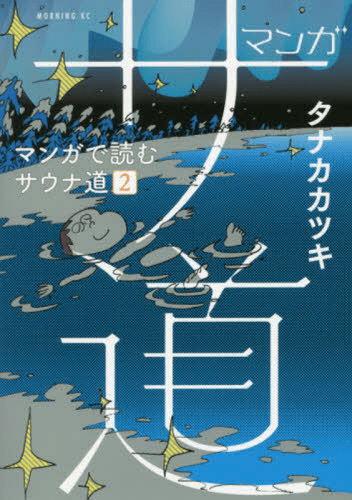
The meteoric rise of sauna in Japan can be attributed to several factors: COVID, a preexisting bath culture, a general interest in health and longevity. But perhaps no single factor was as powerful as “Sado” (サ道), a sauna manga (Japanese style comic) released in 2016. By 2019, Sado received an adaptation as a television drama, catapulting saunas into superstar status in Japan. 

Sado: A Chronology: 

Origins (2011):

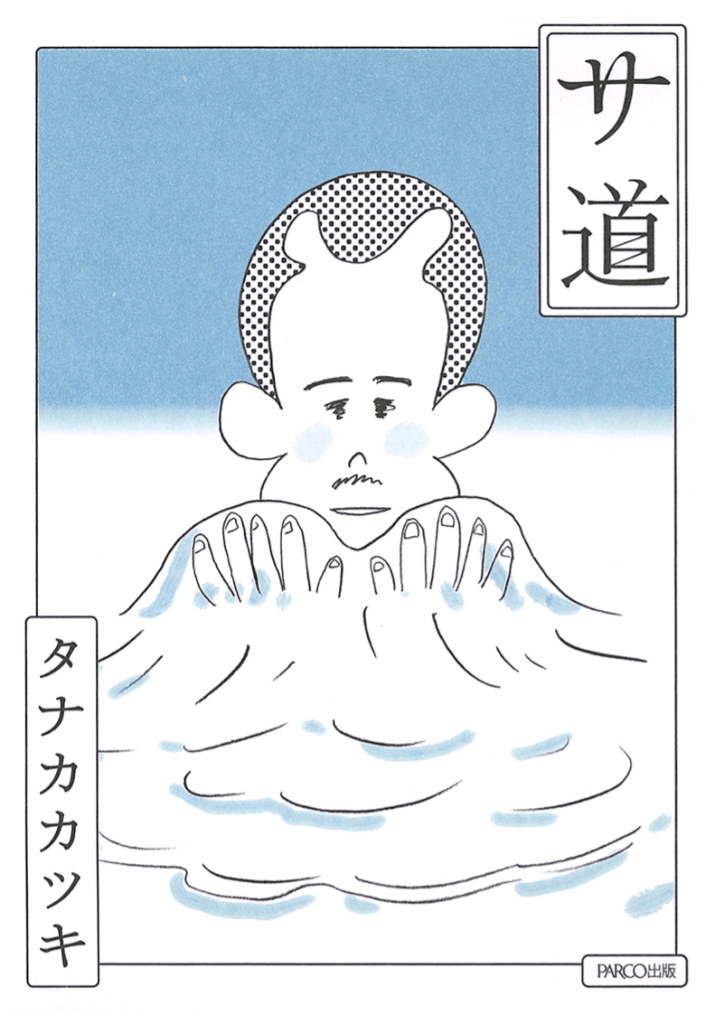
In 2011, Katsuki Tanaka (stylized as タナカカツキ in Japanese) published his original novel “サ道” or “Sado”. This translates into English as “Way of the Sauna”, using the サ katakana character used in サウナ (phonetically-SA-U-NA), followed by the character 道, which in this context, translates to “way” or “path” (in other cases, it can mean road, route, or street). While I have not (yet) read the original novel, summaries in Japanese describe the author’s path to sauna addiction and his discoveries about the essence of sauna along the way. Prior to Sado’s publication, saunas conjured an image of older men relaxing (see the first Japanese sauna boom), leaving the younger generations in Japan anything but enchanted with saunas. The initial publication effectively introduced sauna to a younger generation of Japan, changing the trajectory of Japanese saunas entirely. Now, saunas are as trendy as it gets, a far cry from their decrepit image just a few decades prior.
Manga (2016):

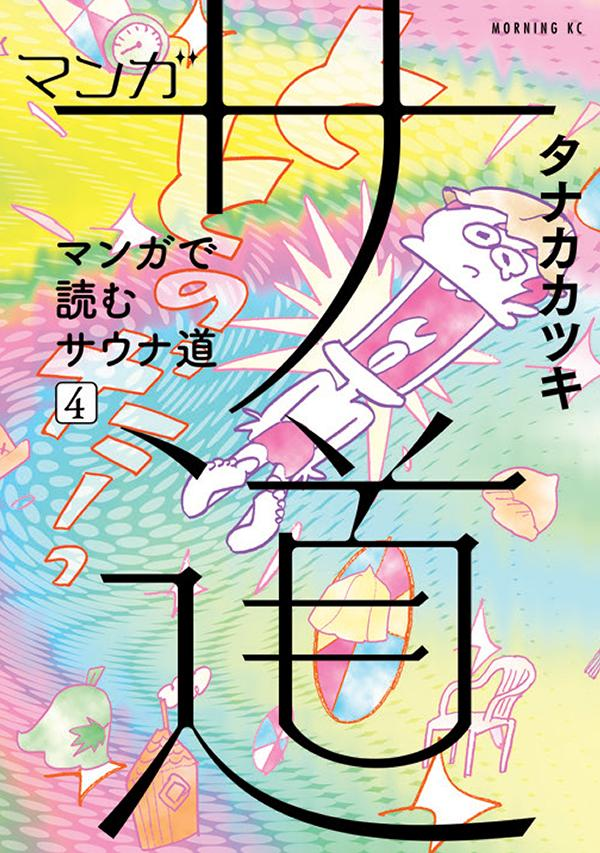
The original work accrued enough of a following for Mr. Tanaka to expand on it by creating a manga based on his original novel. Already an experienced manga artist, Tanaka was able to hit the ground running with Sado. Shortly after its release in 2016, Sado was a major hit.  

With the manga release of Sado coinciding with rise of social media in Japan, many sento (public baths) received requests vis SNS Message and X/Twitter to add a sauna. Many of these came from excited Sado fans, newly converted to regular sauna use.  Today, it’s nearly impossible to find a sento without a sauna!

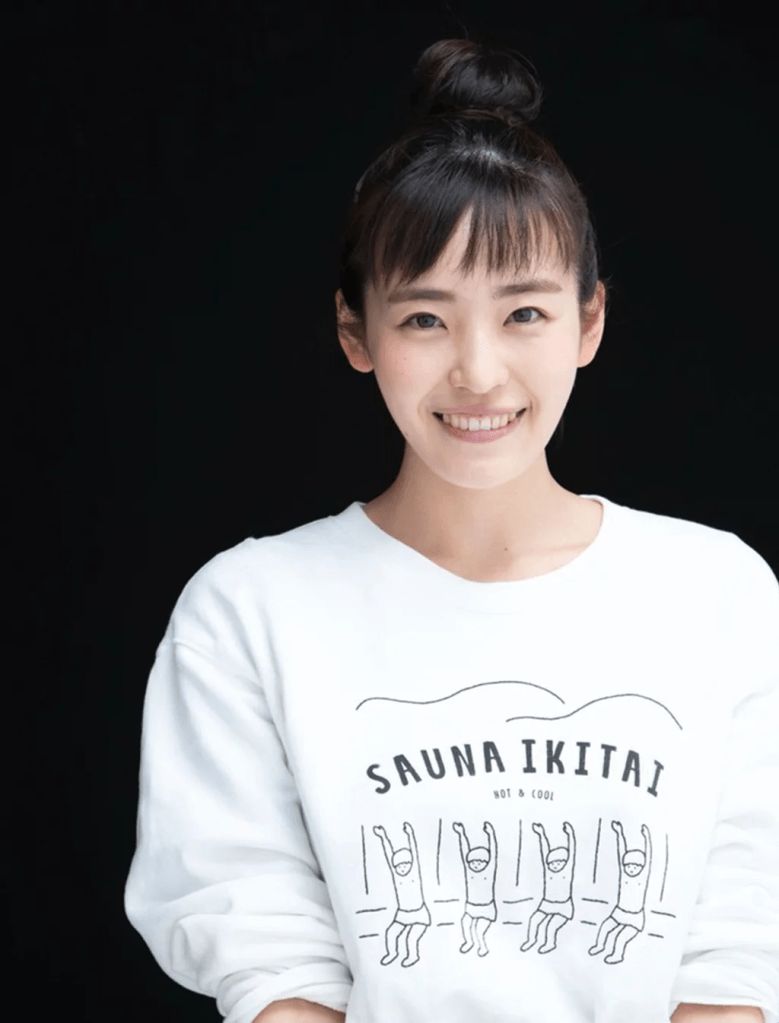
In 2017, Sauna Ikitai (literally “I want to go to the sauna”), a sauna database launched (see my article for more information), compiling sauna knowledge in Japan to one easy-to-find place. Far from a rarity, now saunners could search the top-rated saunas in their area with ease.

At the moment, Sado is one of my primary forms of reading practice in Japanese! While I have not yet finished the series, there are currently six volumes of Sado, and I look forward to reading them all in the near future! 
Television Drama (2019):

In 2019, Sado received an adaptation as a television drama. At this point, sauna had accrued a fairly large degree of popularity in Japan. 

What makes the drama stand out (having watched it myself), is each episode’s inclusion of various sauna from all across Japan (often Tokyo, but not always). I have discovered saunas through Sado, and their choices never disappoint!  For instance, the “home sauna” of the show’s protagonists is a real sauna in Ueno: Sauna and Capsule Hotel Hokuo. Visiting was a blast, and having watched the show drastically enhanced my experience. Sado aside, the facilities are nothing to scoff at either. A great outdoor bath (露天風呂) and top notch Aufguss make it an excellent choice for the show.

Several arcs of the show involve characters taking trips outside of their native Tokyo to other parts of Japan, including Kansai (Osaka, Kyoto, and Kobe) and Kyushu (Japan’s southernmost island), typically for sauna related purposes. 

If you get the chance to visit saunas featured in Sado, the owners often hang up memorabilia from the episode (signed posters, for example), which makes it extra fun to visit the venues selected for the show. 

The show continues today, with an hour-long special most recently being released in December, 2023.

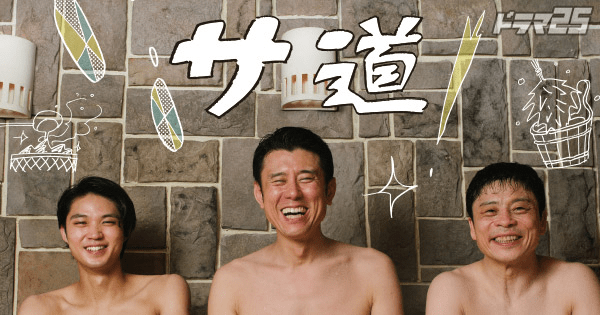
The three main characters at Sauna and Capsule Hotel Hokuo in Ueno.

Sado: Plot and Reading Experience:

Manga:

As mentioned above, I have been working my way through the Sado manga myself. I recently finished the first volume and was a huge fan! The chapters typically cover aspects of the sauna experience, Japanese sauna culture, or both. Chapter titles include: “ Sauna High” (サウナトランス)、”The Correct Way to Sauna” (正しいサウナの入り方), and “Tattoos Not Allowed” (刺青お断り). Generally, the plots revolve around the main character, Nakagawa Tatsuya, and his journey into Japanese sauna culture. Along the way, he typically experiences a mix of comedic and heartwarming interactions. These include interactions with saunners from outside Japan (Finland, the United States, etc.), making new friends, and debates around differing sauna cultures. One of my favorites is an entire chapter “The Sauna-room TV Problem” (サウナ室テレビ問題)  dedicated to the topic of TV’s in the sauna. Generally, Japanese saunners prefer to watch TV in the sauna, where the Finnish treat the sauna as a silent sanctuary at all costs. 

Stretching this out over an entire chapter must have been hard to write, but Tanaka delivers in a manner showcasing both his skills as a mangaka (author of manga, 漫画家 in Japanese) and as an astute observer of sauna culture.

Additionally, I find the art style to be distinct from other manga, especially from action-oriented manga that are most popular outside of Japan (Dragon Ball, One Piece, Naruto, etc.). Many of the shots are atmospheric, and capture the sauna experience incredibly well. From the budding friendships that form, to the one-of-a-kind high that only sauna can produce, it’s easy to tell that this love letter to sauna comes straight from the author’s heart.

The manga is currently not available in English, but for those who can read Japanese and want a light read, I highly recommend Sado! Even if you can’t read Japanese, the pictures alone are fun to look at, and may still be worth a purchase (you can typically get the first volume for around 300 yen, or $2.00 USD).
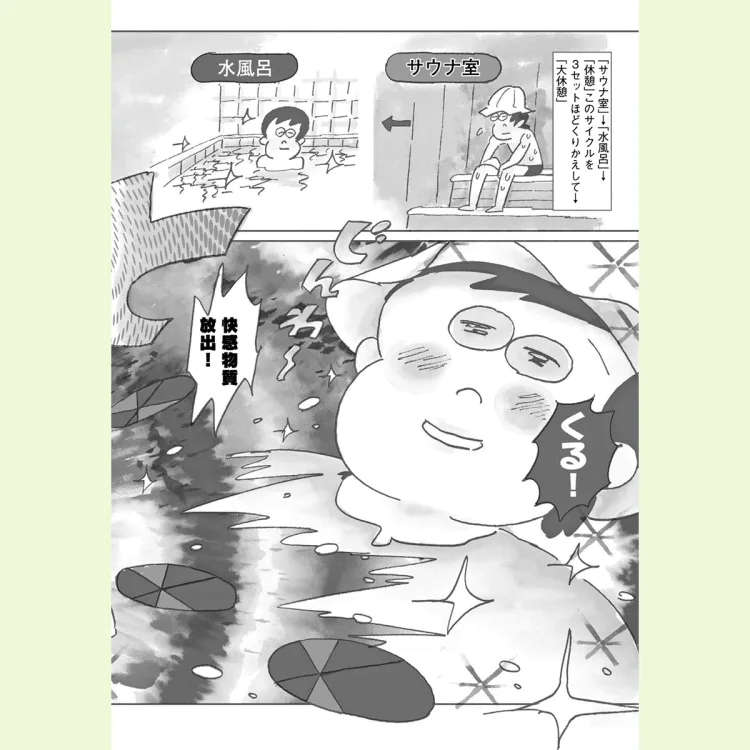
Sauna -> Cold bath -> Totonou/ととのう

Drama: 

The drama centers around three characters, Mr. Tanaka (タナカ), Mr. Coincidence (偶然さん), and Mr. Handsome (イケメンさん) and their sauna escapades. Perhaps the most interesting part of the show are the saunas featured around Japan (as mentioned above). This aspect of the show is particularly fun if you live in or have visited Japan. I have found many of the best sauna spots in Tokyo through Sado, including (but not limited to): Marushin Spa, Times Spa Resta, and Sauna Lab. Sado does a great job of showcasing saunas in a way that makes them look enticing to visit, particularly for those located outside of Tokyo (many that are now on my list when I travel around Japan).

Amazing saunas aside, the antics of the gang range from quirks particular to Japanese humor to funny gags any saunner can relate to. Some of my favorites include: a Godfather parody to introduce the “sauna Godfather” (サウナゴッドファザー) (a real person who helped popularize sauna in Nagoya,), a truck driver who frequents a love hotel for the sole purpose of using their sauna, and nearly getting caught trying to work from home at the sauna cafe. 

The show is goofy, and has a bit of an ‘off-Broadway’ feel, but has an endearing charm at its core, and writes a wonderful love letter to both sauna and the Japanese sauna community.

The show is available on Netflix in Japan only, but can be accessed by using a VPN. While the show is currently only in Japanese, I still think the watching the show still has value, even without full or limited comprehension of Japanese. Many of the scenes transcend the dialogue, and the facilities shown and the sauna highs induced go beyond subtitles. 
Final Thoughts: 

Sado is the kind of phenomenon that’s hard to believe exists. “Sauna comic book” and “Sauna television drama” both sound like they could only conceivably exist in Finland, and even then, it sounds a bit absurd. However, after reading and watching the series, it makes sense why it’s been such a hit and one of the driving forces behind the ongoing  sauna boom. Behind its charming drawings and TV adaption, Sado effectively distills the distinct and idiosyncratic nature of both the sauna experience and Japanese sauna culture. The time away from screens and the outside world, the one-of-a-kind friendships that stem from sauna, and the unique sauna high that doesn’t have any real equivalent…. 

…for those who have experienced any of these, give Sado a try. 

Thanks so much for reading! I hope you enjoyed it. Keep your sauna on as fall arrives in Japan, and I hope you find some ととのう in your near future…
Sauna Methods: Various Paths to Sauna Enlightenment

When talking to prospective new saunners, I am often met with enthusiasm, followed by “…but I feel like I’m doing it wrong…”

So long as you are staying hydrated, not pushing too hard, and listening to your body, there’s not a wrong way to sauna.

That said, many facilities (both in and outside Japan) have developed methods that promise the best sauna high, skin cleanse, or what have you. In Japanese, this is known as 整え方, translating to “how to totonou/ achieve a sauna high”.  I have found saunas will increasingly list their suggestions for how to attain totonou (ととのう). I don’t believe in a singular bulletproof method that works all the time for everyone. That said, I think that:

  1. So many individual factors play into the experience, including what you ate, how you slept, how hydrated you are, that even the same method can give you drastically different results on a given day. This makes a blanket prescription for how to achieve totonou short of ever being bulletproof. It can be a great guide, but you will have to try different tactics overtime to more consistently get the most out of your sauna experience (leading to my next point)
  2. Ultimately, you will need to experiment with what works best for you. Once you start building a sauna practice, you will start experimenting, listening to how your body feels after trying a given method. Mixing and matching methods, understanding what works best relative to certain temperatures and different facilities, and other considerations are paramount to building your sauna routine.

For those who are in Japan, and aren’t sure where to start, here is my default recommendation. *

*Note. I am not a doctor. If you are concerned about any underlying health conditions that would potentially interfere with your experience, please consult a medical professional.

My suggestion:

  • Start with a warm bath.
  • Sauna
  • Cold plunge
  • Relax (5-10 minutes)

Repeat as many times as desired.

I typically go for 2-3 on a standard outing, and extend if I have extra time/want a more intense sauna high. That said, more does NOT necessarily equal better, and I wouldn’t describe it as such. If you are just getting into sauna, one or two rounds will likely be more than enough.

Beginner Guidelines:

  • (Sauna) When in doubt, get out. You are likely still learning how listen to your body. In the modern world where we are increasingly out of touch with our kinetic instincts, you may needlessly push yourself beyond what is optimal (more on this below). More does not always equal better. Start slow, and you can build up over time in needed. I find five minutes on the lowest bench is often a great place to start, but if you can’t do this to start, there is nothing to be worried about!
  • Cold Plunge. Use the water ladle (picture below) to wash off. Start with the outer extremities of your body (hands, feet), and gradually pour inwards. As a beginner, I often suggest avoiding full submersion into the cold plunge. Start with the ladle, and if you feel ready, dip your feet in. At most, I would suggest slowly entering the cold plunge, and getting out once submerged. Just this will, for most people, be invigorating and foreign.
    • Pay particular attention to the temperature of the cold plunge here. Cold pools (水風呂) 20 degrees or higher will be a better entry point than anything 15 degrees or below. As a beginner, 10 degrees or lower will likely be excruciating, and I would avoid it until you feel ready. This part of the experience is the most extreme. As such, exercise the most caution when using the cold pool.
  • R E L A X. Most guides suggest you find a chair (plentiful in nearly any facility), pat dry off, and sit for 5-10 minutes. This will allow your body temperature
  • IF you feel up for it, go for another round. A rule of thumb that I like to use so I’m not glued to the clock, is that once your legs are naturally dry (assuming you pat dried with your face towel), your skin will feel refreshed and ready for another round.  
  • I always consider my first round a warm up round. Starting with the bath especially, my core temperature will be a bit higher, and I won’t be in the full swing of things. It’s completely okay to start lighter.

Side Note:

There is a tendency I hear, particularly with men, to view how long they can spend in the sauna as a point of pride, and even an extension of their character, and masculinity in the case of men.

Recently, I was traveling outside Japan and overheard the following conversation in a gym sauna:

“Yeah, it’s supposed to hurt. It’s supposed to be pain. You’re not supposed to enjoy it. Come on, stay in longer”.

I couldn’t think of a less true statement. For several reasons.

  1. Sauna injuries are real. Full stop. While incredibly rare, they are near either the domain of people needlessly pushing themselves beyond reason, or people touching parts of the sauna that shouldn’t be touched (it happens more than you’d think…). I’ve seen people pass out, shivering for hours afterwards, and burn skin  (all of these have been outside of Japan, in places with less established sauna and bathing cultures). None of these are remotely normal, and all of these cases were 100% preventable if the individuals had applied (repeat after me) common sense and basic safety protocols. Listen. To. Your. Body.
    1. Anecdotally, the presence of alcohol is a commonality between around half of the injuries I see. If you’ve been drinking, save the sauna for another day. It’s simply not worth it.
  2. How you feel in the sauna is variable on so many different things, including: what you ate that day, hydration that day, sleep, exercise, mood, the weather. Like how this will affect your sauna tactics, it should also inform when to take it easy. The race against your ego is a race to nowhere. True in life and in sauna.
  3. More is NOT always better. A common example for me. If I sauna in the morning, I have to be careful not to do too many rounds or push my limits, or I will end up too tired and relaxed for the rest of the day.
    1. See below for my recommendation on a lighter, morning circuit!
    1. If you aren’t hydrated, or ate a lot of food beforehand, or were out in the sun all day and walk in with a high core temperature, more can be disastrous. A lighter session can be just what your body needs in some cases (if sauna is appropriate in the given circumstances).

That being said, on a weekend where I have the time, if I feel up for it, adding an extra round or two more than normal can help me feel deeper sensations, help me sleep and relax, and unwind for the week. It’s all about context and knowing what you need. Different tools for different situations. Having different sauna tactics and routines is about having a toolbox to get the job done in a variety of circumstances. Overtime, you will develop an array of tactics that will become second nature to you, naturally integrating into your sauna experience. With that in mind, here are a few places to get started for those curious about building off of a beginner’s routine.

SAUNA GUIDES: 整え方

Note: These aren’t hard and fast. Experiment with these as you like. There are plenty of ways to sauna- here are just to get started.

“Adopt what is useful. Discard what is useless”– Bruce Lee.

With that in mind, enjoy!

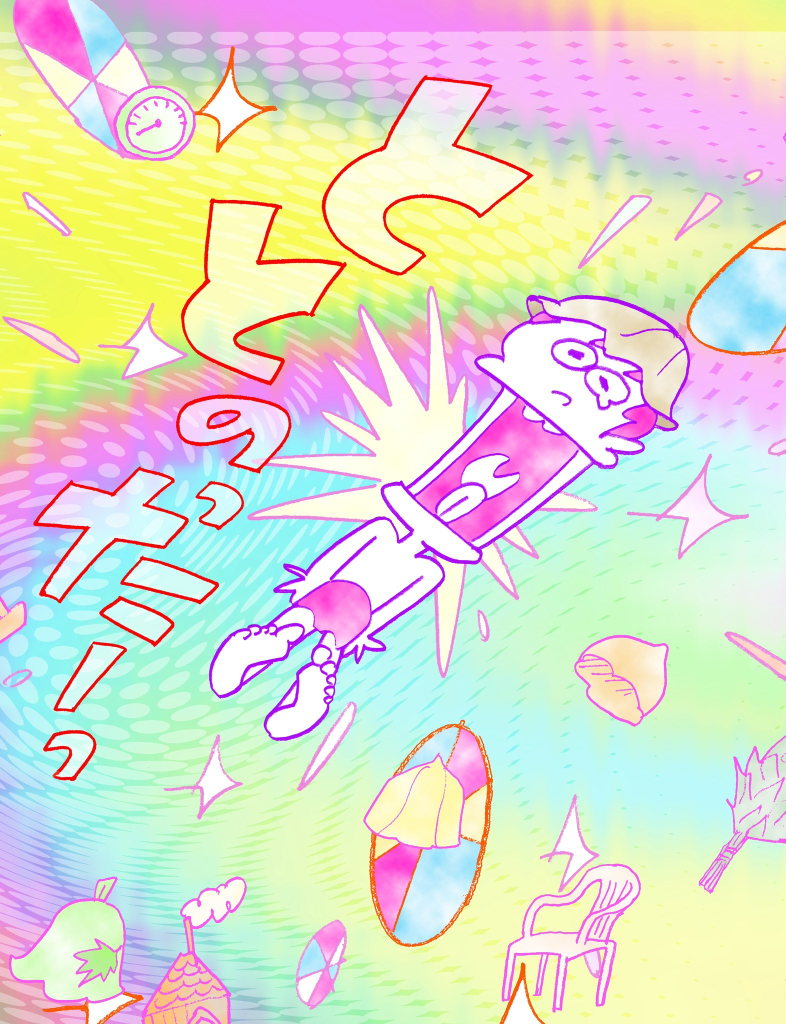
That feel when you find your right routine… (image from the Way of the Sauna manga)
Russian Style: (Intermediate)

  • Warm up (shower, warm bath/hot tub, etc.)
  • Sauna
  • Cold Plunge
  • Repeat sanua and cold cycle 2-3 times (in immediate succession)
  • Relax (as long as needed)

Repeat as needed.

Notably absent: vodka. I do NOT recommend adding this to your routine…

Russian banya (literally “bath” in Russian), is characterized by its parilka (Russian style sauna), which looks like a wood-fired pizza oven, opposed to a Finnish style sauna heater/stove. The focus is generally on a lower humidity and higher heat (between 80 and 100 degrees Celsius, or 175-215 Farenheit, with 15-25% humidity) than a Finnish style sauna (80-90 degrees Celsius/ with about 20-40% humidity, depending on the loyly). That said, this is just an average, and temperatures can vary between locations. The lower humidity allows the heat to be a bit higher while remaining tolerable. Due to the higher heat, I have found the cold pools tend to be a bit more extreme than a lot of Finnish style locations (however, I imagine this isn’t the case in Finland, since going into an actual lake is most common there).

In terms of sauna habits, this tends to result in a more fast paced, hot-cold-hot-cold back and forth. It’s certainly not for the inexperienced, but once you’ve built up to it and can try it safely, it’s a thrill!

Going directly from hot to cold can be incredibly exhilarating! But it can also be a shock to the heart if you have underlying conditions or a lack of experience, so I wouldn’t recommend this unless you are both an experienced saunner and don’t have any underlying heart conditions.

Morning Circuit:

  • Keep it around an hour, hour and a half. No more than two.
  • Two rounds recommended. I would discourage more than 3 unless you want to be really tired for the rest of the day.
  • Go lighter on the sauna, focus on the cold.
  • End on the cold plunge. It’s not necessarily intuitive (especially in the winter), but I find it keeps you energized and awake, rather than too sleepy to take on the rest of the day.

I love this one, and its taken me some experimentation to dial it in. I tend to go into my day more grounded, carrying a more centered inner peace after this routine. My hope is that it gives you the same.

Carbonated Baths: (炭酸泉)

The carbonated bath is a staple of many sento around Japan. It took me a while to really take full advantage of it. Here is a summary of the few tips I have seen.

  • It takes a bit for bubbles to form on your skin. Don’t move around too much and be patient
  • I would suggest staying in for ten to fifteen minutes. Based on the guides I have seen in Japanese, there isn’t really a benefit to staying in longer than 15 minutes. More does not equal better here.
  • I really enjoy using this bath at the end, particularly before bed. It really knocks me out and gets me ready for a good night’s sleep!

Venue Specific Recommendations:

Here are a few found at specific saunas I have visited. I may update with more in the future, but here are a few to get started for now!

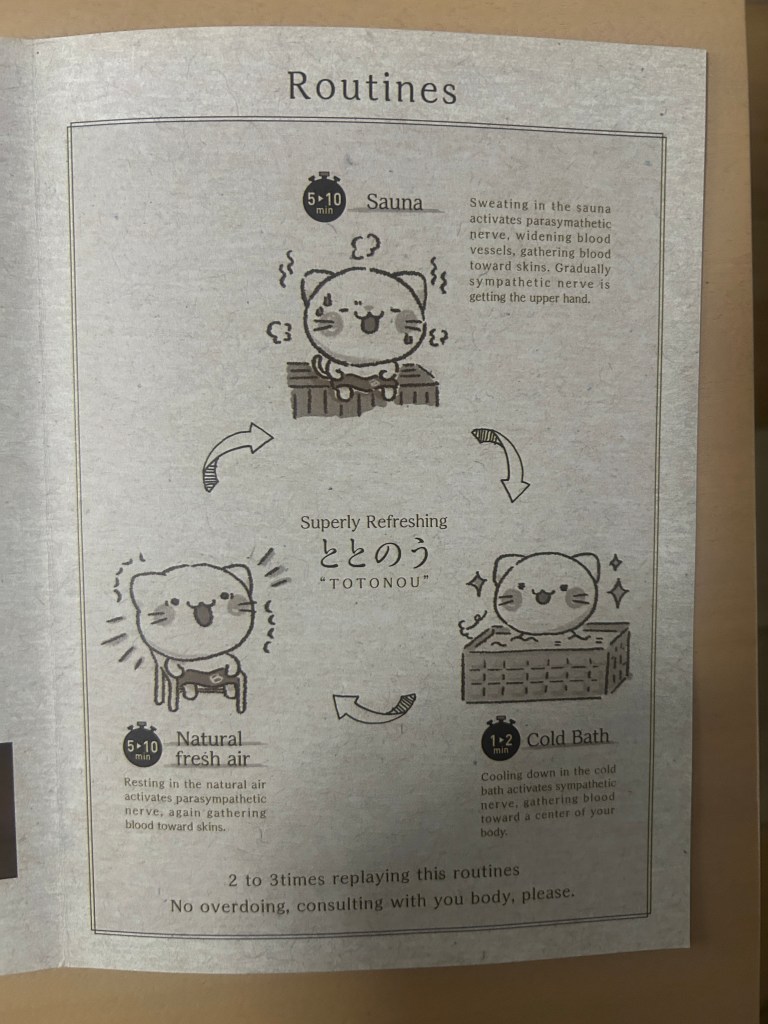
Corridor no yu: (with the cute picture guide pamphlet)

I came across this one while visiting Ginza Granbell Square’s Hotel Sauna. This pamphlet was avaliable at the front desk and I loved it enough to hold on to it!

The English isn’t perfect, but it gets the point across!

Sauna Dojo Guide (on the wall in Japanese):

  1. Dry off before entering sauna
  2. Enter the sauna. 5-10 minutes.
  3. Wash off your body.
  4. Cold plunge
  5. Relax.
  6. Repeat.

SkySpa Yokohama Guide:

For those looking for a bit more of a detailed explanation of the standard Japanese 整え方 (Totonou Method)

Conclusion:

My aim is to provide tools to help navigate your sauna journey. While there are lots of options, my goal is not to overwhelm, but to help guide. There are lots of effective sauna tactics, just keep in mind the following as you experiment:

  1. Use common sense
  2. Listen to your body
  3. Stay hydrated
  4. Keep experimenting and tweaking routines overtime to best suit your needs.

I may continue to add to this guide/write a follow up overtime if this is helpful to readers.

I hope you find some totonou in your week and in your life…. More articles to come soon. Take care and I hope you find a 整え方 that works for you!

Miyano-yu: A sento cafe in the heart of Nezu, Tokyo.

This past weekend, I checked out a sento-related venue that’s been on my list for some time now. However, there was no bathing or sweating involved on this trip. At Miyano-yu, they’ve swapped the baths for coffee! While I decided to visit on a bit of a whim, Miyano-yu has been on my radar for quite some time.  Naturally, I couldn’t help but be curious about a sento café.

After a quick look at Miyano-yu’s official website, one can see their commitment and understanding of communal bathing’s power to connect others, and its relevance in contemporary society.The description on Miyano-yu’s history page of their official website sums this up nicely:

“Overcoming the rough and tumble of the early postwar years, this place has continued to keep people connected as a place of communication in the community.

[…] in 2008, the 57-year history of the public bathhouse came to an end once and for all, but in 2021 MIYANO-YU opened as a new community place. We will take over the name of MIYANO-YU and recreate the role that public bathhouses once played as the center of the local community in the modern age.

Through various creators and events, we aim to become a new symbol of the city and a place for transmitting new culture that transcends the boundaries between “age and generation,” “locals and tourists,” and “Japan and the rest of the world.”

Personally, I found the transition between bathing and coffee to be brilliant. While public baths in Japan were born out of a necessity (keeping the public clean) they gradually evolved into an extension of the public sphere, similar to coffee houses in Enlightenment-era England. Even today, coffee-shops are still great places to catch up with old friends, go on a date, or just unwind. Linking two historic public spheres at Miyano-yu is a stroke of genius that taps in to what makes communal bathing (and sauna) so special.

At the helm is Emi Osato, the manager and general point-person for Miyano-yu, and she takes coffee very seriously. With a background at Sensing Touch of Earth coffee in nearby Asakusa, Osato brings her experience in the coffee world to match the impressive aesthetics of Miyano-yu.

Kenchiku Saikou Kikaku (建築最高企画)carried out the restoration of the building and oversaw the transformation into a coffee shop. The architectural firm, literally translating to Best Plan Architecture, specializes in restoring vacant, historic buildings with an emphasis on preserving their heritage and identity (such buildings are common in a country with a rapidly declining population). A project like Miyano-yu is seemingly right up their alley.

From the firm’s outline for the project on their website:

“The building owner, Suzuwa Jisho, requested us to change the use of the building from a public bath to a complex facility. The architectural reconstruction project was based on [the building owner] Suzuwa Jisho’s vision of “making the public bath a place that people can enjoy for a long time”. We valued this and limited the improvements to the facility to the bare minimum necessary for the change of use, providing the necessary hardware support to make this vision a reality.”

After visiting in person, I can testify to the integrity of the sento feeling intact at Miyano-yu. The dedication to preservation and innovation is impressive, making the results all the more enjoyable to experience.

My Experience:

In the quiet yet trendy Nezu neighborhood, the home of the famous Nezu Shrine, lined with ample trendy coffee shops around the corner hosts one coffee house that stands out among the rest. Sitting next a giant tower with “SENTO” written in English across the length of the structure, you might expect to see a public bath. This isn’t entirely inaccurate…. but fails to tell the entire story.

Just like its neighoring storefronts, Miyano-yu specializes in coffee, while maintaining the core structure of the old bath house. Miyano-yu preserves the aesthetic and role of the bath as a community space, while bringing it into the 21st century in perhaps the best way to attract 20-30 something customers and travelers: high end coffee and Instagram-able Japanese aesthetics.

Entering the store, the storefront is strikingly modern, with nothing loudly screaming “public bath” upon first glance (considering this is where food and drinks are handled, this is probably a good thing). However, upon further investigation, a repurposed shoe locker (ubiquitous of old school sento) next to a front desk-sized counter appears, revealing traces of the old bathhouse.Upon ordering your coffee, your table number will be held with the wooden sento shoe-locker blocks that seal and secure the locker doors.

Entrance of Miyano-yu

The majority of the main café is inside what used to be the main bathing area. The tiles, windows, and even some of the washing stations are left intact. Instead of warm baths and naked patrons, you will find chatting customers (both locals and international guests) and lush greenery in this hip coffee shop.

The natural lighting of the sento turns out to be a great fit for a coffee shop. The expansive windows typical of old school sento (to let the humidity circulate) make for a great coffee shop atmosphere. Who would have thought!

Taking in your surroundings, relaxing background music that would fit in a Playstation 1 or Nintendo 64 game’s menu screen plays in the background.  All of this merges in an eclectic yet cohesive and immersive, laid-back experience.

Oh, did I mention that the coffee is amazing? I honestly wasn’t thinking much about beverage quality when I walked into the shop. Frankly, I was overjoyed that a sento coffee shop existed, and would be happy with anything. That said, I was pleasantly surprised, bordering on shocked with the high quality of the coffee.  

Matcha Latte (will try on my next visit…)

While I am not as much of a coffee enthusiast as I am with sauna/sento, I do know a bit about coffee (thanks to some friends more familiar with the craft), and visit roasters and shops around Tokyo every so often.

I went with a simple iced late (hard to mess up), and it really hit the spot. Visiting with a friend, they had an espresso and left just as satisfied as I did. While I didn’t try on my visit, Miyano-yu is known for its’ matcha latte. Upon my next visit, I am eager to give the drink a try. The matcha is sourced from the Shizuoka region of Japan, and is a testament to the attention to detail at Miyano-yu.

The open lighting, lush greenery, and sento mural mesh so naturally in the shop.

Located in Bunkyo ward, it’s about a 20 minute walk from Ueno Station, and only a 2 minute walk from Nezu Station. For the sento enthusiasts, coffee lovers, and curious Tokyo explorers, I can wholeheartedly recommend a trip to Miyano-yu!

Thanks for reading! Stay tuned for my next article.

An Introduction to Aufguss: A German Sauna ritual finding new life in Japan

Imagine. One moment, you are sitting in the sauna, quietly enjoying your session. All of a sudden, the heat intensifies. You look up and see flashing lights, a moving towel diffusing essential oils throughout the sauna, and all of this is done in sync to awe inspiring music. Only half-sure of what I was getting myself into, little did I know that I would soon become obsessed with this small ritual within the already specific niche Japanese sauna culture. This is Aufguss.

What is Aufguss?

If I were to sum up Aufguss, I would describe it as such:

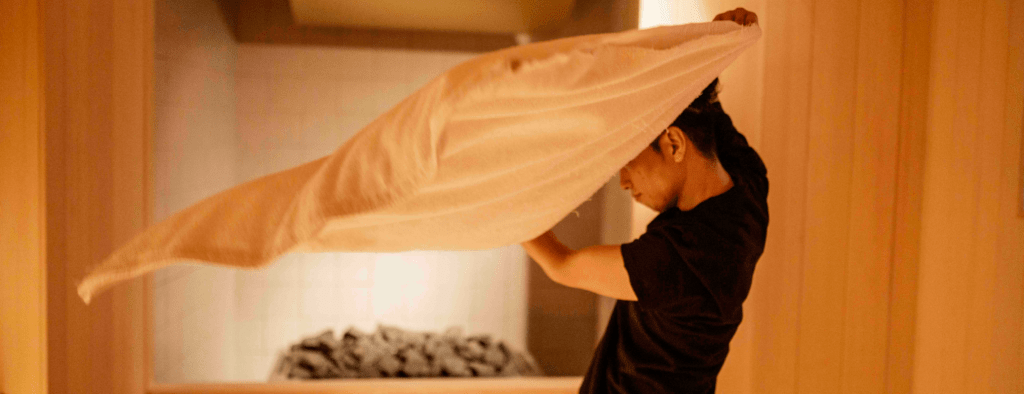
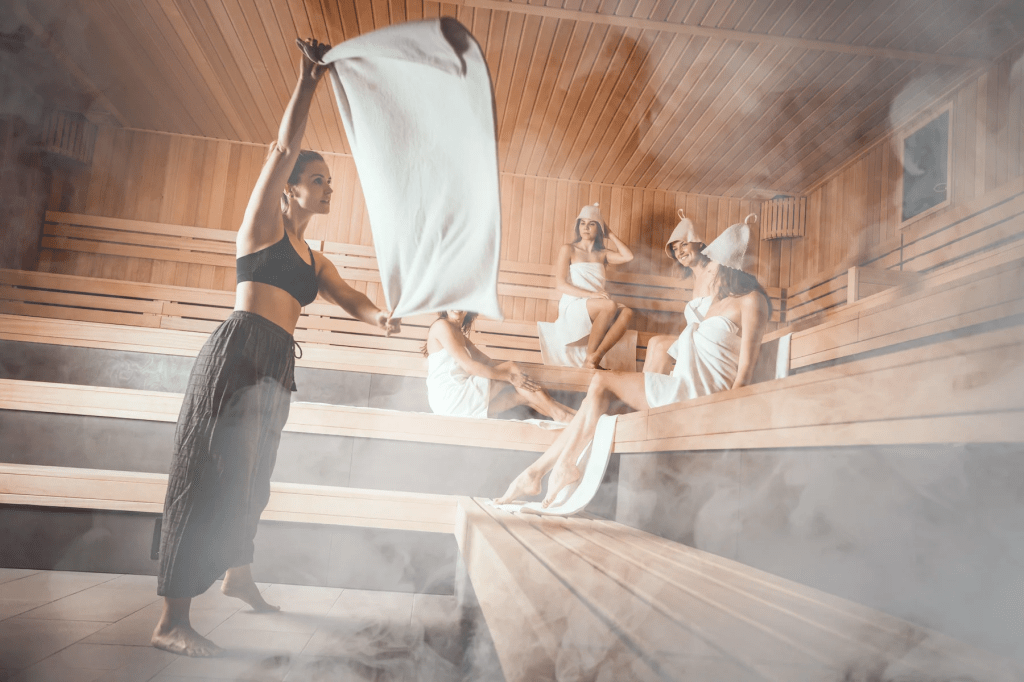
The ceremony of towel waving to diffuse essential oils throughout the sauna, often to music, with the aim of providing the audience with an intense heating experience that is often fused with artistic elements (coordinated towel waving to music, flashing lights, etc.).

To provide more clarity, I will also provide a definition that I really liked from Martjin Vanhoorelbelke, a two-time Aufguss World Champion finalist, taken from an excerpt found on Brooklyn sauna Bathhouse‘s website:

“Aufguss is a sauna ritual lasting about 15 minutes. It’s a multi-sensory experience inside the sauna. The Aufguss master works with water to circulate heat throughout the sauna with a towel. The core elements of an Aufguss are heat, essential oils and music.”

Vanhoorebelke then describes the goal of Aufguss as:

“To take you on a trip. It’s about having an experience that extracts the benefits of a sauna session and heightens them: elevated levels of endorphins and serotonin. Additionally, different essential oils can be utilized for different outcomes. For instance, peppermint can be used as a revitalizing oil, lavender for calm, and eucalyptus to clear the airways.”

Beautifully put. Better than I could have myself.

Aufguss in Japan

While Aufguss originates from Germany, it has gained popularity in Japan amidst the ongoing sauna boom. In Tokyo, many of the more reputable sauna/sento host regular Aufguss nights, with slots often booking out several hours in advance. Some of the top saunas even have their own teams that host elaborate Aufguss shows, many of which are used at “Aufguss Championship Japan”, Japan’s Aufguss national tournament.

At the national tournament, Aufguss performances are evaluated based on the following criteria:

  1. Professionalism
  2. Heat rise and distribution
  3. Fan technique [using the towel]
  4. How to use and amount of fragrance
  5. Theme and show structure
  6. Judge’s personal evaluation
  7. Team Spirit (groups only)

(translated using Google)

Teams and individuals that win move on to the World Aufguss Championship to compete on the international stage.

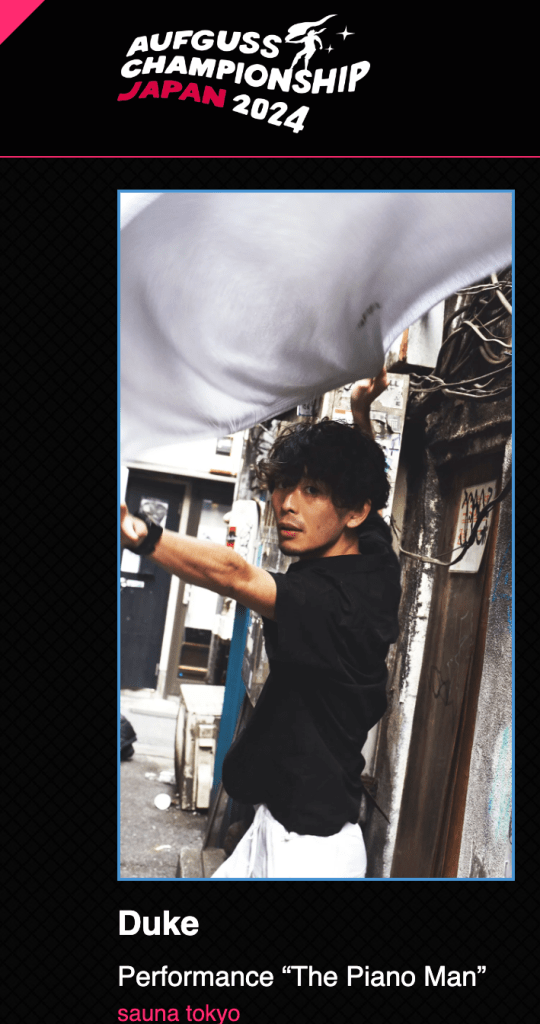
Competitive Aufguss performances are typically centered around a motif, such as a song or story that set the mood for the session. For example, This performer (one I have seen at Sauna Tokyo and is an excellent practitioner) has submitted an entry for the Aufguss Championship Japan for this year, and will use the song “Piano Man” as the centerpiece for his performance.

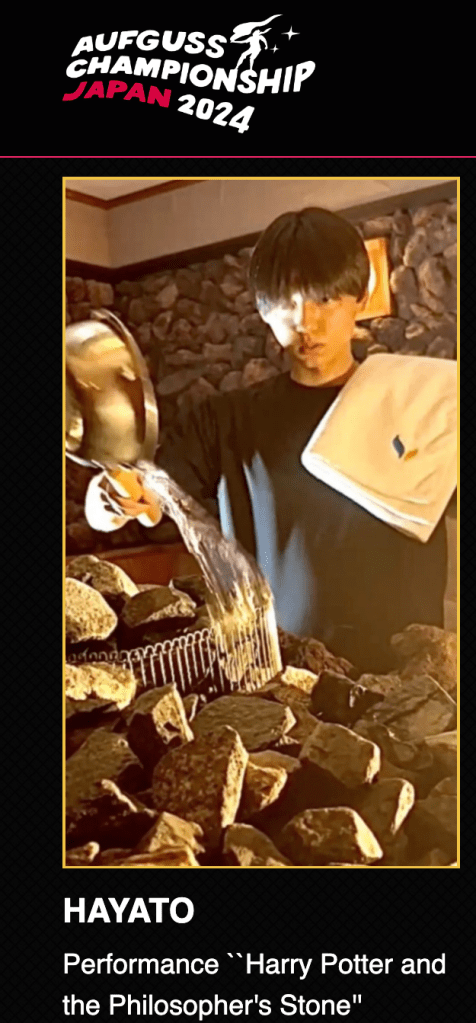
To give another distinct example, I’ll share a submission that really caught my eye. Along with a submitted image that looked like it was taken on a flip phone/potato, the only information for the performance listed is “Harry Potter and the Philosopher’s Stone”. While music can certainly be a driving component in Aufguss, other components like storytelling can also define the Aufguss session. I have to say, I’m quite curious how Harry Potter fits into this, and may have to report back to you all on this if I ever get the chance to find out…

Japan has become a force to be reckoned with in the international Aufguss community, with Yuma Kurokawa & Mayuka Sano from Wellbe Sauna in Nagoya winning the Team Competition category in 2023. Japan’s entrance on the global Aufguss stage has increasingly led to more and more Sauna creating Aufguss teams and programs. Seeing the innovation and creative energies surrounding Aufguss is incredibly exciting, and its inclusion at any given facility is always a highlight at any venue I visit.

From Sky Spa Yokohama, an Aufguss venue that is very high on my to-visit list!

Where can I Experience Aufguss in Tokyo?

Want to try Aufguss on your next trip to Japan, but not sure where to look? Fear not! With Aufguss taking the Japanese sauna world by storm, it can be found at many sauna throughout Japan! Since the majority of my sauna expertise is in the Tokyo area, all of my recommendations will be exclusively for Tokyo.

  • Sauna Tokyo
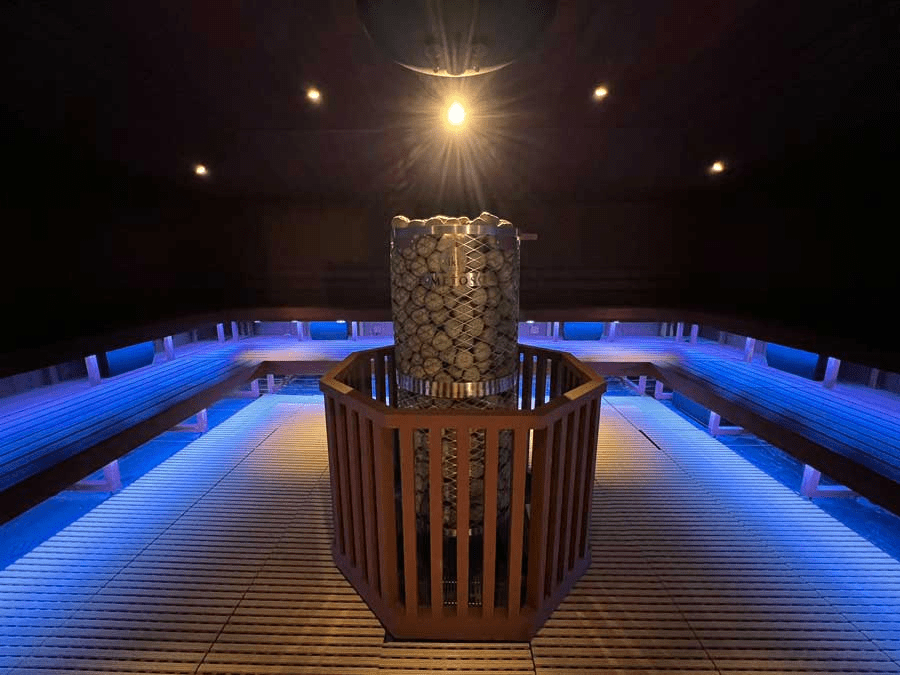
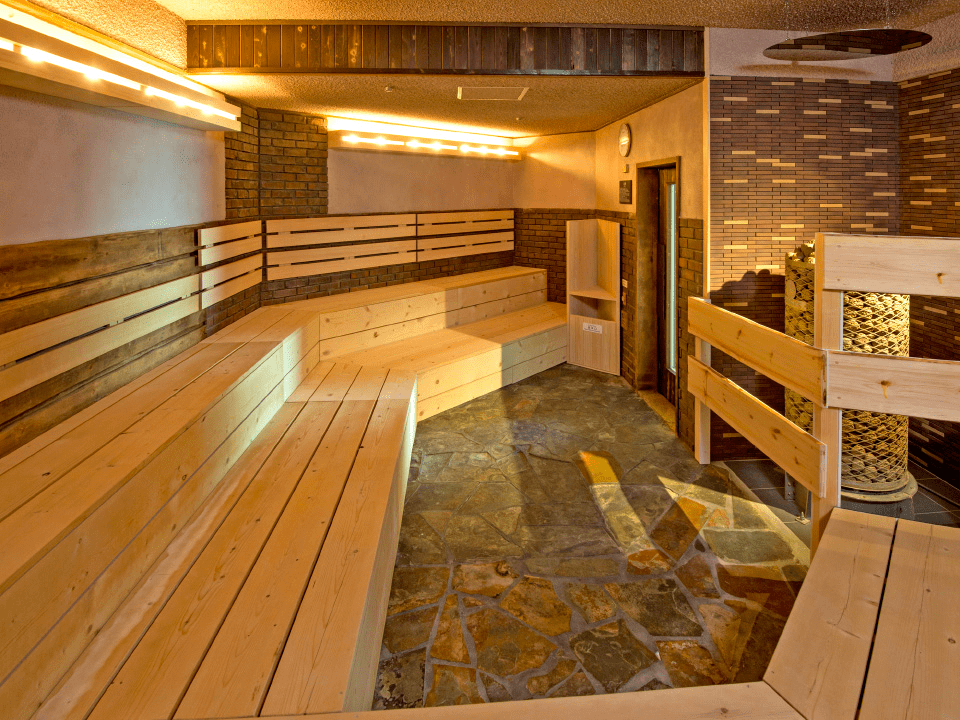
    • At the time of writing this post, this is easily my top recommendation for experiencing Aufguss in Tokyo. Every couple of hours, you are guaranteed to see a top-notch Aufguss show in their sauna outfitted for 50 people.
    • The aufguss practitioners are listed outside of the main sauna, and rotate every hour, so you have lots of opportunities to see different styles of Aufguss in one place.
    • I will go into more detail on Sauna Tokyo’s Aufguss experience in the next section, but to sum it up: Sauna Tokyo is an accessible, high quality way to see Aufguss that I can recommend to anyone.
  • Shibuya Saunas
    • Recognized as a top sauna team that has competed at the Japan Aufguss Championship, this is on the top of my list for Aufguss that I want to check out next. Unfortunately, their Aufguss offerings are somewhat random and are not on a set schedule. It has not been offered on my last two trips here, but online I only hear great things (on the Japanese side of the internet).
    • Regardless, even if Aufguss isn’t offered during your trip, I can highly recommend this facility (review to come at a later date)
  • Spa Laqua
    • Located right by the Tokyo Dome, this is an excellent option if you are looking for a super sento that also offers quality Aufguss sessions.
  • Sky Spa Yokohama
    • Along with Shibuya Saunas, this is on the top of my list for Aufguss that I want to experience. Much like Shibuya Saunas, Sky Spa Yokohama has sent several contestants to the Japan Aufguss National Championship, and regularly is listed as a go-to destination for Aufguss. I still haven’t paid Sky Spa Yokohama a visit, and it’s one of the facilities I am most excited to check out!
  • Sauna and Hotel Karumaru
    • A more low-key option, Aufguss is offered every few hours in their stone sauna. Similar to Spa Laqua’s Aufguss, less performative than Sauna Tokyo, but still done by quality practitioners. Karumaru also has an attached capsule hotel, so if you are looking to bundle your lodging and Aufguss options into one, this is a great choice.

My Aufguss Experience with a Japan National Champion

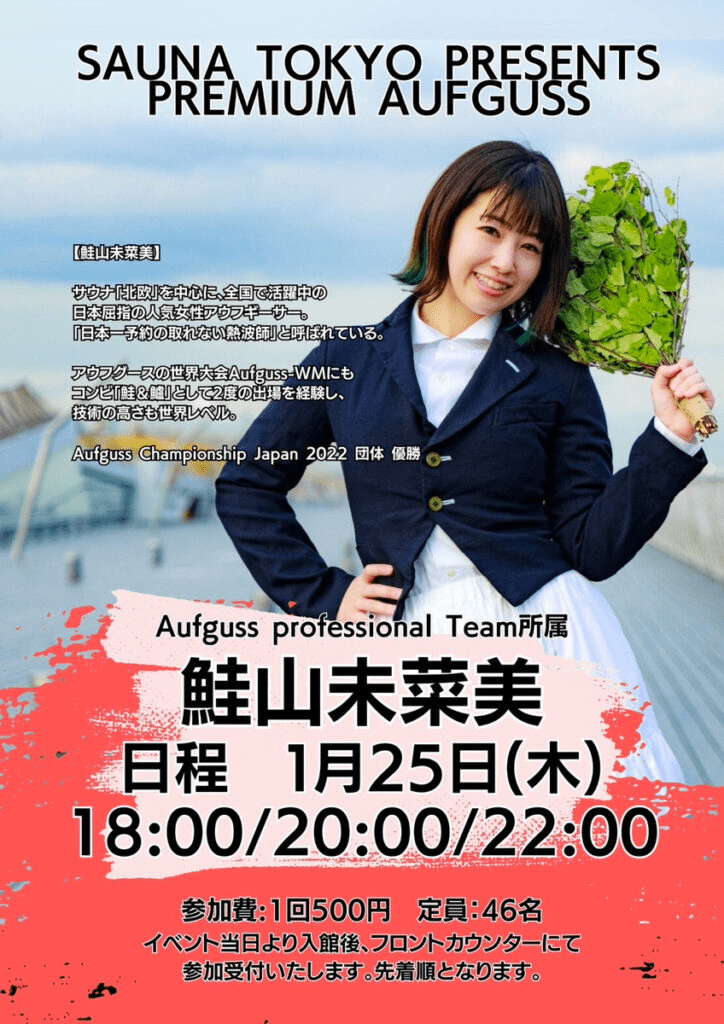
Flyer for the Aufguss event that I attended

While I have been to several Aufguss shows around Tokyo, I had the opportunity (and paid a little extra) to see the 2022 All Japan Aufguss Champion at Sauna Tokyo. While I have been to several impressive Aufguss shows, this one particularly left an impression. To give a taste of the heights of Japanese Aufguss, here is a narrative account of my experience:

After inquiring at the front desk two hours in advance about the Aufguss event, I was given a number (35 out of the 46 person capacity), and was instructed to line up outside the main Loyly sauna five minutes before to prepare.

Jam-packed to its full 46 person capacity (I suspect there were a few more than 50 in reality), the staff strategically placed several conspicuous looking tools near the sauna stove, including an ice block, a speaker, and several essential-oil diffused buckets of water prior to the start of the performance.

Kicking things off, a series of lights turned on and immediately dimmed to a cool blue, then to red. Then, a Japan Airlines announcement cued on the speaker system, with the Aufguss champion emerging in a Flight Attendant Uniform. Announcing in time with the airline announcement, she followed with (in Japanese) “Welcome to the Sauna Airlines! Please locate the emergency exit and enjoy your flight!”. For the next several minutes, classical music played, with ice blocks being melted on top of the center sauna stove in time with the music. A nice warm breeze, relaxing, but not scorching intermittently spread around the room for several minutes.

All of a sudden, red lights started crashing. “Everyone! Everyone! The plane is crashing! The plane is crashing! We are in danger!!!” Immediately following, “Danger Zone” by Kenny Loggins starts to play over the speakers (yes- the one from Top Gun), and the Aufguss practitioner starts to take things up a notch. The towel waves increase in intensity, the collective atmosphere was filled with excitement and awe. As the guitar solo hit, the practitioner started performing one-handed towel spins that went behind the back and thrown mid-air. The audience started to clap to the rhythm, giving the atmosphere more akin to a rowdy sporting event than a “spa day”. This was the point where I had to look at the fifty other naked individuals wearing pointy sauna hats clapping in sync and remind myself that I had not joined a cult.

After the performance concluded, the audience gave a hearty round of applause, and nearly the entire crowd rushed into the nearby cold plunge pools for a much needed cool-off.

A follow up show the next hour included other members of Sauna Tokyo’s Aufguss team. Perhaps the most inventive idea I’ve seen in an Aufguss performance, one performer had a small handheld leaf blower, and used it to help diffuse the heat around the sauna. Backed by the soundtrack from the anime “Death Note”, the practitioner stated (in Japanese) “I am fear! I am fear!” (from what I could translate in my head), and moved the heat around to those with their hands up requesting more heat.

Needless to say, the Aufguss experience at Sauna Tokyo was exhilarating, awe inspiring, and unlike anything I had ever experienced.

Conclusion

While I could write about Aufguss at further length, its appeal is (perhaps even more so than sauna and bathing) difficult to encapsulate with words, and best experienced. If you want to level up your sauna experience, or want to experience a uniquely Japanese take on a tradition with its origins elsewhere (something Japan excels at), give Aufguss a try!

Thank you so much for reading! More content is on the way after a small hiatus, so please stay tuned!

Sauna Ikitai- Japan’s Premier Sauna Database

Overtime, finding new Sento and/or sauna to visit can become a challenge. Once you get past a few “Top Three Sento for your visit to Tokyo!!!” articles, navigating further options can be daunting, especially if you can’t read Japanese.

That’s where Sauna Ikitai (litreally translating to “Let’s Go to the Sauna!”) comes in. Perhaps one of the more ingenious creations to come out of Japan’s ongoing Sauna boom, Sauna Ikitai serves as a sauna database logging almost every sauna facility in Japan. Let’s take a look at what that entails, and how to use Sauna Ikitai.

*Author’s Note: This article uses Google Translate extensively. For the purposes of this post and providing images of the web pages that were not originally in English, I decided that using Google’s Translate feature to generate English language versions of the pages would be the best fit for the article. All features of Sauna Ikitai are designed for use in Japanese. Please keep that in mind when you see any translations that may look a bit strange.

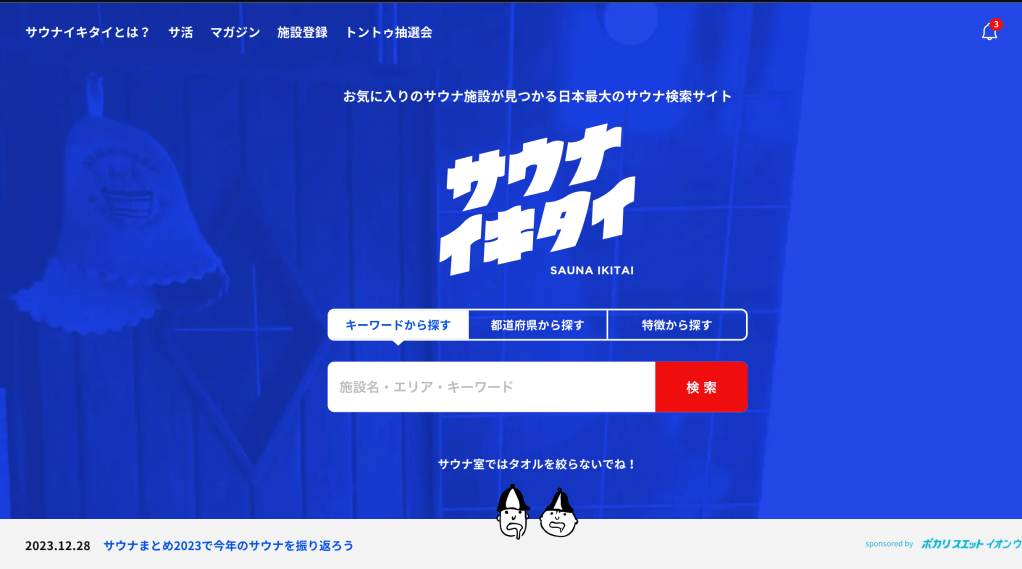
Sauna Ikitai Home Page

The Primary Functions of Sauna Ikitai are (as listed on its website):

  1. Easy to access Sauna database
    • The most common use, and the feature I take the most advantage of. Sauna Ikitai logs over 5,000 sauna (and counting) across Japan, and is the resource for finding information on nearly any given sauna in Japan.
    • Information provided includes (but not limited to):
      • Sauna and cold bath temperatures
      • Sauna auto-heating mechanism time intervals (known as “auto loyly”)(ex. automatically heats every ten minutes)
      • Payment methods (cash, card, electronic money, etc.)
      • Rental availability (towels, sauna mats, etc.)
      • Hours and days open
      • Parking availability
      • Cost
  2. Sauna Ikitai Magazine.
  3. Serving as a community space for sauna enthusiasts (known in Japan as Saunners). Concretely, this is done in two ways: community message boards on the site, as well as Sauna Ikitai’s presence at in-person events.
    • Online: You can create an account that allows you to log which sauna facilities you have visited, as well as leave written reviews for facilities. It even has a system similar to Reddit Gold, in which the Finish sauna deity “Tontou” gives you “gold” in exchange for your good deeds (leaving reviews, engaging with the community, etc).
    • Offline: Sauna Ikitai supports in person events. Sauna Ikitai members even get perks at certain saunas, such as a free Pocari Sweat (for those unfamiliar, Pocari Sweat is Japan’s equivalent of Gatorade) or small piece of merchandise. Not too shabby!

What can I use it for?

Looking at Sauna Ikitai’s homepage can be a little intimidating, especially if you can’t read Japanese. I’ll break down its core functions that I use, so you can get some ideas on how it might best suit your needs. A lot of the Google Translations are fairly egregious, (Sauna Ikitai regularly gets translated as Sauna Nike Thailand), so I have gone through with my limited kanji knowledge and sorted through each page.

As a Sauna Database

This is the feature that I use Sauna Ikitai the most for. Here’s how I like to utilize it to find the top rated Sauna in my area

  1. Starting at the Sauna Ikitai Home Page, select the middle button above the search bar (please refer to the picture of the Sauna Ikitai Home Page above).
  2. Using Google Translate, select which area/prefecture you would like to visit (for this example, I will use Tokyo Prefecture).
    • Author’s note: If you are searching in a larger metropolitan area (Greater Tokyo, Kansai Region, etc.), keep in mind that you may need to select multiple Prefectures to best optimize your results. For instance, Yokohama, Japan’s second largest city and host of a Saunachelin winner, is not included in the Tokyo listing, despite it being 30 minutes away from Downtown Tokyo by train.
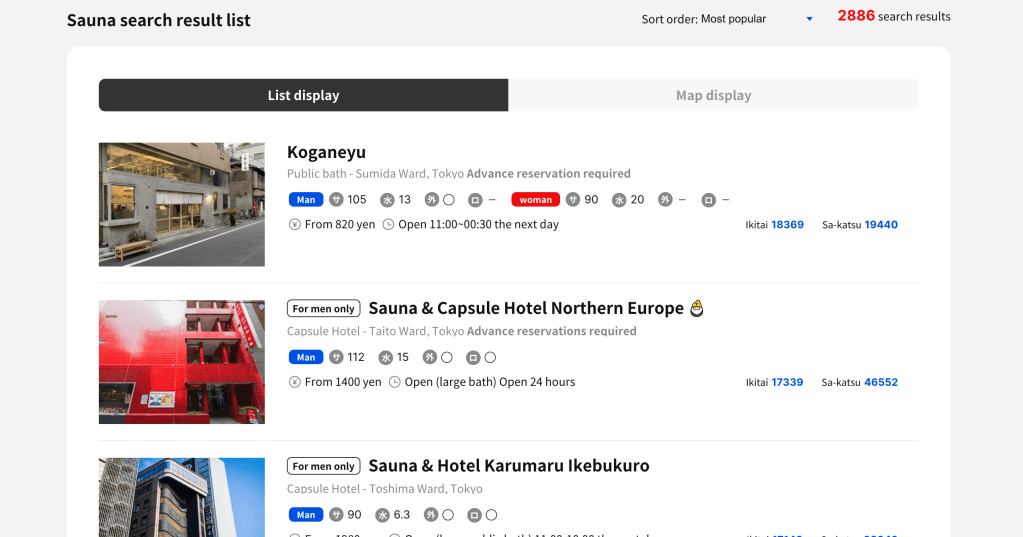
  3. A list of Sauna’s in your selected prefecture(s) will pop up on your screen. The default sorting will be by the most popular, but you can sort by other categories, including by highest or lowest sauna/cold plunge temperatures, highest rated by each gender, and more.
    • Please note that Sauna Ikitai only includes facilities that have saunas. Many otherwise great facilities that only have baths are not included on Sauna Ikitai.
Your end result should look something like the above picture. Mine is translated into English for the purposes of this article, but the page looks a bit cleaner in its native Japanese.

As a Community

Sauna Ikitai has several components that allow you to interact with other sauna lovers (saunners) around Japan.

  • Logging Saunas and leaving reviews
    • If you look at the above picture of the “Sauna Search Result List”, there are two words with numbers following the Sauna listings on the right hand side of the page: “Ikitai” and “Sa-Katsu”
      • “Ikitai” loosely translates here to ” Let’s Go”. Here, this is used to demonstrate that you have went to the listed sauna.
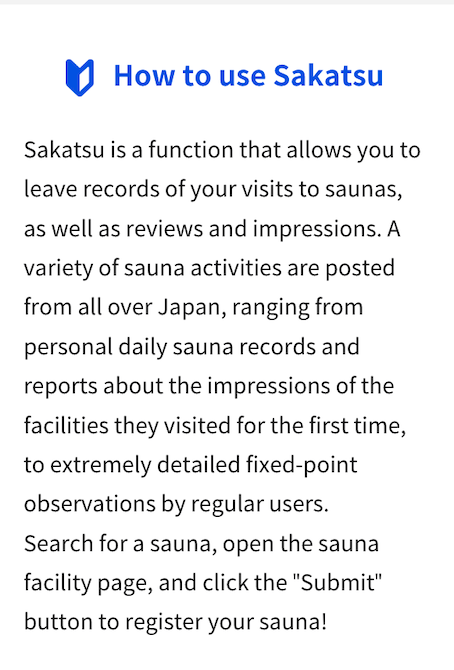
      • “Sa-katsu” here is a bit tricky to translate, but I believe it means “Sauna Life”, with “サ” standing for the “sa” in “Sauna” in Katakana (one of the two Japanese phoenetic alphabets, most commonly used for foreign loanwords), and “Katsu” coming for the Kanji “活”, for “Life. This is the review section of Sauna Ikitai, where users can share their experiences at the sauna. While all in Japanese, I really enjoy reading from time to time to gain insight into how the sauna community interacts with the venues they visit.
Translation of How to Use Sakatsu from Sauna Ikitai (Translated using Google)
  • Tontou!
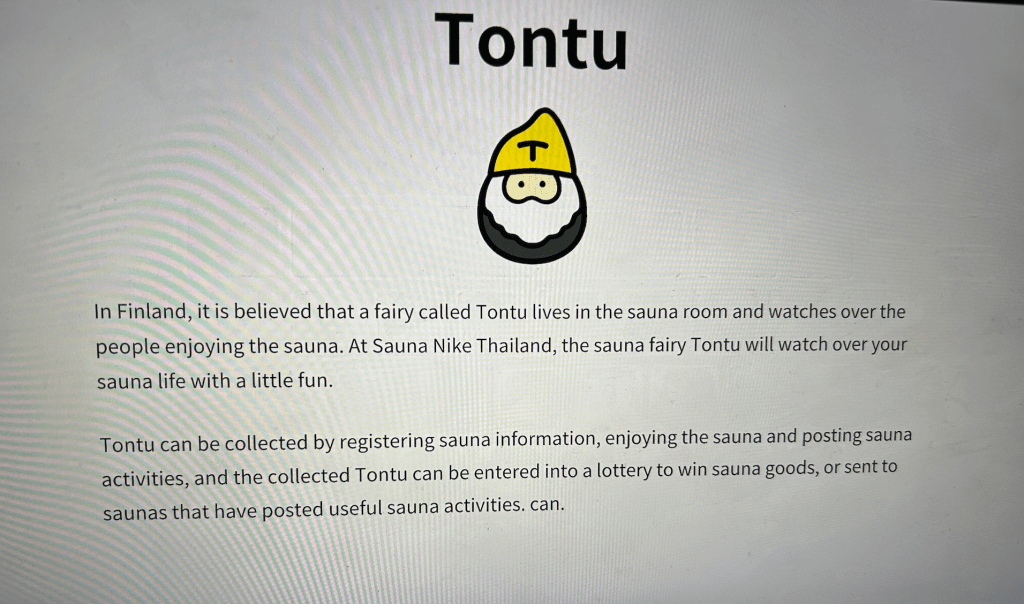
    • Similar to Reddit’s “Gold” feature where users gain points for doing good deeds, Tontou does the same for Sauna Ikitai users with the help of Tontu! Accruing Tontu allows you to enter lotteries to win various goods from Sauna Ikitai.
    • You may be asking “who is Tontou?”. Tontu is a sauna Elf with its origins in Finnish folklore that looks after sauna goers, and rewards those who uphold sauna etiquette, and punishes those who are disrespectful of the sauna. I promise, I’m not making this up. You can find more info on the Finnish Wikipedia page here .
I found my Google translation to be particularly entertaining….

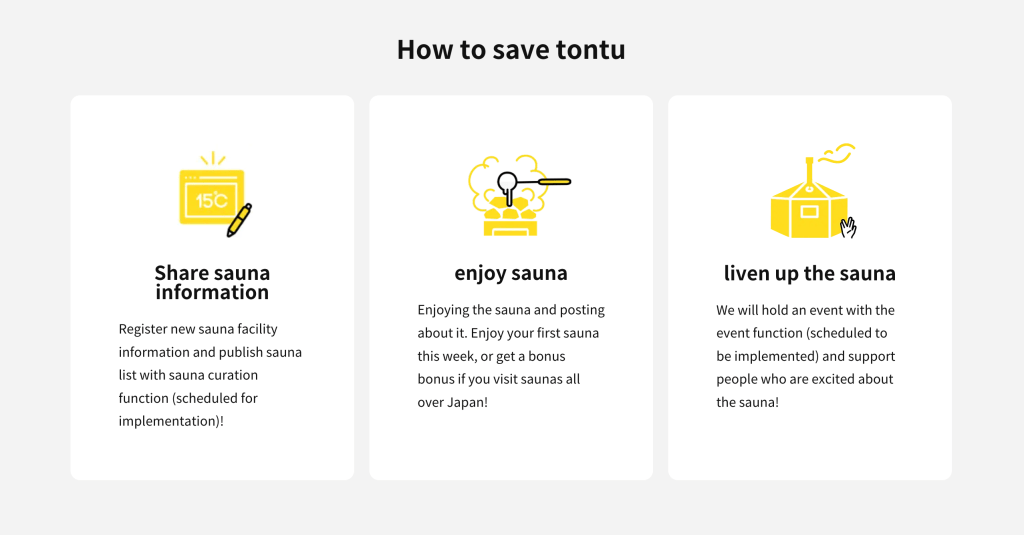
In the spirit of Tontu, Sauna Ikitai users earn Tontu by adding value for other users on the platform. This can be done by adding information to the page of a given sauna that has missing information (or better yet, adding a facility that isn’t yet on Sauna Ikitai), sharing about your experience, or attending in-person Sauna Ikitai events.

Earning Tontu!

Using in Sauna Ikitai in Person (!)

If you don’t speak Japanese, this probably won’t be super applicable, but I thought it would be interesting to share that it exits! Sauna Ikitai members often get certain benefits at venues partnered at Sauna Ikitai. While normally small, these can include:

  • A free towel rental
  • Free Sauna Hat rental
  • Free Pocari Sweat (for those unfamiliar, think Japanese Gatorade) or drink

Not anything major, but a lot of nice little boosts!

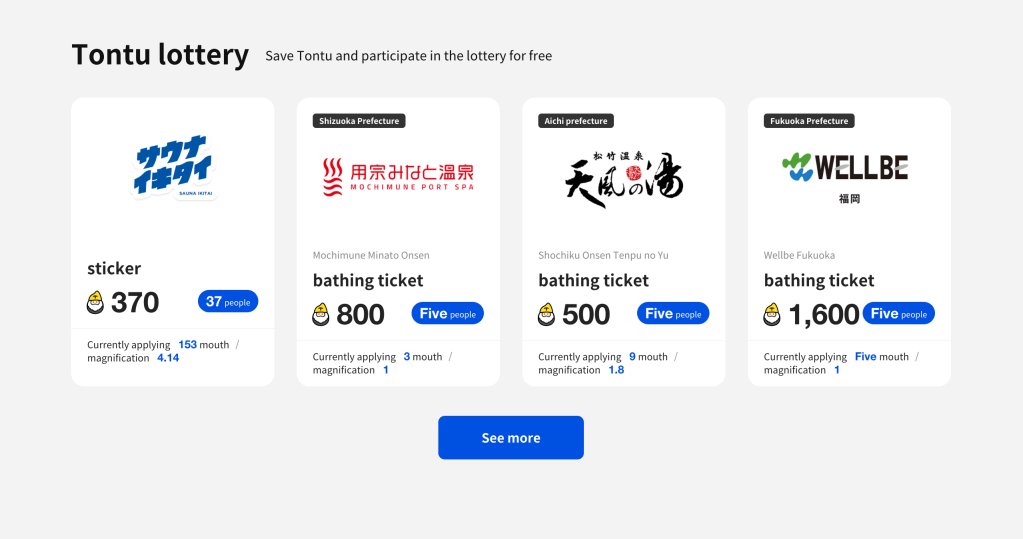
Additionally, using Tontu can earn you free merchandise, and even Sauna visits! Accrued Tontu can be spent in Sauna Ikitai’s Tontu Lottery. The lottery options often include merchandise (sauna hats, stickers, sauna mats, etc.), free entry, and complimentary food/drink vouchers.

Some of the Tontu Lottery options for January 2024.

User Guide- Using your Sauna Ikitai Account

If you either live in Japan, or are particularly interested in the sauna community in Japan, you can create an account on Sauna Ikitai! For privacy purposes, I won’t be sharing my profile, but I will show you what I have found having an account as useful for:

  • Logging visited Sauna
    • I visit enough sauna that it becomes hard to keep track at a certain point, especially if I visit several in the same area that use the same kanji. That’s where Sauna Ikitai comes in. I can check back on which sauna I’ve visited based on the pictures provided, which really comes in handy for when I want to revisit a sauna that I can’t remember the name of.
  • Tontu
    • Having an account allows you to accrue Tontu, which you can use to enter the Tontu lottery. I have started to build up a bit, and am very excited to potentially earn some rewards!
  • Updating Profile Information
    • There are several fun pieces of information you can put on your Sauna Ikitai Profile, including
      • Your Home Sauna
      • Your ideal sauna
      • The date of your first sauna or “Sauna Debut”
      • Self Introduction
    • While small, I feel like these help me feel like I belong on the site a little bit more, and it adds あpersonal touch to the experience.

Concluding Thoughts

I regularly use Sauna Ikitai to search for what sauna I am going to visit next. I wish more countries had somethign similar, and I have a lot of fun using Sauna Ikitai for my various Sauna needs. I hope that this guide is helpful in getting you started on your sauna hunting needs in Japan. Thank you for reading, and I hope you can find some totonou (sauna enlightenment) in your week!

Remember, act like Tontu is watching you…

Saunachelin (yes…. really!)

Most people are familiar with Michelin Stars, the most sought after restaurant accolade in the world. You may not be familiar with, however, Saunachelin stars!

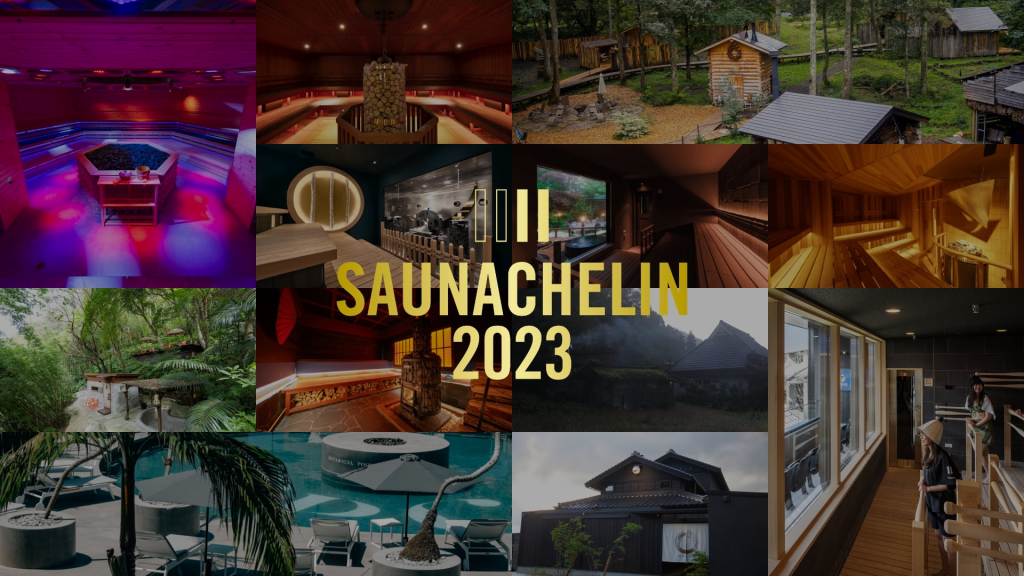
Taking full advantage of Japan’s sauna boom, Saunachelin has ranked the eleven most outstanding saunas across Japan every year since 2018! Let’s take a look at what it takes to earn a Saunachelin star.

Who is Behind Saunachelin?

When stumbling upon Saunechelin, I couldn’t help but think “who came up with such a brilliant idea?”.

The Japanese sauna organization TTNE are the minds behind Saunachelin. The organization’s name is an abbreviation for the Japanese word “totonou” (ととのう), which refers to the state of temporary enlightenment and peace achieved by several rounds of alternating between hot and cold.

In 2017, TTNE was founded Dai Matsuo (松尾 大) and Daisuke Akiyama (秋山 大輔). Founding TTNE as a brand specifically for sauna culture, Matsuo and Akiyama sought out to create a space for sauna enthusiasts (particularly in their 20-30’s) to embrace and spread sauna culture within Japan. Through their collaboration, the two bring their experiences from the corporate world to their endeavors in the sauna sphere. As a part of TTNE, the two have founded not only Saunachelin, but established “The Sauna Society of Japan”, “Sauna FES Japan”, launched a sauna-apparel line, and served as brand ambassadors for Finnish sauna brand “Harvia”. Taking a look at the various projects the two are involved in, their enthusiasm for sauna is palpable, and is clearly a major factor behind TTNE’s success. I found the following quote from the TTNE website to really sell the company’s passion and vision for sauna in Japan:

“Surfers have a brand of surfers,
Skaters have a skater brand.
Sauna brand for sauna …”

Today, TTNE has several offices (two in Tokyo, one in Sapporo), and has eighteen employees listed on their website. I have found that the majority of sauna related events around Tokyo are in some way affiliated with TTNE. If you are ever curious about what is happening in the Japanese sauna world, looking at any of TTNE’s projects will likely put you in the right direction.

Annual Rankings

Each year on November 11th, also known as “Totonou Day”, Saunechelin announces its 11 top saunas in Japan. To make the cut, a venue has to stand out among the 12,000 other sauna across Japan to be considered innovative or noteworthy in the world of sauna.

To see what I mean, let’s take a look at a few of this year’s winner’s for 2023:

  • Sauna Tokyo (サウナ東京)
    • “The largest sauna facility in Kanto [the greater Tokyo area], opened in Asakusa. [It has] five types of saunas and three temperatures of baths”
      • Many of these facilities, such as its steam room with a “cupboard bath” inside, take inspiration from traditional Japanese culture and the Edo period.
    • “The main sauna “Steam Dance’”, which automatically controls lighting, sound, and 6 special speakers and woofers and is compatible with the Aufguss [the process of diffusing essential oil throughout the sauna, often done in a flashy manner with a towel] show, is full of power. It’s amazing that it’s not just flashy, but also comfortable, with the introduction of a ‘CO2 concentration automatic detection ventilation system’ that automatically controls ventilation using AI.”
      • Frankly, I’m not entirely sure what all of the specific jargon refers to here, but I found it demonstrates the kind of specificity that Saunachelin venues have in their spaces.
        • Quoted portions are translated from Japanese using Google
  • Annetai Sauna (亜熱帯サウナ)
    • “A sauna in the jungle, owner Tetsuji Sakamoto was moved by a garden spa that utilized an entire mountain that he came across in Thailand, and based on that experience, created Annetai Sauna. Enjoy an outdoor bath surrounded by subtropical nature.”
      • Translated from Japanese using Google
  • Wellbe Sakae (ウェルビー栄)
    • “We recreate the environment of Finland, the home of saunas, with a `Forest Sauna’ that resembles a sauna hut in the forest, and an `Ice Sauna’ where you can experience the cool outside air (minus 25 degrees Celsius) and a lake.”
      • Translated from Japanese using Google

As seen above, Saunachelin winners consistently outperform by both refining and innovating their sauna experience in ways that push the boundaries of Sauna culture in Japan.

Saunner Of the Year

In addition to ranking the top saunas, Saunachelin also celebrates outstanding contributors to Sauna culture in Japan, commonly referred to as “Saunners”.

For example, some of the 2023 nominees include:

  • Katsuki Tanaka
    • Manga author and creator of “Sado” (literally translates to “Way of the Sauna) (サ道).
    • The series (which I am yet to read, unfortunately) follows the main character’s visits to a local gym sauna, where he discovers the joys of sauna and makes lasting friendships through the power of sauna (as you do). Sado is often attributed as one of the driving factors of the sauna boom in Japan (a topic for a later date).
  • Misato Shimizu
    • Japanese actress who is also a huge “saunner” herself. She has frequently worked with popular sauna website “Sauna Ikitai” (literally meaning “Let’s Go to the Sauna), and has been on several radio shows and interviews discussing sauna in Japan.
  • Jin’s Co LTD
    • An eyewear company with a line of glasses specifically designed for use in the sauna. Heat and fog resistant, this product line is a great example of the kinds of unique sauna merchandise that are coming out of Japan right now.

The list goes on, but essentially, candidates are not limited to those working in the sauna industry, and can be awarded to anyone who advances and contributes to sauna culture in Japan.

Closing Thoughts

While Saunachelin seems almost too good to be true, in Japan, it is a highly respected accolade that reflects the nation’s booming sauna culture. I regularly refer to Saunechelin not only find new venues to visit, but also to gain insights into contributors in the Japanese sauna world.

I hope you enjoyed this week’s dive into Japanese sauna culture. Have a great week, and I hope you can find some “totonou” in your week!